This model is discontinued
AirTAC has phased out the MAL series. The drop-in replacement is ACEJ16X100-10S — same bore, stroke, output force, port and mounting, so it fits the same application. Simply order the ACEJ16X100-10S in place of this model. The ACE replacement is a current-production ISO 21287 compact cylinder in the same bore, stroke and force class, with a matching short body and the same mounting-accessory family, so it fits the same envelope. Confirm mounting-interface dimensions against the ACE datasheet before ordering.
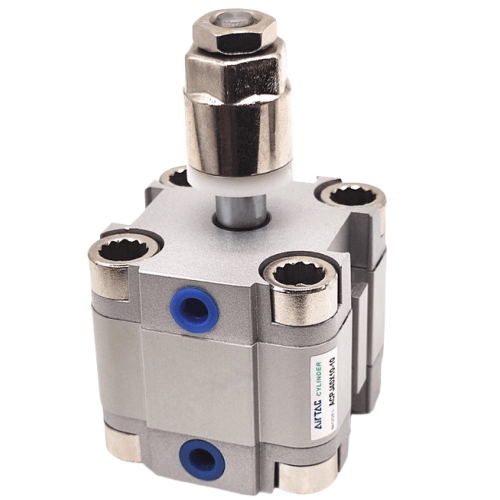
Airtac ACPJ Adjustable Compact Cylinder ACPJ16X100-10S
The AirTAC Airtac ACPJ Adjustable Compact Cylinder ACPJ16X100-10S is a double acting, adjustable stroke DIN-standard tight/compact air cylinder with a Ø16mm bore and 100mm stroke, M5×0.8 air ports and a hard-anodized aluminium body. This model is discontinued — the current-production replacement is the ACEJ16X100-10S (ISO 21287 ACE), in the same bore, stroke and force class.
- BoreØ16 mm
- Stroke100 mm
- Port sizeM5×0.8
- Acting typeDouble acting, adjustable stroke
- Rod threadM4×0.7
- StatusDiscontinued → ACEJ16X100-10S
About the Airtac ACPJ Adjustable Compact Cylinder ACPJ16X100-10S
Double acting and adjustable, the ACPJ16X100-10S is a discontinued DIN-standard compact cylinder with a 16 mm bore and a 100 mm stroke that a stop screw trims by up to 10 mm, giving a usable extend range of 90-100 mm. Air pushes the rod out at 100.5 N and pulls it back at 75.4 N at 0.5 MPa, rising to 140.7 N at 0.7 MPa. The 100 mm stroke exceeds the 75 mm maximum standard stroke for this bore, so it is a made-to-order build. The -S code means the magnet is fitted, so CMSE / DMSE reed or solid-state switches can be clamped to the body for end-of-stroke sensing.
The hard-anodized aluminium body with an S45C hard-chrome rod saves about 50% of the mounting length of an ISO 15552 profile cylinder, so it slots into tight jigs and guarding where a full-length body will not fit. In practice, plan on roughly 60 N (about 6 kg) of real work at 0.5 MPa, which lifts about 5 kg vertically with a 2:1 margin. Note the stop screw is a mechanical end stop only: on air loss the piston still drifts, so it never holds a load. This model is discontinued; the current-production drop-in is ACEJ16X100, and you should confirm the ISO 21287 mounting dimensions before swapping because the ACP is DIN-standard.
Airtac ACPJ Adjustable Compact Cylinder ACPJ16X100-10S Technical Specifications
| Model | Airtac ACPJ Adjustable Compact Cylinder ACPJ16X100-10S |
|---|---|
| Series | ACPJ DIN compact cylinder (discontinued) |
| Replacement | ACEJ16X100-10S |
| Bore size | Ø16 mm |
| Stroke | 100 mm |
| Acting type | Double acting, adjustable stroke |
| Port size | M5×0.8 |
| Rod thread | M4×0.7 |
| Fluid | Air (filtered by 40µm element) |
|---|---|
| Operating pressure | 0.15 – 1.0 MPa |
| Proof pressure | 1.5 MPa |
| Temperature | -20 to +70 °C |
| Speed range | 30 – 500 mm/s |
| Cushion | Fixed bumper (both ends) |
| Max standard stroke | Up to 75 mm |
Specifications follow the official AirTAC ACP datasheet (now discontinued). The ACEJ16X100-10S (ISO 21287) carries the same bore/stroke/force class; confirm mounting-interface dimensions against the ACE datasheet before installation. Rod type: female thread (blank) or male thread (B). Thread options: PT (blank) / G.
Theoretical Output Force (Ø16mm)
| Pressure | Push force | Pull force |
|---|---|---|
| 0.5 MPa | 101 N | 75 N |
| 0.7 MPa | 141 N | 106 N |
| Max (@1.0 MPa) | 21 kgf | |
The ACEJ16X100-10S produces the same force from the same bore. Actual usable force is lower than theoretical; size with a margin.
Model Code: Airtac ACPJ Adjustable Compact Cylinder ACPJ16X100-10S
| ACPJ | DIN compact cylinder (adjustable-stroke, discontinued). |
|---|---|
| 16 | Bore size in mm. |
| ×100 | Stroke length in mm. |
| -10 | Adjustable stroke window (mm the extend stroke can be shortened on site). |
| S | Optional built-in magnet for sensor position sensing (omit for no magnet). |
| B | Rod type: B = male thread; blank = female thread. |
Replacement mapping (swap P for E): ACP→ACE, ASP→ASE, ATP→ATE, ACPD→ACED, ACPJ→ACEJ. ACP-family: ACP (double acting), ASP / ATP (single acting push / pull), ACPD (double rod), ACPJ (adjustable stroke).
Where the Airtac ACPJ Adjustable Compact Cylinder ACPJ16X100-10S Is Used
Small-parts ejection on assembly fixtures
The 100.5 N push at 0.5 MPa clears stamped terminals or molded caps from a nest, and the 10 mm trim lets the operator tune the extend position without re-machining the jig.
Position-verified test stations
With the -S magnet fitted, CMSE or DMSE switches confirm the rod has reached the trimmed end of the 90-100 mm range before an electronics leak test starts.
Light press-fit of bushings
About 60 N of usable force at 0.5 MPa seats small nylon or aluminum bushings in sensor housings, with the fixed TPU bumper softening the end of each 30-500 mm/s cycle.
Replacing the Airtac ACPJ Adjustable Compact Cylinder ACPJ16X100-10S with the ACEJ16X100-10S
Size both ways before ordering: a 12 mm bore gives 56.5 N push at 0.5 MPa, while a 20 mm bore reaches 157.1 N, so the 16 mm at 100.5 N sits between them for light clamping and indexing. Mounting is FA/FB flange or LB foot, and I/Y rod knuckles bolt to the face. The female rod thread is M4x0.7 and the port is M5x0.8. Because the 100 mm stroke is non-standard for this bore, order it as a made-to-order item or move to the ACEJ16X100 replacement, confirming ISO 21287 dimensions first.
Replacement checklist
- ✓ Current-production ACE → ACEJ16X100-10S
- ✓ Same bore / stroke / force class
- ✓ Confirm ISO 21287 mounting dimensions
- ✓ Port/thread type (PT / G)
- ✓ Add -S for magnet if you need sensors
Airtac ACPJ Adjustable Compact Cylinder ACPJ16X100-10S FAQ
At 0.5 MPa it pushes 100.5 N and pulls 75.4 N; at 0.7 MPa it pushes 140.7 N and pulls 105.6 N; theoretical maximum is 20.5 kgf at 1.0 MPa. The -10 code gives a 10 mm adjustment window, so the 100 mm extend stroke can be trimmed to anywhere in a 90-100 mm range with the stop screw. The stroke is non-standard for this bore (max standard is 75 mm), so it is made to order. Operating pressure is 0.15-1.0 MPa (22-145 psi), speed 30-500 mm/s, and the model is discontinued in favor of ACEJ16X100.
It is a short-body compact cylinder with a hard-anodized aluminium body, an S45C hard-chrome rod, a fixed TPU bumper at both ends and an M5x0.8 port. The short body saves about 50% of the mounting length of an ISO 15552 profile cylinder. This -S version carries the optional magnet, so CMSE / DMSE reed or solid-state switches mount directly on the body. FA/FB flange and LB foot mountings bolt to the ISO 21287-style face. For new builds, order the ACEJ16X100 replacement and confirm the ISO 21287 mounting dimensions.
Related AirTAC ACE Cylinders
Request a Quote for the ACEJ16X100-10S
Send us the quantity and destination. We confirm price, stock and lead time on the ACEJ16X100-10S replacement — usually within 7-8 hours.