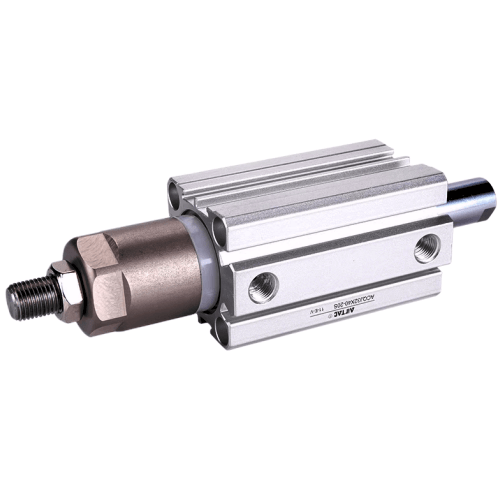
Airtac ACQJ32~40 Adjustable Thin-Type Cylinder ACQJ40X40-30S
The AirTAC ACQJ32~40 Adjustable Thin-Type Cylinder ACQJ40X40-30S is a genuine double-acting COMPACT (JIS) cylinder with an EXTERNAL adjustable stop on the extend stroke — a Ø40mm bore and 40mm full stroke. Turn the stop to fine-tune the end position on the machine without changing parts.
- BoreØ40 mm
- Full stroke40 mm
- Port sizePT1/8
- Adjuster threadM12×1.25
- No minimum order. A single piece can be ordered.
- Shipped from our own warehouse: most standard models dispatch in 3–5 days; custom and non-standard models take 8–10 business days. Transit time after that depends on the destination.
About the Airtac ACQJ32~40 Adjustable Thin-Type Cylinder ACQJ40X40-30S
The AirTAC ACQJ40X40-30S is a double-acting JIS compact cylinder featuring an external threaded stop and lock nut that restricts the extend end position. With a 40mm full stroke and a 30mm window, you can fine-tune the usable extend range from 10mm up to 40mm directly on the machine without swapping parts. The retract stroke remains unaffected by this adjustment.
This bore 40 unit uses a 16mm rod, a PT1/8 port, and includes the -S magnet for position sensing. It relies on a fixed NBR elastomer bumper at each end for end-of-stroke deceleration.
Airtac ACQJ32~40 Adjustable Thin-Type Cylinder ACQJ40X40-30S Technical Specifications
| Model | Airtac ACQJ32~40 Adjustable Thin-Type Cylinder ACQJ40X40-30S |
|---|---|
| Series | ACQJ JIS compact adjustable-stroke cylinder |
| Bore size | Ø40 mm |
| Full stroke | 40 mm |
| Adjuster thread | M12×1.25 |
| Port size | PT1/8 |
| Fluid | Air (filtered by 40µm element) |
|---|---|
| Operating pressure | 0.15 – 1.0 MPa |
| Proof pressure | 1.5 MPa |
| Temperature | -20 to +70 °C |
| Speed range | 30 – 500 mm/s |
| Rod thread | M8×1.25 (F) / M14×1.5 (B) |
Specifications follow the official AirTAC ACQJ datasheet. The adjustable stop shortens the EXTEND stroke only; ACQJ is double-rod, so push is lower than a standard ACQ of this bore. Adjustable window options: 10/20/30/40/50/75/100 mm.
Theoretical Output Force (Ø40mm)
| Pressure | Push force | Pull force |
|---|---|---|
| 0.5 MPa | 528 N | 528 N |
| 0.7 MPa | 739 N | — |
| Max (@1.0 MPa) | 108 kgf | |
ACQJ is double-rod: the rear rod that carries the stroke adjuster passes through the rear cover, so both piston faces lose rod area. Push is shown at the annular-area value (conservative), lower than a single-rod ACQ push of the same bore. Actual usable force is lower due to friction; size with a safety margin.
Model Code: Airtac ACQJ32~40 Adjustable Thin-Type Cylinder ACQJ40X40-30S
| ACQJ | JIS compact double-acting ADJUSTABLE-STROKE cylinder series. |
|---|---|
| 40 | Bore size in mm. |
| ×40 | Full stroke length in mm. |
| -0 | Adjustable window in mm (extend stroke can be shortened by up to this). |
| S / B | Magnet (S) / male-thread rod (B); omit for none / female thread. |
Thread: PT standard (G / NPT available). Related: ACQ (fixed stroke), ACQD (double rod), TACQ (guided / non-rotating).
Where the Airtac ACQJ32~40 Adjustable Thin-Type Cylinder ACQJ40X40-30S Is Used
Product Changeover Stops
Quickly dial in the extend position from 10 to 40mm during packaging line format changes without replacing the cylinder or mechanical stops.
Trial End Positions
Safely test clamping end positions on a CNC fixture by limiting the outward travel, preventing crashes during initial setup and tool proving.
Varying Fixture Depths
Accommodate multiple part heights on a single assembly station by adjusting the extend stroke outward limit on the fly to match each specific fixture.
Is the Airtac ACQJ32~40 Adjustable Thin-Type Cylinder ACQJ40X40-30S the Right Cylinder?
Selecting this bore 40 model provides a maximum push force of 128kgf at 1.0MPa. A standard fixed-stroke ACQ cylinder is sufficient if your end position never varies, but this ACQJ variant is essential for product-changeover setups. Confirm ordering essentials: 40mm bore, 40mm full stroke, 30mm window, -S magnet, and the default female M8x1.25 rod-end thread.
AirtacDistr lists every ACQJ40 order code with its price on one page at https://airtacdistr.com/products/airtac-acqj40-adjustable-cylinder
Quick checklist
- ✓ Need on-machine end-position tuning?
- ✓ Full stroke and adjust window (mm)
- ✓ Force at your working pressure
- ✓ Magnet (S) for sensors?
- ✓ Female (blank) or male (B) rod thread
Installation & Maintenance Notes
- check Use clean air filtered to 40µm or finer.
- check Keep within 0.15 – 1.0 MPa operating pressure.
- check Lock the adjuster nut after setting the stop.
- check The stop limits the EXTEND stroke only.
- check Avoid side load on the short piston rod.
- check Installation by qualified personnel per AirTAC docs.
Airtac ACQJ32~40 Adjustable Thin-Type Cylinder ACQJ40X40-30S FAQ
The full stroke is 40mm with a 30mm window, allowing a usable extend range of 10-40mm. The retract stroke remains fixed at 40mm.
An M12x1.25 threaded adjuster with a lock nut mechanically limits the extend travel, meaning force is identical to a standard ACQ since piston area is unchanged. The cylinder uses a fixed NBR elastomer bumper for deceleration, not an adjustable air cushion. The included -S magnet allows tracking by either reed or electronic solid-state switches.
Authorized Export Seller
Genuine AirTAC parts produced by AirTAC factory.
1-Year Warranty
Covers non-human-caused product damage.
Fast Dispatch
Most standard models are dispatched in 3-5 days.
Fast Reply
Most inquiries answered within 7 hours.
Related AirTAC ACQJ Compact Cylinders
Request a Quote for Airtac ACQJ32~40 Adjustable Thin-Type Cylinder ACQJ40X40-30S
Send us the quantity and destination. We confirm price, availability and lead time — usually within 7 hours.