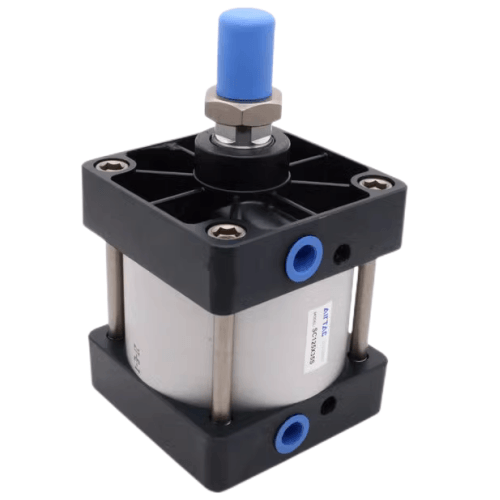
Airtac AIRTAC SC125-160 Standard Cylinder SC125X40FA
The AirTAC Airtac AIRTAC SC125-160 Standard Cylinder SC125X40FA is a genuine double-acting standard air cylinder with a Ø125mm bore and 40mm stroke, PT1/2 air ports and adjustable end cushioning. It is used for push, pull, lift and clamp motion in industrial automation.
- BoreØ125 mm
- Stroke40 mm
- Port sizePT1/2
- Acting typeDouble acting
- Rod threadM27×2
- CushionAdjustable, 28 mm
About the Airtac AIRTAC SC125-160 Standard Cylinder SC125X40FA
The SC125X40FA is a double-acting single-rod tie-rod cylinder with a 125 mm bore and a short 40 mm stroke, factory-assembled with an FA front rectangular flange for direct panel mounting. At 0.5 MPa air pressure it produces 6136 N of push force and 5734 N on the pull stroke, moving a 32 mm diameter piston rod through a rigid 203 mm body length A.
This model uses the standard PT (Rc) tapered port thread of 1/2 inch and TPU seals rated for -20 to +70 °C. The adjustable air cushion at each end provides 28 mm of controlled deceleration, softening the stop even under the high inertial loads typical of a large-bore cylinder.
Airtac AIRTAC SC125-160 Standard Cylinder SC125X40FA Technical Specifications
| Model | Airtac AIRTAC SC125-160 Standard Cylinder SC125X40FA |
|---|---|
| Series | SC big-bore tie-rod cylinder (ISO 6430 class) |
| Bore size | Ø125 mm |
| Stroke | 40 mm |
| Acting type | Double acting |
| Port size | PT1/2 |
| Rod thread | M27×2 |
| Fluid | Air (filtered by 40µm element) |
|---|---|
| Operating pressure | 0.15 – 1.0 MPa |
| Proof pressure | 1.5 MPa |
| Temperature | -20 to +70 °C |
| Speed range | 30 – 500 mm/s |
| Cushion | Adjustable, 28 mm |
| Max stroke | Up to 1500 mm |
Specifications follow the official AirTAC SC series datasheet. Operating pressure 0.15–1.0 MPa, proof pressure 1.5 MPa, temperature −20 to +70 °C. Confirm against the product label before installation. Thread options: PT (standard) / G.
Theoretical Output Force (Ø125mm)
| Pressure | Push force | Pull force |
|---|---|---|
| 0.5 MPa | 6136 N | 5734 N |
| 0.7 MPa | 8590 N | — |
| Max (approx.) | 1251 kgf | |
Actual usable force is lower than theoretical due to friction and back-pressure. Size with a safety margin.
Model Code: Airtac AIRTAC SC125-160 Standard Cylinder SC125X40FA
| SC | Standard tie-rod cylinder series. |
|---|---|
| 125 | Bore size in mm. |
| ×40 | Stroke length in mm. |
| -S | Optional built-in magnet for sensor position sensing. |
Related variants: SCD (double rod), SCJ (adjustable stroke), SCT (multi-position). Seals: TPU standard / H = Viton / N = NBR. Thread: blank = PT, G = G thread.
Where the Airtac AIRTAC SC125-160 Standard Cylinder SC125X40FA Is Used
Short-Stroke Clamping
The 40 mm stroke and high 6136 N push force make this cylinder ideal for powerful, fast-acting clamping fixtures on assembly lines where space is limited.
Press-Fit Assembly
Delivers controlled, repeatable force for pressing bearings, pins, or bushings into housings. The adjustable cushion protects parts from impact damage at the end of the pressing cycle.
Ejector Mechanism
Mounted via the front flange, it provides a rigid, aligned push to eject heavy parts from forming dies or molds, with the short stroke enabling high cycle rates.
Is the Airtac AIRTAC SC125-160 Standard Cylinder SC125X40FA the Right Cylinder?
For applications needing more force, stepping up to the 160 mm bore adds over 3900 N of push at the same 0.5 MPa pressure. If a shorter body or lower force is acceptable, the 100 mm bore (3927 N push at 0.5 MPa) is a lighter alternative. The 40 mm stroke is well within the 1500 mm maximum standard stroke for this bore.
To ensure a direct replacement, match five points: 125 mm bore, 40 mm stroke, PT port thread, the FA front flange mounting (accessory F-SC125FA), and the non-magnet configuration. This ISO 6430 class tie-rod cylinder is shorter than an ISO 15552 profile cylinder and is not dimensionally interchangeable with that standard.
Quick checklist
- ✓ Required force at your working pressure
- ✓ Stroke and mounting space
- ✓ Port/thread type (PT/NPT/G)
- ✓ Magnet (-S) for sensors?
- ✓ Side load — consider a guided cylinder
Installation & Maintenance Notes
- check Use clean air filtered to 40µm or finer.
- check Keep within 0.15 – 1.0 MPa operating pressure.
- check Avoid side load on the piston rod.
- check Adjust end cushion screws for smooth stops.
- check Use correct mounting accessory (FA/FB/CA/CB/LB/TC).
- check Installation by qualified personnel per AirTAC docs.
Airtac AIRTAC SC125-160 Standard Cylinder SC125X40FA FAQ
At 0.7 MPa operating pressure, the theoretical push force is 8590 N. The pull force at the same pressure is 5734 N, accounting for the 32 mm rod area.
No. The AirTAC SC series is a tie-rod cylinder with a shorter overall body length than an ISO 15552 profile cylinder. It is not dimensionally interchangeable with ISO 15552. For big bores like the 125, it follows the ISO 6430 class. Match bore, stroke, port thread, and front flange mounting for a successful replacement.
Authorized Export Seller
Genuine AirTAC parts produced by AirTAC factory.
1-Year Warranty
Covers non-human-caused product damage.
Fast Dispatch
Standard models usually ship in 3-4 days.
Fast Reply
Most inquiries answered within 7-8 hours.
Request a Quote for Airtac AIRTAC SC125-160 Standard Cylinder SC125X40FA
Send us the quantity and destination. We confirm price, stock and lead time — usually within 7-8 hours.