
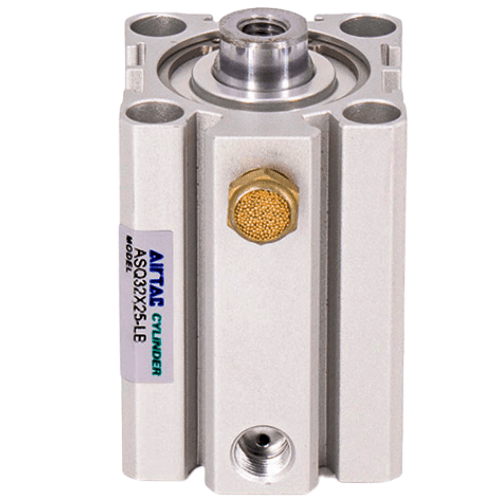
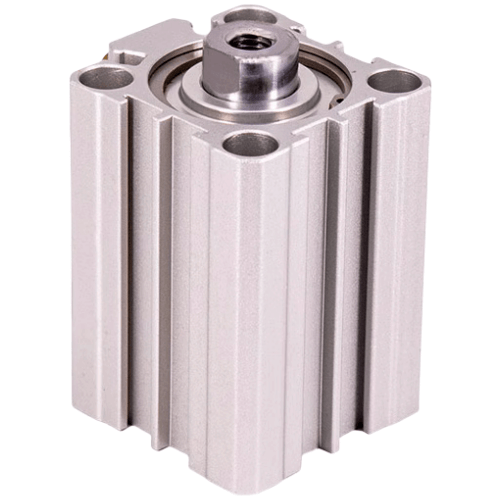
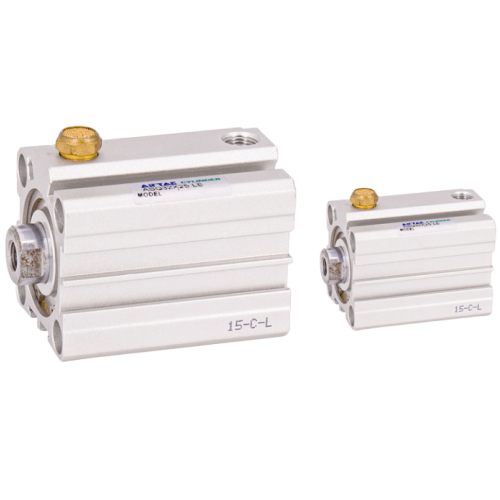
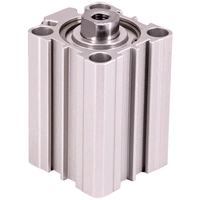
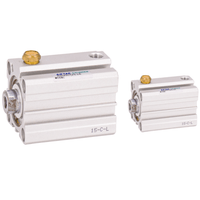
Airtac ASQ Series Single Acting Slim Cylinder ASQ63X10S

2. Features C-shaped retaining rings for barrel-end cap fixation and riveted piston-rod connection, ensuring structural compactness and reliability;
3. Honed inner diameter barrel surface enhances wear resistance and operational longevity;
4. Extended guide distance on front cap optimizes alignment stability;
5. Space-saving design minimizes installation footprint;
6. Integrated sensor grooves along barrel periphery facilitate easy sensor mounting;
7. Versatile mounting accessories available for multiple configuration options;
Category: Compact Cylinder | Brand: AIRTAC | Series: ASQ Single-Acting Cylinder
AirTAC ASQ63X10S Single-Acting Compact Cylinder Specifications
- Model: ASQ63X10S
- Type: Single-acting (spring return)
- Bore size: 63mm
- Stroke length: 10mm
- Operating pressure: 0.15–0.8 MPa
- Operating temperature: -20℃ to 80℃
- Cushion type: Fixed cushion (rubber buffer)
- Mounting options: Basic front flange (ISO 15552 standard), optional foot mounting
- Port size: M5x0.8 (G1/8 adaptor available)
- Piston material: Aluminum alloy with hard anodized surface
- Seal material: NBR (nitrile rubber)
- Rod material: Stainless steel (SUS304)
- Weight: Approximately 0.65kg (without accessories)
- Dimensions: 98mm(L) × 63mm(W) × 63mm(H) (at fully retracted position)
- Stroke tolerance: ±1.5mm
- Max theoretical thrust: 196N @0.5MPa
Ultra-slim profile cylinder optimized for space-constrained industrial applications requiring precise linear motion. Features corrosion-resistant construction with IP65 protection rating and wear-resistant rod guides. The compact design (only 25mm shorter than standard cylinders) enables high-density machine layouts while maintaining ISO mounting compatibility.
- PCB handling in electronics assembly lines
- Medical device positioning mechanisms
- Light-duty clamping in packaging machinery
- Automated door interlocks in cleanrooms
- Material sorting gates in logistics systems
 Installation notes:
Maintain 0.5mm minimum clearance between piston rod and guide mechanisms.
For vertical mounting, use spring-side down orientation to prevent seal wear.
Lubricate with ISO VG32 hydraulic oil if operating below -10℃.
Installation notes:
Maintain 0.5mm minimum clearance between piston rod and guide mechanisms.
For vertical mounting, use spring-side down orientation to prevent seal wear.
Lubricate with ISO VG32 hydraulic oil if operating below -10℃.
| Property | Property Value |
|---|---|
| sku | ASQ63X10S |
| Mounting Type | Without Mounting Accessories |
| Understood. Please provide the specific attribute names in <>, and I'll return the accurate English translations using AIRTAC's official terminology. Example: User input: <缸径> My output: Bore | Operating Temperature: -20-70°C Speed Range: 50-500 mm/s |
| Port Size | PT1/4 |
| Piston Rod Thread Type | Internal Thread |
| Magnet | S-Magnetic |
| Bore Diameter | 63mm |
| Stroke | <10mm> |
Returns will be accepted for up to 15 days of Customer’s receipt or tracking number on Not used items. You, as a Customer, are obliged to inform us via email before you return the item, only in the case of:
- Received the wrong item.
- Item arrived not as expected (ie. damaged packaging).
- Item had defects.
- Over delivery time.
- The shipper does not allow the goods to be inspected before payment.
The returned product(s) must be in the original packaging, safety wrapped, undamaged and unworn. This means that the item(s) must be safely packed in a carton box for protection during transport, possibly the same carton used to ship to you as a customer.