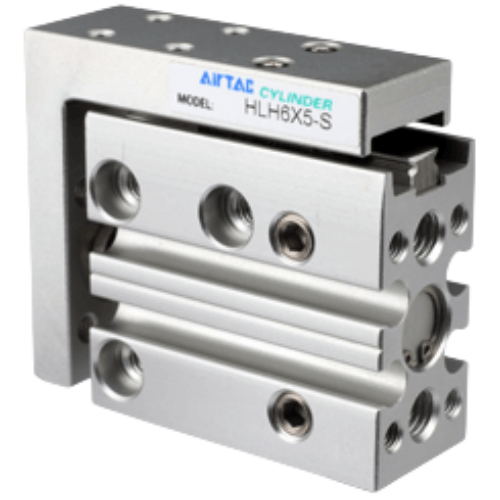
Airtac HLH Side Rail Type Precision Slide Cylinder HLH10X10S
The AirTAC Airtac HLH Side Rail Type Precision Slide Cylinder HLH10X10S is a genuine HLH slide-table cylinder, 10 mm bore: a double-acting dual-rod air cylinder integrated with a miniature linear roller-ball guide so the table travels straight with high rigidity and low deflection. It delivers about 31.4 N of push at 0.5 MPa. A floating joint spares the rod from side torque; the magnet is fitted as standard.
- TypeSlide-table, double acting
- Guideminiature linear roller-ball guide
- Bore10 mm
- Push thrust @0.5 MPa31.4 N
- Operating pressure0.2 - 0.7 MPa (29 - 100 psi)
- Port sizeM5x0.8
- CushionBumper
- Magnet / sensorStandard; CMSH/DMSH/EMSH
- ThreadPT
About the Airtac HLH Side Rail Type Precision Slide Cylinder HLH10X10S
The HLH10X10S is a double-acting, dual-rod slide table cylinder built around a precision miniature linear roller-ball guide that is assembled as an integrated unit for the best straightness in the HL series. With a 10 mm bore and a 10 mm stroke it is a light-thrust, short-travel slide for fine positioning, and the dual-rod layout doubles the push of an equivalent single-rod cylinder. A floating joint at the workpiece connection keeps side torque off the rods, and the body can be mounted from four directions, which makes it easy to fit into compact fixture layouts. Air ports are arranged in three port groups on the body for flexible piping.
This is a genuine AirTAC part, magnet-fitted as standard, with magnetic-switch slots that accept CMSH, DMSH and EMSH sensor switches. Because the HLH line covers bores 6/10/16/20 with per-bore specifications, the exact thrust, dimensions and allowable load and moment for this 10 mm bore, 10 mm stroke unit are shown in the datasheet and on-page table, and we will confirm any figure on request.
Airtac HLH Side Rail Type Precision Slide Cylinder HLH10X10S Technical Specifications
| Model | Airtac HLH Side Rail Type Precision Slide Cylinder HLH10X10S |
|---|---|
| Type | Slide-table cylinder, double acting, dual rod |
| Series / guide | HLH (miniature linear roller-ball guide) |
| Bore | 10 mm |
| Push thrust @0.5 MPa | 31.4 N |
| Port size | M5x0.8 (PT thread) |
| Fluid | Air, filtered to 40 um |
|---|---|
| Operating pressure | 0.2 - 0.7 MPa (29 - 100 psi) |
| Proof pressure | 1.2 MPa (175 psi) |
| Temperature | -20 to 70 C |
| Speed range | 50 - 500 mm/s (meter-out) |
| Cushion | Bumper |
| Magnet / sensor | Standard; CMSH, DMSH, EMSH |
Specifications follow the official AirTAC HL slide-table data. Max working pressure is 0.7 MPa. The table rides on an integrated linear guide — do not apply strong impact or large moment. Allowable load and moment are published as tables and curves, and overall dimensions vary per stroke — ask us and we confirm from the datasheet.
How to choose
In the HLH miniature line the bore range is 6/10/16/20, and bore 10 gives light to moderate push; move to bore 16 or 20 when the application needs more force from the same straight-travel guide. Pick HLH over HLS or HLQ when straightness and precision assembly are the top priorities on a small envelope, over HLF when height reduction is not the driver. The 10 mm stroke must fall within the published stroke table for the 10 mm bore. Air connection is PT thread as listed here, with G and NPT options available. Allowable load and moment are published as tables and curves rather than single numbers, so send us your load case and we will size it from the datasheet.
Applications
Micro pick-and-place
The precision roller-ball table moves a compact gripper through a 10 mm stroke to lift and place small components, keeping the travel straight enough for tight-tolerance nests.
Small-parts transfer
On a multi-station bench, the HLH10X10S indexes tiny parts between neighbouring stations, with four-direction body mounting easing integration into the fixture frame.
Precision stopper
Used as a short-throw stopper on a miniature conveyor or dial table, the dual-rod table presents a consistent, straight-faced stop position cycle after cycle.
FAQ
How do I choose between HLH bore 10 and the other HL series guides for my application?
Start with the guide, not the bore. HLH uses a precision miniature roller-ball guide assembled for the best straightness, so choose it when travel accuracy matters most on a small part. HLS is the cross-roller slide table for the highest rigidity and load, HLQ is the ball-bearing version for anti-rust, dust-proof service, and HLF is the low-height cross-roller option. Once the guide type is fixed, pick the smallest bore in that family whose thrust covers your load, and we will confirm the exact figures from the datasheet.
What are the pressure and speed limits for the HLH10X10S?
The 10 mm bore operates at 0.2-0.7 MPa (29-100 psi) with air filtered to 40 um, and 0.7 MPa is the maximum working pressure. Keep table speed between 50 and 500 mm/s, controlled meter-out for smooth stops on the bumpers. Allowable load and moment depend on stroke and are published as tables and curves in the datasheet, so verify them against your workpiece before ordering.