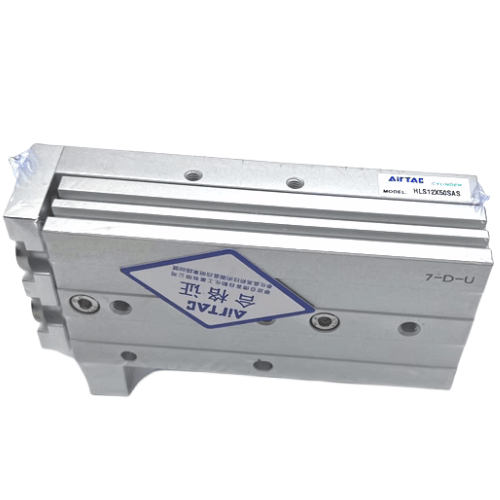
Airtac HLSL Precision Slide Table Cylinder HLSL20X50SAS
The AirTAC Airtac HLSL Precision Slide Table Cylinder HLSL20X50SAS is a genuine HLS slide-table cylinder, 20 mm bore: a double-acting dual-rod air cylinder integrated with a cross-roller guide so the table travels straight with high rigidity and low deflection. It delivers about 236 N of push at 0.5 MPa. This is the symmetrical version. A floating joint spares the rod from side torque; the magnet is fitted as standard.
- TypeSlide-table, double acting
- Guidecross-roller guide
- Bore20 mm
- Push thrust @0.5 MPa236 N
- Operating pressure0.15 - 0.7 MPa (22 - 100 psi)
- Port size1/8"
- CushionBumper (+ shock-absorber option)
- Magnet / sensorStandard; CMSH/DMSH/EMSH
- ThreadPT
- No minimum order. A single piece can be ordered.
- Ready in 3–5 business days. That is the time we take to process the order and hand it to the carrier. Transit time after that depends on the destination.
About the Airtac HLSL Precision Slide Table Cylinder HLSL20X50SAS
The HLSL20X50SAS is a symmetrical cross-roller slide table cylinder combining a double-acting, dual-rod air cylinder with an integrated cross-roller linear guide, so the table travels straight and resists deflection under load. The 20 mm bore delivers higher thrust than the 6-16 mm bores of the series, and the dual-rod layout doubles that thrust compared with a single-rod cylinder of equal bore. A floating joint built into the table keeps side torque off the rods, which protects the guide and the seals in day-to-day use.
This is a genuine AirTAC part. A position-detecting magnet is fitted as standard, with magnetic-switch slots on the body for CMSH, DMSH or EMSH sensor switches. The working medium is air filtered to 40 um; proof pressure is 1.2 MPa (175 psi), the working range for this bore is 0.15-0.7 MPa (22-100 psi), speeds run from 50-500 mm/s and the temperature range is -20 to 70 C. Exact thrust, dimensions and allowable load and moment figures for this model are carried in the on-page spec table and datasheet, and we will confirm them on request.
Airtac HLSL Precision Slide Table Cylinder HLSL20X50SAS Technical Specifications
| Model | Airtac HLSL Precision Slide Table Cylinder HLSL20X50SAS |
|---|---|
| Type | Slide-table cylinder, double acting, dual rod |
| Series / guide | HLSL (cross-roller guide) |
| Bore | 20 mm |
| Push thrust @0.5 MPa | 236 N |
| Port size | 1/8" (PT thread) |
| Fluid | Air, filtered to 40 um |
|---|---|
| Operating pressure | 0.15 - 0.7 MPa (22 - 100 psi) |
| Proof pressure | 1.2 MPa (175 psi) |
| Temperature | -20 to 70 C |
| Speed range | 50 - 500 mm/s (meter-out) |
| Cushion | Bumper; shock-absorber / adjustable-stopper options |
| Magnet / sensor | Standard; CMSH, DMSH, EMSH |
Specifications follow the official AirTAC HL slide-table data. Max working pressure is 0.7 MPa. The table rides on an integrated linear guide — do not apply strong impact or large moment. Allowable load and moment are published as tables and curves, and overall dimensions vary per stroke — ask us and we confirm from the datasheet.
How to choose
Take the 20 mm bore when the push from a 12 or 16 mm bore is marginal - larger bores give higher thrust, and the verified figure for this model sits in the spec table, not in a rough rule. Within the HL family the symmetrical cross-roller HLSL guide is the top choice for precision, rigidity and load capacity; HLQ covers anti-rust, dust-proof ball-bearing duty, HLH is the miniature roller-ball guide with four-direction mounting, and HLF is the low-height cross-roller body. Stroke 50 mm is a standard length in the 20 mm bore table. The AS suffix here fits an adjustable rubber stopper on the extension side only (A covers both ends, AF the retraction side, and B-type shock absorbers are available on this bore), and the port thread is PT, with G and NPT variants to order. Send us your load and moment conditions and we will verify them against the published tables and deflection curves.
Applications
Pick-and-place
A gripper mounted to the rigid cross-roller table is placed and lifted over a 50 mm stroke, with the extension-side stopper cushioning each reach into the pick position.
Test and gauging positioner
Straight, low-deflection travel suits light test or gauging heads that must approach a part the same way every cycle, supported by the doubled thrust of the dual-rod design.
Lane diverter
The symmetrical table pushes small parts between conveyor lanes or into a chute, with the floating joint absorbing misalignment between cylinder and track.
FAQ
Why is the magnet listed as standard on the HLSL20X50SAS?
Every cylinder in the HL series ships with the position-detecting magnet fitted, so the S in the model code is part of the standard build rather than a paid option. The magnetic-switch slots on the body accept CMSH, DMSH or EMSH switches for end-of-stroke or intermediate position detection.
What limits apply when sizing this slide table?
Keep the working pressure at or below 0.7 MPa (22-100 psi range for this 20 mm bore) and the speed within 50-500 mm/s, usually set with meter-out flow controls on the exhaust. Allowable load, moment and kinetic energy are published per model in tables, with guide deflection shown as curves - we will confirm the figures for your specific mounting before you order.