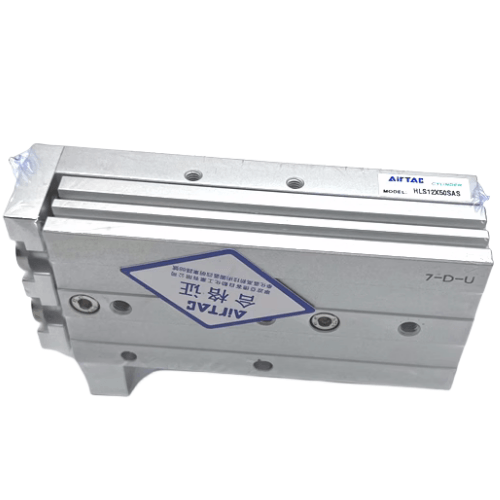
Airtac HLSL Precision Slide Table Cylinder HLSL8X40SAS
The AirTAC Airtac HLSL Precision Slide Table Cylinder HLSL8X40SAS is a genuine HLS slide-table cylinder, 8 mm bore: a double-acting dual-rod air cylinder integrated with a cross-roller guide so the table travels straight with high rigidity and low deflection. It delivers about 38 N of push at 0.5 MPa. This is the symmetrical version. A floating joint spares the rod from side torque; the magnet is fitted as standard.
- TypeSlide-table, double acting
- Guidecross-roller guide
- Bore8 mm
- Push thrust @0.5 MPa38 N
- Operating pressure0.2 - 0.7 MPa (29 - 100 psi)
- Port sizeM5x0.8
- CushionBumper (+ shock-absorber option)
- Magnet / sensorStandard; CMSH/DMSH/EMSH
- ThreadPT
- No minimum order. A single piece can be ordered.
- Ready in 3–5 business days. That is the time we take to process the order and hand it to the carrier. Transit time after that depends on the destination.
About the Airtac HLSL Precision Slide Table Cylinder HLSL8X40SAS
The HLSL8X40SAS is a symmetrical cross-roller slide table cylinder from AirTAC: a double-acting, dual-rod air cylinder with an integrated cross-roller guide that keeps the moving table travelling straight and with low deflection. The 8 mm bore with 40 mm stroke suits compact, light-duty positioning, the dual rods give doubled thrust for the bore, and the built-in floating joint spares the rods from side torque applied by the workpiece. The symmetrical HLSL body offers the same cross-roller precision and rigidity in a form that can be mounted from either side.
This is a genuine AirTAC part, listed and orderable through airtacdistr.com for the US market. A position magnet is fitted as standard, so CMSH, DMSH or EMSH sensor switches can be clipped into the magnetic-switch slots on the body. Ports are M5x0.8 with PT thread, and the AS code means adjustable rubber stoppers are fitted on the extension side. The exact thrust, dimensions and load/moment ratings for this model are shown in the on-page specification table, and we are happy to confirm them from the datasheet on request.
Airtac HLSL Precision Slide Table Cylinder HLSL8X40SAS Technical Specifications
| Model | Airtac HLSL Precision Slide Table Cylinder HLSL8X40SAS |
|---|---|
| Type | Slide-table cylinder, double acting, dual rod |
| Series / guide | HLSL (cross-roller guide) |
| Bore | 8 mm |
| Push thrust @0.5 MPa | 38 N |
| Port size | M5x0.8 (PT thread) |
| Fluid | Air, filtered to 40 um |
|---|---|
| Operating pressure | 0.2 - 0.7 MPa (29 - 100 psi) |
| Proof pressure | 1.2 MPa (175 psi) |
| Temperature | -20 to 70 C |
| Speed range | 50 - 500 mm/s (meter-out) |
| Cushion | Bumper; shock-absorber / adjustable-stopper options |
| Magnet / sensor | Standard; CMSH, DMSH, EMSH |
Specifications follow the official AirTAC HL slide-table data. Max working pressure is 0.7 MPa. The table rides on an integrated linear guide — do not apply strong impact or large moment. Allowable load and moment are published as tables and curves, and overall dimensions vary per stroke — ask us and we confirm from the datasheet.
How to choose
Bore size sets the push: bore 8 gives light-to-moderate thrust for compact loads, while stepping up to bore 12, 16, 20 or 25 gives more push - no need to oversize. For the guide, the HLSL cross-roller design maximises precision and rigidity; choose HLQ if anti-rust, dust-proof ball-bearing guidance is the priority, HLH for a miniature roller-ball guide with the best straightness, or HLF when a reduced body height matters. Stroke 40 mm sits within the published bore-8 table; the thread can be ordered as PT (this model), G or NPT. Confirm allowable load and moment against the published tables or ask us before sizing.
Applications
Small-part pick and place
The straight, low-deflection cross-roller table carries a small gripper or vacuum cup laterally between pick and place points with repeatable 40 mm travel.
Gripper traverse
Mounted under a compact gripper, the dual-rod slide shuttles the tool to a second station, with the extension-side rubber stopper giving a cushioned, adjustable end position.
Assembly-stage indexing
The symmetrical body mounts flexibly in a light assembly fixture, advancing small parts to a pressing or insertion position with guided, straight-line motion.
FAQ
What does the AS at the end of HLSL8X40SAS mean?
It is the adjuster code: on HLS/HLQ slide tables, AS means adjustable rubber stoppers are fitted on the extension side only. Other options are B (shock absorbers both ends), BS (extension side), AF/BF (retraction side), or no code for the basic cushioned version. B-type options are not offered on bore 6.
What pressure and speed should I run this cylinder at?
Bore 8 works at 0.2-0.7 MPa (29-100 psi) - 0.7 MPa is the maximum working pressure, with 1.2 MPa (175 psi) proof pressure. Control speed meter-out within the 50-500 mm/s range on clean air filtered to 40 um, and check allowable load and moment for your stroke against the published datasheet tables.