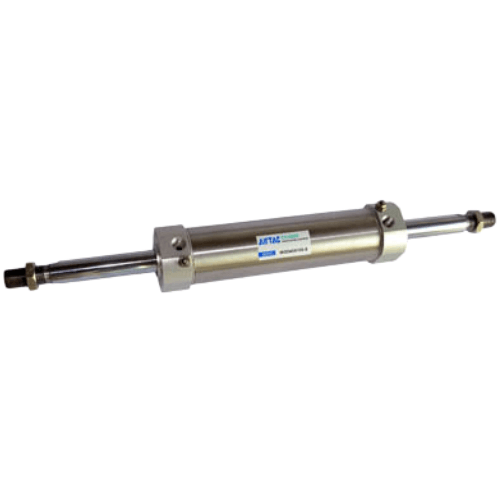
Airtac MGCD Stainless Steel Mini Air Cylinder MGCD63X225
The AirTAC Airtac MGCD Stainless Steel Mini Air Cylinder MGCD63X225 is a genuine double acting, double rod + cushion JIS-standard round-body mini air cylinder with a Ø63mm bore and 225mm stroke, 1/4" air ports and a SUS304 stainless-steel barrel with a hard-chrome-plated rod for reliable, mildly corrosion-resistant service.
- BoreØ63 mm
- Stroke225 mm
- Port size1/4"
- Acting typeDouble acting, double rod + cushion
- Rod threadM18×1.5
- CushionVariable air cushion, both ends
About the Airtac MGCD Stainless Steel Mini Air Cylinder MGCD63X225
The AirTAC MGCD63X225 is a double acting, double rod JIS round-body mini cylinder with a 63 mm bore and 225 mm stroke. Because a 20 mm rod exits both covers with the same M18x1.5 male thread at each end, both strokes work on the rod-side area, so the output force is equal in both directions: about 1400.9 N at 0.5 MPa and 1961.2 N at 0.7 MPa, with a theoretical maximum of 285.7 kgf at 1.0 MPa. Unlike the bumper-equipped MGD, this build carries a variable air cushion at both ends, so the piston decelerates smoothly into each cover for high-speed or heavier-load cycling. Air supply is 0.15-1.0 MPa (22-145 psi), proof pressure is 1.5 MPa (215 psi), speed range is 30-800 mm/s, and the fluid is air filtered to 40 um.
Construction follows the JIS mini-cylinder footprint: a riveted SUS304 stainless barrel with hard-chrome plated carbon-steel rods, plus a two-way lubricant-storing piston seal for long service life. The 225 mm stroke sits well inside the 500 mm maximum standard stroke for this bore, so no special-order length is needed. Ports are 1/4". The rear rod end can drive a second load or carry a position flag, and the through-rod resists rotation in transfer work. Mounting options are LB foot and FA flange with I and Y rod knuckles; the optional S code adds a magnet for CMSG, DMSG or EMSG switches. Note that the cushion only decelerates the stroke ends and is not a lock: for load holding, add an external rod lock or pilot check valve.
Airtac MGCD Stainless Steel Mini Air Cylinder MGCD63X225 Technical Specifications
| Model | Airtac MGCD Stainless Steel Mini Air Cylinder MGCD63X225 |
|---|---|
| Series | MGCD JIS mini cylinder |
| Bore size | Ø63 mm |
| Stroke | 225 mm |
| Acting type | Double acting, double rod + cushion |
| Port size | 1/4" |
| Rod thread | M18×1.5 |
| Fluid | Air (filtered by 40µm element) |
|---|---|
| Operating pressure | 0.15 – 1.0 MPa |
| Proof pressure | 1.5 MPa |
| Temperature | -20 to +70 °C |
| Speed range | 30 – 800 mm/s |
| Cushion | Variable air cushion, both ends |
| Max standard stroke | Up to 500 mm |
Specifications follow the official AirTAC MG-series (JIS standard) datasheet. Barrel: SUS304 stainless steel (round-body, riveted construction); piston rod: carbon steel with 20µm hard-chrome plating. Thread options: PT (blank) / G / NPT.
Theoretical Output Force (Ø63mm)
| Pressure | Force (both ways) |
|---|---|
| 0.5 MPa | 1402 N |
| 0.7 MPa | 1962 N |
| Max (@1.0 MPa) | 286 kgf |
Double-rod: a rod exits both covers, so output force is equal in both directions (rod-side area used).
Model Code: Airtac MGCD Stainless Steel Mini Air Cylinder MGCD63X225
| MGCD | JIS round-body mini cylinder (double-rod, variable cushion). |
|---|---|
| 63 | Bore size in mm. |
| ×225 | Stroke length in mm. |
| -S | Optional built-in magnet for CMSG / DMSG / EMSG sensors. |
| FA / LB | Mounting: FA flange, LB foot. |
MG-family variants: MG / MGC (double acting ±cushion), MSG / MTG (single acting push / pull), MGD / MGCD (double rod ±cushion). Accessories: LB foot, FA flange, plus I and Y knuckles. Thread PT (blank) / G / NPT.
Where the Airtac MGCD Stainless Steel Mini Air Cylinder MGCD63X225 Is Used
High-speed anti-rotation transfer
At 30-800 mm/s with a variable air cushion at both ends, the 63 mm through-rod moves pallets or fixtures between stations without rotating, decelerating smoothly into each stop at about 1400 N per direction.
Twin-load press with soft stop
The front rod presses one part while the rear rod end drives a second tool or counter-feature, and the adjustable cushion gives a controlled soft landing for the roughly 142 kgf-class thrust at 0.5 MPa.
Rear-flag slide with switch feedback
A flag on the rear rod end trips CMSG, DMSG or EMSG switches (with the S magnet option) to confirm both end positions on a 225 mm slide, while the cushion protects the covers at speed.
Is the Airtac MGCD Stainless Steel Mini Air Cylinder MGCD63X225 the Right Cylinder?
Size the MGCD63X225 when your application needs roughly 1400 N per direction with smooth, adjustable end-of-stroke deceleration: it is the largest bore in the cushioned double-rod MGCD range (20/25/32/40/50/63). If you need less force, step down to the MGCD50; if you want a double-rod cylinder with a fixed bumper instead of an adjustable cushion in the smaller 20-40 bores, look at the MGD; for a single-rod cushioned cylinder, the MGC is the equivalent. Choose the double-rod layout when you need equal force both ways, anti-rotation guidance, or a rear rod end for a stop, flag or second load. Specify LB foot or FA flange mounting and I or Y knuckles as required, and add the S code if you plan to fit CMSG, DMSG or EMSG magnetic switches. For long strokes with side loads, use external guides; the cylinder itself does not hold position on air loss, so pair it with a pilot check valve or external lock where holding matters.
Quick checklist
- ✓ Required force at your working pressure
- ✓ Stroke and mounting space
- ✓ Port/thread type (PT / G / NPT)
- ✓ Magnet (-S) for sensors?
- ✓ Mounting (LB / FA) & knuckle
Installation & Maintenance Notes
- check Use clean air filtered to 40µm or finer.
- check Keep within 0.15 – 1.0 MPa operating pressure.
- check Avoid side load on the piston rod.
- check Do not dismantle the riveted front/back covers.
- check On first run, back off the cushion and release gradually.
- check Installation by qualified personnel per AirTAC docs.
Airtac MGCD Stainless Steel Mini Air Cylinder MGCD63X225 FAQ
Because it is a double rod cylinder, the force is equal in both directions: 1400.9 N at 0.5 MPa and 1961.2 N at 0.7 MPa, with a theoretical maximum of 285.7 kgf at 1.0 MPa. Operating pressure is 0.15-1.0 MPa (22-145 psi), proof pressure is 1.5 MPa (215 psi), speed is 30-800 mm/s, temperature is -20 to +70 C, and the air must be filtered to 40 um. For a realistic working load, size around 60 percent of the 0.5 MPa force, about 840 N; for a vertical lift that is roughly 71 kg.
The MGCD63X225 has an adjustable air cushion at both ends that decelerates the piston smoothly before each cover, allowing higher speeds and heavier loads than an unbuffered cylinder; it is not a brake and will not hold the load on air loss, so add a pilot check valve or external rod lock for holding. Unlike the MGD, which uses fixed bumper pads, the cushion here is adjustable. Unlike the single-rod MGC, the MGCD has a rod at both ends with the same M18x1.5 thread, giving equal force both ways, anti-rotation behavior and a rear rod end for a second load or position flag. The optional S code adds a magnet for CMSG, DMSG or EMSG switches.
Authorized Export Seller
Genuine AirTAC parts produced by AirTAC factory.
1-Year Warranty
Covers non-human-caused product damage.
Fast Dispatch
Standard models usually ship in 3-4 days.
Fast Reply
Most inquiries answered within 7-8 hours.
Related AirTAC MGCD Cylinders
Request a Quote for Airtac MGCD Stainless Steel Mini Air Cylinder MGCD63X225
Send us the quantity and destination. We confirm price, stock and lead time — usually within 7-8 hours.