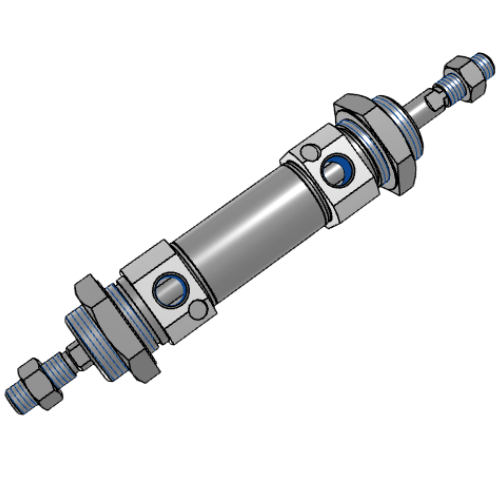
Airtac MICD Air Cushion Double Rod Mini Cylinder MICD32X30S
The AirTAC Airtac MICD Air Cushion Double Rod Mini Cylinder MICD32X30S is a genuine double acting, double rod + cushion round-body mini air cylinder with a Ø32mm bore and 30mm stroke, 1/4" air ports and a stainless-steel barrel and rod for mildly corrosive environments.
- BoreØ32 mm
- Stroke30 mm
- Port size1/4"
- Acting typeDouble acting, double rod + cushion
- Rod threadM10×1.25
- CushionVariable air cushion, both ends
About the Airtac MICD Air Cushion Double Rod Mini Cylinder MICD32X30S
Built for guided, high-speed motion, this stainless steel round-body mini cylinder pushes and pulls with equal force. The through-rod design exits both covers, yielding 345.6 N at 0.5 MPa and 483.8 N at 0.7 MPa in both directions. An adjustable air cushion at each end soaks up end-of-stroke shock, while the 1/4 inch port feeds the 12 mm rod. Because the -S suffix denotes a built-in magnet, this unit is ready for CMSG, DMSG or EMSG position sensing.
The stainless barrel and rod resist mild corrosion and washdown environments. For sizing, a safe working load is roughly 207 N, which translates to moving about 17.6 kg vertically each way with a 2:1 safety margin. Note that while the cushions decelerate the load near the stroke ends, they do not function as a lock; the piston will drift on air loss unless you fit an external rod lock or pilot check valve.
Airtac MICD Air Cushion Double Rod Mini Cylinder MICD32X30S Technical Specifications
| Model | Airtac MICD Air Cushion Double Rod Mini Cylinder MICD32X30S |
|---|---|
| Series | MICD mini cylinder |
| Bore size | Ø32 mm |
| Stroke | 30 mm |
| Acting type | Double acting, double rod + cushion |
| Port size | 1/4" |
| Rod thread | M10×1.25 |
| Fluid | Air (filtered by 40µm element) |
|---|---|
| Operating pressure | 0.15 – 1.0 MPa |
| Proof pressure | 1.5 MPa |
| Temperature | -20 to +70 °C |
| Speed range | 30 – 800 mm/s |
| Cushion | Variable air cushion, both ends |
| Max standard stroke | Up to 500 mm |
Specifications follow the official AirTAC MI/MIC (ISO 6432) datasheet. Barrel & rod: stainless steel (round-body, riveted construction). Thread options: PT (blank) / G. Note: the Ø32 bore is a larger, non-ISO-6432 size.
Theoretical Output Force (Ø32mm)
| Pressure | Force (both ways) |
|---|---|
| 0.5 MPa | 346 N |
| 0.7 MPa | 484 N |
| Max (@1.0 MPa) | 70 kgf |
Double-rod: a rod exits both covers, so output force is equal in both directions (rod-side area used).
Model Code: Airtac MICD Air Cushion Double Rod Mini Cylinder MICD32X30S
| MICD | round-body mini cylinder (double-rod, variable cushion). |
|---|---|
| 32 | Bore size in mm. |
| ×30 | Stroke length in mm. |
| -S | Optional built-in magnet for CMSG / DMSG / EMSG sensors. |
MI-family variants: MI / MIC (double acting ±cushion), MSI / MTI (single acting push / pull), MID / MICD (double rod ±cushion), MIJ / MICJ (adjustable stroke ±cushion). Back covers CA / U / R / CM. Mounting LB / FA / SDB / TC.
Where the Airtac MICD Air Cushion Double Rod Mini Cylinder MICD32X30S Is Used
Transfer Diversion
Equal push and pull force of 345.6 N lets a diverter arm positively strip parts off a moving belt in both directions without twisting.
Flap Folding
Twin rods keep the folding blade perfectly aligned through a fast 30 mm stroke, while the adjustable air cushions prevent jarring at the stroke ends.
Component Seating
The through-rod design provides 207 N of safe working load to press a small bushing into a housing, with the back rod available to trip a sensor.
Is the Airtac MICD Air Cushion Double Rod Mini Cylinder MICD32X30S the Right Cylinder?
If 345.6 N at 0.5 MPa is too much, step down to the MICD25 bore for 206.1 N; if you need more power, the MICD40 provides 527.8 N. This 32 mm bore is ideal when your application demands the twin-rod anti-rotation benefit combined with shock absorption for fast 30 mm strokes. You can mount it using LB foot, FA flange or TC trunnion brackets, but the SDB pivot block is not offered on this double-rod variant. Position sensing is fully enabled here thanks to the included magnet.
Quick checklist
- ✓ Required force at your working pressure
- ✓ Stroke and mounting space
- ✓ Port/thread type (PT / G)
- ✓ Magnet (-S) for sensors?
- ✓ Back cover (CA/U/R/CM) & mount (LB/FA/SDB/TC)
Installation & Maintenance Notes
- check Use clean air filtered to 40µm or finer.
- check Keep within 0.15 – 1.0 MPa operating pressure.
- check Avoid side load on the piston rod.
- check Do not dismantle the riveted front/back covers.
- check Use correct back cover (CA/U/R/CM) & mount (LB/FA/SDB/TC).
- check Installation by qualified personnel per AirTAC docs.
Airtac MICD Air Cushion Double Rod Mini Cylinder MICD32X30S FAQ
Because a rod exits both ends, force is equal both ways. It generates 345.6 N at 0.5 MPa, 483.8 N at 0.7 MPa, and a maximum theoretical 70.5 kgf at 1.0 MPa. The air port is 1/4 inch.
No, the piston will drift on air loss. The adjustable air cushions at both ends only decelerate the load near the end of stroke; they do not act as a brake or lock. Use an external rod lock or pilot check valve for holding.
Authorized Export Seller
Genuine AirTAC parts produced by AirTAC factory.
1-Year Warranty
Covers non-human-caused product damage.
Fast Dispatch
Standard models usually ship in 3-4 days.
Fast Reply
Most inquiries answered within 7-8 hours.
Related AirTAC MICD Cylinders
Request a Quote for Airtac MICD Air Cushion Double Rod Mini Cylinder MICD32X30S
Send us the quantity and destination. We confirm price, stock and lead time — usually within 7-8 hours.