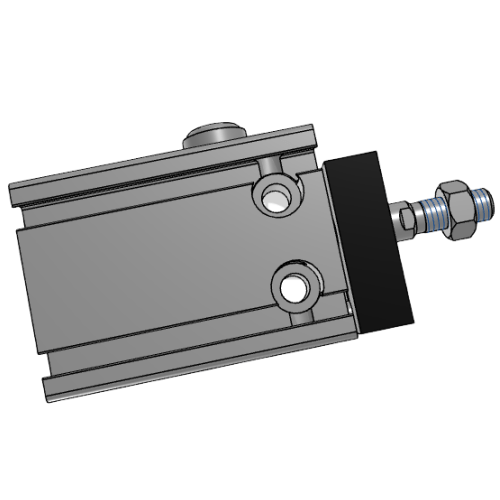
Airtac MSK Multi-position Locking Cylinder MSK10X15
The AirTAC Airtac MSK Multi-position Locking Cylinder MSK10X15 is a genuine MK multi-mount cylinder (single acting, push type), 10 mm bore. Its compact square body fixes from six directions and mounts side by side to save space. It delivers about 15.8 N of push force at 0.5 MPa. A bumper cushions the impact. As an MK unit a fixed rod stops the piston rod rotating.
- TypeMulti-mount, single acting, push type
- SeriesMK (no-rotating)
- Bore10 mm
- Push thrust @0.5 MPa15.8 N
- Operating pressure0.2 - 1.0 MPa (28 - 145 psi)
- Port sizeM5x0.8
- CushionBumper
- MagnetWithout magnet
- ThreadPT
- No minimum order. A single piece can be ordered.
- Ready in 3–5 business days. That is the time we take to process the order and hand it to the carrier. Transit time after that depends on the destination.
About the Airtac MSK Multi-position Locking Cylinder MSK10X15
MSK10X15 is a single-acting push-type multi-mount cylinder: a 10 mm bore, 15 mm stroke compact square body that fixes from 6 directions (front, back, left, right, top and bottom) and mounts side by side to save space on tight fixtures. Push type means air pressure drives the rod out and it retracts when the air is released, a natural fit for eject and clamp jobs that should self-release on air loss. Operating pressure is 0.2-1.0 MPa (28-145 psi), theoretical push thrust is 15.8 N at 0.5 MPa, speed is 50-500 mm/s and the cushion is a bumper. Use air filtered to 40 um; the temperature range is -20 to 70 C.
This is a genuine AirTAC part from the MK family, where a no-rotating plate, bushing and fixed rod stop the piston rod from turning (the MD family is the standard type where rod rotation is allowed). As coded, this SKU is supplied without a magnet and with PT thread; the S magnet and G thread options exist but are not this SKU. We confirm overall dimensions, which vary with stroke, and sizing details from the datasheet on request.
Airtac MSK Multi-position Locking Cylinder MSK10X15 Technical Specifications
| Model | Airtac MSK Multi-position Locking Cylinder MSK10X15 |
|---|---|
| Type | Multi-mount cylinder, single acting, push type |
| Series | MK (no-rotating) |
| Bore | 10 mm |
| Push thrust @0.5 MPa | 15.8 N |
| Port size | M5x0.8 (PT thread) |
| Magnet | Without magnet |
| Fluid | Air, filtered to 40 um |
|---|---|
| Operating pressure | 0.2 - 1.0 MPa (28 - 145 psi) |
| Proof pressure | 1.5 MPa (215 psi) |
| Temperature | -20 to 70 C |
| Speed range | 50 - 500 mm/s |
| Cushion | Bumper |
| Mounting | Fix from 6 directions; mountable side by side |
Specifications follow the official AirTAC MD/MK multi-mount data. The front cover and piston are short, so avoid an over-long stroke. An optional high-temperature seal material extends the range to 0 to 150 C. Overall dimensions vary per stroke and allowable side-load is published as curves — ask us and we confirm from the datasheet.
How to choose
Bore 10 single-acting push produces about 15.8 N theoretical thrust at 0.5 MPa, so move up a bore if the job needs more push. MK (this SKU) stops rod rotation, MD allows it. Within the MK family, push (MSK) extends under air, pull (MTK) retracts under air, and double acting (MK) works both ways. Single-acting strokes run up to 20 mm, so 15 mm is near the top of the single-acting table; check the short-cover limit before specifying anything longer. No trailing S means no magnet on this SKU (add S for one), and the thread is PT as coded with G available; the port on this bore is M5x0.8. Route side-load questions to us.
Applications
Jig positioning and clamp
Push a small part against a jig stop to locate it before fastening, with retraction on air release freeing the part automatically. The square body fixes from 6 directions to fit the jig wherever space allows.
Pallet-sensor trigger
Mount the cylinder beside a narrow aisle guide rail to push a small roller or flag into the path of pallet trucks or trolleys as a mechanical trigger, with the no-rotating rod keeping the flag orientation steady.
Vertical ejection from nests
Fix the body under a feed nest to lift or eject a small finished part upward into a chute; the 15 mm stroke suits shallow nests and the fixed rod keeps the ejector pin from twisting.
FAQ
Why choose single-acting push (MSK) over single-acting pull (MTK) or double acting (MK)?
Push type extends the rod under air pressure and retracts when the air is released, which suits clamping and ejecting. Pull type does the reverse, and double acting controls both directions. All MK versions are no-rotating; at bore 10 the single-acting push thrust is about 15.8 N at 0.5 MPa.
Can the cylinder take side loads, and what are its exact dimensions?
Side-load capacity depends on the application and mounting, so route it to us for confirmation rather than assuming a figure. Overall dimensions vary with the stroke, so use the datasheet figures for the MSK10X15 when laying out your fixture; the 6-direction fixing makes the final placement flexible.