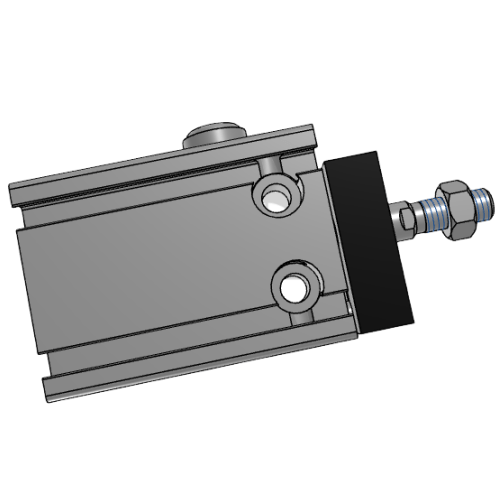
Airtac MSK Multi-position Locking Cylinder MSK16X10
The AirTAC Airtac MSK Multi-position Locking Cylinder MSK16X10 is a genuine MK multi-mount cylinder (single acting, push type), 16 mm bore. Its compact square body fixes from six directions and mounts side by side to save space. It delivers about 70.4 N of push force at 0.5 MPa. A bumper cushions the impact. As an MK unit a fixed rod stops the piston rod rotating.
- TypeMulti-mount, single acting, push type
- SeriesMK (no-rotating)
- Bore16 mm
- Push thrust @0.5 MPa70.4 N
- Operating pressure0.2 - 1.0 MPa (28 - 145 psi)
- Port sizeM5x0.8
- CushionBumper
- MagnetWithout magnet
- ThreadPT
- No minimum order. A single piece can be ordered.
- Ready in 3–5 business days. That is the time we take to process the order and hand it to the carrier. Transit time after that depends on the destination.
About the Airtac MSK Multi-position Locking Cylinder MSK16X10
The AirTAC MSK16X10 is a 16 mm bore single acting push type multi-mount cylinder with a 10 mm stroke. Its compact square body can be fixed from 6 directions - front, back, left, right, top and bottom - and units can be mounted side by side to save space. As a push type single acting cylinder, air extends the rod while an internal spring returns it, so it needs air on one side only, running at 0.2-1.0 MPa (28-145 psi) with a 50-500 mm/s speed range. At 0.5 MPa the theoretical push force at this bore is 70.4 N, with cushioning provided by a bumper.
This is a genuine AirTAC part. The MK family is the no-rotating version of the multi-mount cylinder: a fixed rod and plate stop the piston rod from turning, unlike the standard MD family where rotation is allowed. As shown by the SKU, this model does not include a magnet. We confirm dimensions, stroke tables and sizing from the datasheet on request.
Airtac MSK Multi-position Locking Cylinder MSK16X10 Technical Specifications
| Model | Airtac MSK Multi-position Locking Cylinder MSK16X10 |
|---|---|
| Type | Multi-mount cylinder, single acting, push type |
| Series | MK (no-rotating) |
| Bore | 16 mm |
| Push thrust @0.5 MPa | 70.4 N |
| Port size | M5x0.8 (PT thread) |
| Magnet | Without magnet |
| Fluid | Air, filtered to 40 um |
|---|---|
| Operating pressure | 0.2 - 1.0 MPa (28 - 145 psi) |
| Proof pressure | 1.5 MPa (215 psi) |
| Temperature | -20 to 70 C |
| Speed range | 50 - 500 mm/s |
| Cushion | Bumper |
| Mounting | Fix from 6 directions; mountable side by side |
Specifications follow the official AirTAC MD/MK multi-mount data. The front cover and piston are short, so avoid an over-long stroke. An optional high-temperature seal material extends the range to 0 to 150 C. Overall dimensions vary per stroke and allowable side-load is published as curves — ask us and we confirm from the datasheet.
How to choose
Choose the 16 mm bore when your job needs moderate push force - about 70.4 N theoretical at 0.5 MPa, well above the 15.8 N of the 10 mm bore. Pick the MK family when the rod must not turn; if rotation is acceptable, the standard MD family is the alternative. Acting type here is single acting push (air extends, spring retracts); double acting, double rod, pull type and adjustable-stroke versions exist in the range. Single acting strokes run up to 20 mm, and this model's 10 mm stroke covers short clamp and eject moves - short covers mean an over-long stroke is not an option. No magnet is fitted on this SKU; magnet versions carry an S suffix. Port thread is PT as standard, with G available as a suffix. Side-load figures and exact dimensions come from the datasheet - ask us.
Applications
Light press or crimp
A short 10 mm air push presses a bushing, crimps a terminal or seats a small cover, with about 70.4 N at 0.5 MPa. The no-rotating rod keeps the tool face oriented, and the spring returns the ram between parts.
Workholding clamp
Clamping a fixture plate or toggle clamp on a small machining jig: air pushes the clamp into the workpiece, and the spring releases it when air drops. Several cylinders mount side by side along one edge of the fixture.
Index stopper
A pop-up stopper halts parts on a pallet or indexing conveyor at a station. The compact square body fixes from the top or side of a narrow frame, and the no-rotating rod holds the stopper face steady.
FAQ
Why choose the 16 mm bore over a smaller multi-mount cylinder?
Thrust scales with bore area: at 0.5 MPa this 16 mm single acting push type cylinder gives about 70.4 N theoretical push, versus 15.8 N for the 10 mm bore. Pick the bore by the force your clamp, ejector or stopper needs, and confirm exact dimensions from the datasheet.
What stops the rod from turning on this cylinder?
The MK family adds a no-rotating plate, brass bushing and fixed rod that prevent the piston rod from turning, so a pusher or clamp pad stays square to the work. Materials are typical - aluminium alloy body, stainless or S45C rod, NBR seals - and bore-specific details and side-load limits come from the datasheet.