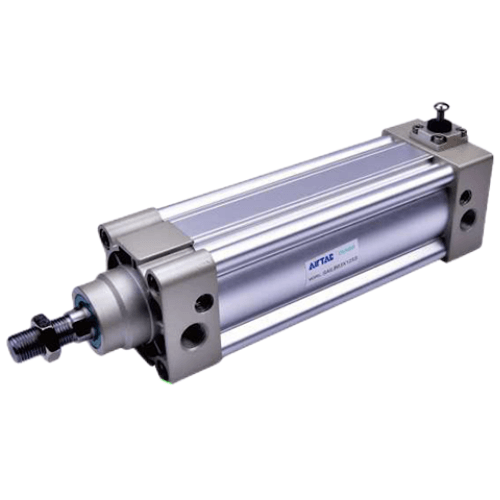
Airtac SAILB Rear Lock Cylinder SAILB63X160
The AirTAC Airtac SAILB Rear Lock Cylinder SAILB63X160 is a genuine double-acting ISO 15552 profile cylinder with a Ø63mm bore, 160mm stroke and a built-in spring-applied, air-released mechanical lock in the back cover — it holds the load at the retracted (rod-in) stroke end even when air is lost.
- BoreØ63 mm
- Stroke160 mm
- Port sizeG3/8
- Lock positionBack cover
- Rod threadM16×1.5
- UnlockAir + manual
About the Airtac SAILB Rear Lock Cylinder SAILB63X160
The AirTAC SAILB63X160 is a double-acting ISO 15552 profile cylinder equipped with a spring-applied, air-released mechanical lock housed in the back cover. This built-in mechanism holds the rod securely at the retracted stroke end, meaning a load remains safely clamped the moment pressure is cut. In the 63mm bore class, it delivers a 0.5 MPa pull force of 1402 N and a push force of 1559 N.
Because the lock engages statically after the piston stops, it is not a dynamic brake for a moving rod. The locker end features a 21 mm variable air cushion, intentionally shorter than the 30 mm cushion on the free end to accommodate the locking hardware. For position detection, you can add a magnet (-S) to use CMSE reed or DMSE electronic sensors.
Airtac SAILB Rear Lock Cylinder SAILB63X160 Technical Specifications
| Model | Airtac SAILB Rear Lock Cylinder SAILB63X160 |
|---|---|
| Series | SAIL ISO 15552 cylinder with lock |
| Bore size | Ø63 mm |
| Stroke | 160 mm |
| Acting type | Double acting, with lock |
| Port size | G3/8 |
| Rod thread | M16×1.5 |
| Lock type | Spring-applied, air-released (back cover) |
|---|---|
| Unlock | Automatic (air) & manual |
| Operating pressure | 0.15 – 1.0 MPa |
| Temperature | -20 to +70 °C |
| Speed range | 30 – 800 mm/s |
| Cushion | Adjustable (30 mm free end / 21 mm lock end) |
| Max stroke | Up to 1500 mm |
Specifications follow the official AirTAC SAIL datasheet (ISO 15552). Confirm against the product label before installation. Port options: PT / G.
How the Lock Holds
The lock is spring-applied and air-released: a spring drives a lock pin into the rod when the release air is removed, so the load is held at the retracted (rod-in) stroke end without live pressure. Supply air to the release port to unlock automatically, or use the manual release lever.
The lock engages only when the piston reaches the stroke terminal on the back-cover side — it is a static end-of-stroke hold, not a mid-stroke clamp and not a moving-rod brake. For locking at any position along the stroke, choose a BSAI clamp-lock instead.
Theoretical Output Force (Ø63mm)
| Pressure | Push force | Pull force |
|---|---|---|
| 0.5 MPa | 1559 N | 1402 N |
| 0.7 MPa | 2182 N | — |
| Max (@1.0 MPa) | 318 kgf | |
Cylinder thrust is separate from the lock's holding capability. Actual usable force is lower than theoretical due to friction and back-pressure — size with a margin.
Where the Airtac SAILB Rear Lock Cylinder SAILB63X160 Is Used
Vertical Lift Safety
Holds a lifted load securely at the retracted stroke end when air pressure drops, preventing sudden falls on vertical actuators.
Power-Off Clamping
Maintains a tight grip on workpieces during power loss, ensuring parts remain fixed in place until release air is restored.
Gate Position Hold
Keeps heavy safety gates and doors firmly shut at the end of the stroke without relying on continuous live air pressure.
Is the Airtac SAILB Rear Lock Cylinder SAILB63X160 the Right Lock Cylinder?
Choose this 63mm bore if your application requires a 1402 N pull at 0.5 MPa, stepping down to a 50mm bore (825 N pull) for lighter loads or up to an 80mm bore (2268 N pull) for heavier forces. Select this SAILB configuration when the load must be held in the retracted position; choose a SAILF variant if the extended end must be locked instead. If your process requires locking at an arbitrary mid-stroke point rather than the stroke end, use a BSAI clamp-lock cylinder instead.
Remember that the lock is a static holding device, not a mid-stroke clamp. Valve selection is critical: never use a fast-exhaust valve with this cylinder, as back-pressure on the locker side can unintentionally release the lock—use an independent-exhaust solenoid valve. For any safety-critical vertical load, add an independent mechanical safety measure. Replacement requires matching the 160mm stroke, back locker position, 3/8 PT port, and your preferred mounting style from the ISO 15552 interface.
Quick checklist
- ✓ Hold needed at the retracted (rod-in) end?
- ✓ Or lock anywhere → use BSAI
- ✓ Independent-exhaust valve fitted
- ✓ Port/thread type (PT/G)
- ✓ Extra safety measure for people
Airtac SAILB Rear Lock Cylinder SAILB63X160 FAQ
At 0.5 MPa, the 63mm bore provides 1559 N of push force and 1402 N of pull force. At 0.7 MPa, the push force increases to 2182 N.
The lock is spring-applied and air-released, engaging statically only when the rod reaches the retracted stroke end. It unlocks automatically via air supply or manually via a lever, but it does not clamp at arbitrary mid-stroke positions.
Related AirTAC Lock & Standard Cylinders
Request a Quote for Airtac SAILB Rear Lock Cylinder SAILB63X160
Send us the quantity and destination. We confirm price, stock and lead time — usually within 7-8 hours.