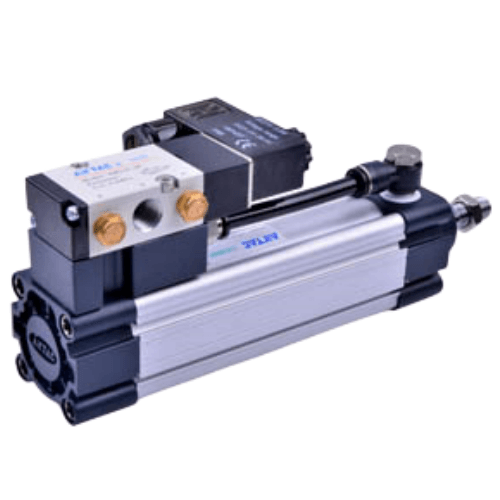
Airtac SAUF Series Valve-Mounted Air Cylinder SAUF32X400-06A
The AirTAC Airtac SAUF Series Valve-Mounted Air Cylinder SAUF32X400-06A is a genuine double-acting profile-type cylinder with a Ø32mm bore, 400mm stroke and a built-in 4M210-06 5/2 solenoid valve — it switches itself from one coil signal, so no separate remote valve or extra plumbing is needed.
- BoreØ32 mm
- Stroke400 mm
- Built-in valve4M210-06
- Valve port1/8"
- CoilAC220V
- EntryTerminal
About the Airtac SAUF Series Valve-Mounted Air Cylinder SAUF32X400-06A
The SAUF32X400-06A is a double-acting profile cylinder with a built-in AirTAC 4M210-06 5/2 solenoid valve on the cap. One AC220V coil signal drives the 32mm bore and 400mm stroke, eliminating remote plumbing and saving a manifold slot. The extruded aluminum body is shorter than an ISO 15552 unit of the same size, and the cylinder port is 1/8".
Size force within the 0.15-0.8 MPa valve window, even though the cylinder body rates to 1.0 MPa. At 0.5 MPa it delivers 402N push and 345N pull. This yields a safe working load of roughly 241N, or a 20kg vertical lift with a 2:1 margin. The 1/8" valve port gives 14 mm2 flow (Cv 0.78) at up to 5 cycles per second. This terminal-entry SKU lacks a magnet, so it cannot accept a sensor.
Airtac SAUF Series Valve-Mounted Air Cylinder SAUF32X400-06A Technical Specifications
| Model | Airtac SAUF Series Valve-Mounted Air Cylinder SAUF32X400-06A |
|---|---|
| Series | SAUF profile cylinder with valve |
| Bore size | Ø32 mm |
| Stroke | 400 mm |
| Acting type | Double acting, self-valved |
| Cylinder port | 1/8" |
| Rod thread | M10×1.25 |
| PU tube | Ø8 × Ø5 |
| Built-in valve | 4M210-06 (5/2) |
|---|---|
| Valve flow | 14.0 mm² (Cv 0.78) |
| Max frequency | 5 cycle/sec |
| Coil voltage | AC220V · AC 3.5 VA |
| Electrical entry | Terminal · IP65 · B class |
| Response time | 0.05 s and below |
| Operating pressure | 0.15 – 0.8 MPa (valve limit) |
| Speed range | 30 – 800 mm/s |
The cylinder rates to 1.0 MPa but the built-in valve operates 0.15–0.8 MPa, so run the assembled SAUF at 0.15–0.8 MPa. Default: rod retracts when the coil is energised (reconfigurable to extend). Specs follow the official AirTAC SAUF datasheet. Port options: PT / G.
Theoretical Output Force (Ø32mm)
| Pressure | Push force | Pull force |
|---|---|---|
| 0.5 MPa | 402 N | 346 N |
| 0.7 MPa | 563 N | — |
Sized within the valve's 0.15–0.8 MPa range. Actual usable force is lower than theoretical due to friction and back-pressure.
Model Code: Airtac SAUF Series Valve-Mounted Air Cylinder SAUF32X400-06A
| SAUF | Profile cylinder with built-in 4M valve. |
|---|---|
| 32×400 | Bore × stroke in mm. |
| -06 | Valve port 1/8" → 4M210-06. |
| A | Coil voltage AC220V. |
| I / (blank) | Terminal electrical entry. |
SAUF does not hold its load without air — the valve routes air, it is not a lock. For a held load, add an external rod lock or a pilot-operated check valve.
Where the Airtac SAUF Series Valve-Mounted Air Cylinder SAUF32X400-06A Is Used
Decentralized Clamping
Actuate a remote clamping jaw directly at the point of operation without routing long control lines back to a central manifold.
Divert Gate Control
Switch a sorting diverter on a conveyor using the integrated 4M210 valve, saving manifold space and tubing on the main line.
Package Push-off
Push cartons off a roller table with a self-contained actuator that requires only one coil signal and a local air supply.
Is the Airtac SAUF Series Valve-Mounted Air Cylinder SAUF32X400-06A the Right Choice?
For a 400mm stroke, compare this 32mm bore (402N push at 0.5 MPa) against the 40mm neighbor (628N) if your load grows, or step down if excess force damages the product. Confirm the AC220V terminal entry and PT threads match your supply. The default action retracts the rod when energised; reposition the valve to extend on signal. Keep pressure between 0.15-0.8 MPa to match the valve, not the 1.0 MPa cylinder rating. Because the valve only routes air, add an external rod lock or pilot-operated check valve to hold a load. At 400mm, use an external guide to prevent rod bending and side-load wear.
Quick checklist
- ✓ Force at 0.15–0.8 MPa
- ✓ Coil voltage matches panel
- ✓ Terminal vs grommet entry
- ✓ Retract- or extend-when-energised
- ✓ Load-holding → external rod lock
Airtac SAUF Series Valve-Mounted Air Cylinder SAUF32X400-06A FAQ
It generates 402N push and 345N pull at 0.5 MPa. The built-in valve is a 4M210-06 (1/8" port, Cv 0.78, 5 cycles/sec max) driven by an AC220V terminal-entry coil. Although the cylinder body rates to 1.0 MPa, you must size force within the valve's 0.15-0.8 MPa operating window.
By default the rod retracts when the coil is energised, but you can reposition the valve to extend on signal. The valve only routes air; it is not a lock. The piston will drift on air loss, so add an external rod lock or pilot-operated check valve for load holding.
Related AirTAC Cylinders & Valves
Request a Quote for Airtac SAUF Series Valve-Mounted Air Cylinder SAUF32X400-06A
Send us the quantity and destination. We confirm price, stock and lead time — usually within 7-8 hours.