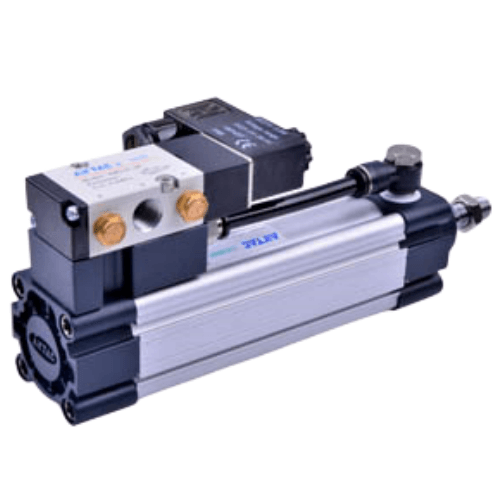
Airtac SAUF Series Valve-Mounted Air Cylinder SAUF50X250S-06B
The AirTAC Airtac SAUF Series Valve-Mounted Air Cylinder SAUF50X250S-06B is a genuine double-acting profile-type cylinder with a Ø50mm bore, 250mm stroke and a built-in 4M210-06 5/2 solenoid valve — it switches itself from one coil signal, so no separate remote valve or extra plumbing is needed.
- BoreØ50 mm
- Stroke250 mm
- Built-in valve4M210-06
- Valve port1/8"
- CoilDC24V
- EntryTerminal
About the Airtac SAUF Series Valve-Mounted Air Cylinder SAUF50X250S-06B
The SAUF50X250S-06B is a double-acting profile cylinder with a built-in AirTAC 4M210-06 5/2 solenoid valve on the cap. One DC24V coil signal drives the actuator, eliminating remote plumbing and saving a manifold slot. The 50mm bore uses a 1/4" cylinder port, a Ø20mm rod with an M16x1.5 thread, and 21mm adjustable cushions. The S suffix means a piston magnet is present for CMSG/DMSG/EMSG switches.
Size force within the valve's 0.15-0.8 MPa window, not the 1.0 MPa cylinder body rating. At 0.5 MPa it delivers 982N push and 825N pull. The 4M210-06 valve has a 1/8" port, 14 mm2 flow (Cv 0.78), and handles 5 cycles/sec. For sizing, the safe working load is roughly 589N (about 60% of the 0.5 MPa push), and it can vertically lift around 50kg with a 2:1 safety margin.
Airtac SAUF Series Valve-Mounted Air Cylinder SAUF50X250S-06B Technical Specifications
| Model | Airtac SAUF Series Valve-Mounted Air Cylinder SAUF50X250S-06B |
|---|---|
| Series | SAUF profile cylinder with valve |
| Bore size | Ø50 mm |
| Stroke | 250 mm |
| Acting type | Double acting, self-valved |
| Cylinder port | 1/4" |
| Rod thread | M16×1.5 |
| PU tube | Ø8 × Ø5 |
| Built-in valve | 4M210-06 (5/2) |
|---|---|
| Valve flow | 14.0 mm² (Cv 0.78) |
| Max frequency | 5 cycle/sec |
| Coil voltage | DC24V · DC 3.0 W |
| Electrical entry | Terminal · IP65 · B class |
| Response time | 0.05 s and below |
| Operating pressure | 0.15 – 0.8 MPa (valve limit) |
| Speed range | 30 – 800 mm/s |
The cylinder rates to 1.0 MPa but the built-in valve operates 0.15–0.8 MPa, so run the assembled SAUF at 0.15–0.8 MPa. Default: rod retracts when the coil is energised (reconfigurable to extend). Specs follow the official AirTAC SAUF datasheet. Port options: PT / G.
Theoretical Output Force (Ø50mm)
| Pressure | Push force | Pull force |
|---|---|---|
| 0.5 MPa | 982 N | 825 N |
| 0.7 MPa | 1374 N | — |
Sized within the valve's 0.15–0.8 MPa range. Actual usable force is lower than theoretical due to friction and back-pressure.
Model Code: Airtac SAUF Series Valve-Mounted Air Cylinder SAUF50X250S-06B
| SAUF | Profile cylinder with built-in 4M valve. |
|---|---|
| 50×250 | Bore × stroke in mm. |
| -06 | Valve port 1/8" → 4M210-06. |
| B | Coil voltage DC24V. |
| I / (blank) | Terminal electrical entry. |
SAUF does not hold its load without air — the valve routes air, it is not a lock. For a held load, add an external rod lock or a pilot-operated check valve.
Where the Airtac SAUF Series Valve-Mounted Air Cylinder SAUF50X250S-06B Is Used
Decentralized Clamping
Ideal for a machining cell where each clamping station uses one coil signal to actuate independently, saving manifold space.
Inline Diverters
Perfect for conveyor routing gates that require individual 5/2 valve control without running long tubing back to a central island.
Package Stops
Suits independent package stops on a sorting line, using the built-in 4M210 valve for fast 5 cycle/sec actuation.
Is the Airtac SAUF Series Valve-Mounted Air Cylinder SAUF50X250S-06B the Right Choice?
When sizing, compare neighbouring bores: a 40mm bore gives 628N push while a 63mm bore gives 1559N at 0.5 MPa. This 50mm unit provides 982N push. Confirm the DC24V coil, terminal entry, and PT threads suit your setup. The rod retracts by default when energised but can be reconfigured to extend by repositioning the valve. Because the built-in valve only routes air, it cannot hold a load on pressure loss—add an external rod lock or pilot-operated check valve for suspended loads. For this 250mm stroke, ensure adequate side-load guidance to prevent rod binding.
Quick checklist
- ✓ Force at 0.15–0.8 MPa
- ✓ Coil voltage matches panel
- ✓ Terminal vs grommet entry
- ✓ Retract- or extend-when-energised
- ✓ Load-holding → external rod lock
Airtac SAUF Series Valve-Mounted Air Cylinder SAUF50X250S-06B FAQ
It uses a 4M210-06 valve (1/8" port, Cv 0.78, 5 cycles/sec) with a DC24V terminal coil. Push force is 982N and pull is 825N at 0.5 MPa. The cylinder body rates to 1.0 MPa, but you must size the assembled unit within the built-in valve's 0.15-0.8 MPa operating window.
Yes, the default action retracts the rod when energised, but you can reposition the valve to make it extend instead. The valve routes air and is not a lock; the piston will drift on air loss, so use an external rod lock or pilot-operated check valve to hold a load.
Related AirTAC Cylinders & Valves
Request a Quote for Airtac SAUF Series Valve-Mounted Air Cylinder SAUF50X250S-06B
Send us the quantity and destination. We confirm price, stock and lead time — usually within 7-8 hours.