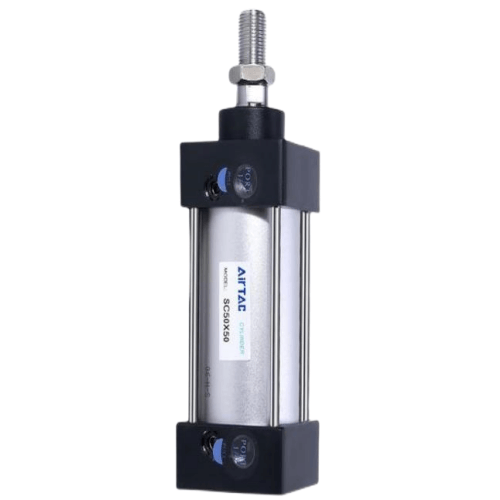
Airtac SC50 Standard Cylinder SC50X1365S
The AirTAC Airtac SC50 Standard Cylinder SC50X1365S is a genuine double-acting standard air cylinder with a Ø50mm bore and 1365mm stroke, PT1/4 air ports and adjustable end cushioning. It is used for push, pull, lift and clamp motion in industrial automation.
- BoreØ50 mm
- Stroke1365 mm
- Port sizePT1/4
- Acting typeDouble acting
- Rod threadM16×1.5
- CushionAdjustable, 21 mm
About the Airtac SC50 Standard Cylinder SC50X1365S
The SC50X1365S is a double-acting pneumatic cylinder with a 50 mm bore and an extended 1365 mm stroke, built for applications demanding a long, straight push or pull. With a 20 mm diameter piston rod and an adjustable air cushion length of 21 mm, it delivers a theoretical push force of 1767 N at the maximum operating pressure of 0.9 MPa, providing substantial linear power for its compact tie-rod body.
This non-standard stroke model is manufactured to order, exceeding the standard 1200 mm maximum for the SC50 series. The integrated magnet (suffix -S) allows direct mounting of CMSG, DMSG, or EMSG sensors on the barrel for precise, contactless end-of-stroke or mid-position detection, eliminating the need for external limit switches.
Airtac SC50 Standard Cylinder SC50X1365S Technical Specifications
| Model | Airtac SC50 Standard Cylinder SC50X1365S |
|---|---|
| Series | SC standard tie-rod cylinder |
| Bore size | Ø50 mm |
| Stroke | 1365 mm |
| Acting type | Double acting |
| Port size | PT1/4 |
| Rod thread | M16×1.5 |
| Fluid | Air (filtered by 40µm element) |
|---|---|
| Operating pressure | 0.15 – 1.0 MPa |
| Proof pressure | 1.5 MPa |
| Temperature | -20 to +70 °C |
| Speed range | 30 – 800 mm/s |
| Cushion | Adjustable, 21 mm |
| Max stroke | Up to 1200 mm |
Specifications follow the official AirTAC SC series datasheet. Operating pressure 0.15–1.0 MPa, proof pressure 1.5 MPa, temperature −20 to +70 °C. Confirm against the product label before installation. Thread options: PT (standard) / G.
Theoretical Output Force (Ø50mm)
| Pressure | Push force | Pull force |
|---|---|---|
| 0.5 MPa | 982 N | 825 N |
| 0.7 MPa | 1374 N | — |
| Max (approx.) | 200 kgf | |
Actual usable force is lower than theoretical due to friction and back-pressure. Size with a safety margin.
Model Code: Airtac SC50 Standard Cylinder SC50X1365S
| SC | Standard tie-rod cylinder series. |
|---|---|
| 50 | Bore size in mm. |
| ×1365 | Stroke length in mm. |
| -S | Optional built-in magnet for sensor position sensing. |
Related variants: SCD (double rod), SCJ (adjustable stroke), SCT (multi-position). Seals: TPU standard / H = Viton / N = NBR. Thread: blank = PT, G = G thread.
Where the Airtac SC50 Standard Cylinder SC50X1365S Is Used
Long-Reach Material Transfer
Pushes or pulls heavy bins and pallets across wide conveyor gaps where a standard-stroke cylinder falls short, with sensor confirmation of full extension.
Automated Gluing Station Actuator
Extends a dispensing head deep into a large assembly fixture. The built-in magnet provides mid-stroke deceleration signals for precise bead control.
Vertical Door or Hopper Gate Operator
Opens and closes a tall vertical door on a silo or hopper, using the 1767 N push force to lift a heavy gate against gravity, with end-of-travel sensors for safety interlocks.
Is the Airtac SC50 Standard Cylinder SC50X1365S the Right Cylinder?
For applications requiring less force, the SC40 bore provides 1130 N of push at 0.9 MPa. If a higher force is needed, stepping up to the SC63 bore offers 2805 N. With a 1365 mm stroke, the 20 mm rod is highly susceptible to bending under side loads or high-speed cycling; an external linear guide or a guided cylinder is strongly recommended to prevent rod bearing damage and ensure consistent motion. When replacing, match the 50 mm bore, 1365 mm stroke, PT port thread, and the -S magnet option to retain sensor compatibility.
Quick checklist
- ✓ Required force at your working pressure
- ✓ Stroke and mounting space
- ✓ Port/thread type (PT/NPT/G)
- ✓ Magnet (-S) for sensors?
- ✓ Side load — consider a guided cylinder
Installation & Maintenance Notes
- check Use clean air filtered to 40µm or finer.
- check Keep within 0.15 – 1.0 MPa operating pressure.
- check Avoid side load on the piston rod.
- check Adjust end cushion screws for smooth stops.
- check Use correct mounting accessory (FA/FB/CA/CB/LB/TC).
- check Installation by qualified personnel per AirTAC docs.
Airtac SC50 Standard Cylinder SC50X1365S FAQ
At 0.5 MPa, the theoretical push force is 982 N and the pull force is 825 N. At the maximum operating pressure of 0.9 MPa, the push force reaches 1767 N. These values are based on the standard 20 mm piston rod.
For a stroke this long, the piston rod is at high risk of buckling under compressive loads and bending from side forces. You must guide the load externally with a linear rail or rod guide, or use a self-guided cylinder. The air cushion only decelerates the piston at the stroke end and does not provide any support or locking function.
Authorized Export Seller
Genuine AirTAC parts produced by AirTAC factory.
1-Year Warranty
Covers non-human-caused product damage.
Fast Dispatch
Standard models usually ship in 3-4 days.
Fast Reply
Most inquiries answered within 7-8 hours.
Request a Quote for Airtac SC50 Standard Cylinder SC50X1365S
Send us the quantity and destination. We confirm price, stock and lead time — usually within 7-8 hours.