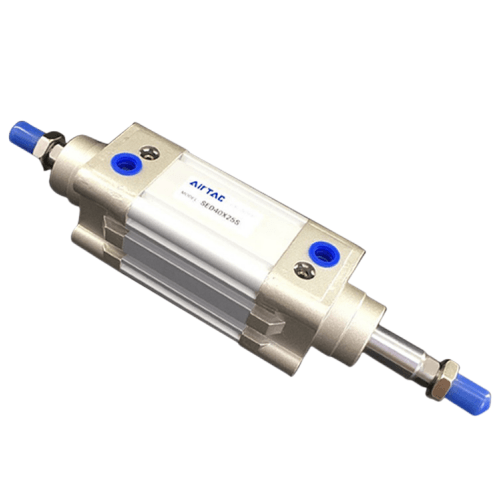
Airtac SED Double Rod Cylinder SED50X30S
The AirTAC SED Double Rod Cylinder SED50X30S is a genuine double-acting ISO 15552 double-rod cylinder: a Ø20mm piston rod exits BOTH ends of the Ø50mm bore, giving equal force and speed in both directions and letting you mount tooling or a sensor flag on the back rod. Stroke 30mm, PT1/4 ports, adjustable cushioning.
- BoreØ50 mm
- Stroke30 mm
- Port sizePT1/4
- ConfigurationDouble rod
- Rod threadM16×1.5
- CushionAdjustable, 30 mm
- No minimum order. A single piece can be ordered.
- Ready in 3–5 business days. That is the time we take to process the order and hand it to the carrier. Transit time after that depends on the destination.
About the Airtac SED Double Rod Cylinder SED50X30S
The AirTAC SED50X30S is a double-acting, double-rod profile cylinder adhering to the ISO 15552 interface. A 20mm rod extends from both end covers, yielding an identical annulus area on each side. This architecture generates 825 N of output force in both extend and retract directions at 0.5 MPa.
Equipped with a magnet (-S), it supports CMSE reed and DMSE electronic sensors for dual-end position tracking. The extruded aluminum barrel lacks external tie rods, and adjustable air cushioning at 30 mm decelerates the load near stroke ends without acting as a mechanical lock.
Airtac SED Double Rod Cylinder SED50X30S Technical Specifications
| Model | Airtac SED Double Rod Cylinder SED50X30S |
|---|---|
| Series | SED ISO 15552 double-rod cylinder |
| Bore size | Ø50 mm |
| Stroke | 30 mm |
| Configuration | Double rod, double acting |
| Port size | PT1/4 |
| Rod thread | M16×1.5 |
| Fluid | Air (filtered by 40µm element) |
|---|---|
| Operating pressure | 0.15 – 1.0 MPa |
| Proof pressure | 1.5 MPa |
| Temperature | -20 to +70 °C (0–150 °C with FKM seals) |
| Speed range | 30 – 800 mm/s |
| Cushion | Adjustable, 30 mm |
| Max stroke | Up to 1200 mm |
Specifications follow the official AirTAC SED datasheet and ISO 15552 / VDMA 24562 dimensions. Confirm against the product label before installation. Port options: PT (standard) / G (BSPP).
Theoretical Output Force (Ø50mm)
| Pressure | Force (both directions) |
|---|---|
| 0.5 MPa | 825 N |
| 0.7 MPa | 1155 N |
| Max (@1.0 MPa) | 168 kgf |
Because a rod exits both ends, the effective piston area — and therefore the force — is identical on extend and retract. Actual usable force is lower than theoretical; size with a safety margin.
Model Code: Airtac SED Double Rod Cylinder SED50X30S
| SED | ISO 15552 profile-barrel DOUBLE-ROD double-acting cylinder. |
|---|---|
| 50 | Bore size in mm. |
| ×30 | Stroke length in mm. |
| -S | Optional built-in magnet for CMSE / DMSE sensor sensing. |
Rod material: carbon steel (blank) / SUS420J2 (A) / SUS304 (B). Seals: TPU (blank) / FKM high-temp (H) / NBR (N). Thread: PT (blank) / G. Mounting (SED): Basic, LB, FA, TC, FTC, TCM1, TCM2. Related: SE (single rod), SEJ (double-rod adjustable stroke), BSED (double-rod rod lock).
Where the Airtac SED Double Rod Cylinder SED50X30S Is Used
Web Guiding Mechanisms
Drives film or foil steering rollers with 825 N of equal bidirectional force, ensuring the rear rod can simultaneously actuate a tension feedback cam.
Shuttle Transfer Units
Moves light packaging components between conveyor lanes, leveraging the twin rods to resist rotational torque during rapid 30mm strokes.
Pick-and-Place Grippers
Actuates small electronic component grippers where the dual-ended design allows a DMSE sensor flag to mount on the opposing rod end.
Is the Airtac SED Double Rod Cylinder SED50X30S the Right Cylinder?
Choose this 50mm bore when an application demands exactly 825 N of symmetrical force within a 30mm stroke. If your payload is lighter, the 40mm bore provides 528 N both ways at 0.5 MPa. For heavier thrust, stepping up to the 63mm bore yields 1402 N both ways. The twin-rod design excels over a single-rod SE cylinder by preventing mechanical rotation and allowing a rear-rod cam to trigger external limits.
As a direct ISO 15552 dimension match, specify the PT1/4 port, M16x1.5 thread, and a mounting subset (Basic, FA, LB, TC, FTC, TCM1, TCM2). Note that a plain SED will drift upon air loss; utilize a BSED variant or external lock for fail-safe holding.
Quick checklist
- ✓ Equal force/speed both directions needed?
- ✓ Back-rod space for tooling or a flag
- ✓ Stroke and mounting space
- ✓ Port/thread type (PT/G)
- ✓ Magnet (-S) for CMSE/DMSE sensors?
Installation & Maintenance Notes
- check Use clean air filtered to 40µm or finer.
- check Keep within 0.15 – 1.0 MPa operating pressure.
- check Support both rod ends; avoid side load.
- check Adjust end cushion screws for smooth stops.
- check Use correct mounting accessory (LB/FA/TC/FTC/TCM1/TCM2).
- check Installation by qualified personnel per AirTAC docs.
Airtac SED Double Rod Cylinder SED50X30S FAQ
Because the double-rod design creates equal annulus areas, it outputs 825 N both ways at 0.5 MPa, 1154 N at 0.7 MPa, and a maximum of 168 kgf at 1.0 MPa.
The twin rods provide superior anti-rotation guidance and allow the rear rod end to drive a secondary mechanism or sensor flag, while maintaining identical force and speed in both directions.
Authorized Export Seller
Genuine AirTAC parts produced by AirTAC factory.
1-Year Warranty
Covers non-human-caused product damage.
Fast Dispatch
Standard models are processed and dispatched in 3-5 business days.
Fast Reply
Most inquiries answered within 7-8 hours.
Related AirTAC SED Cylinders
Request a Quote for Airtac SED Double Rod Cylinder SED50X30S
Send us the quantity and destination. We confirm price, stock and lead time — usually within 7-8 hours.