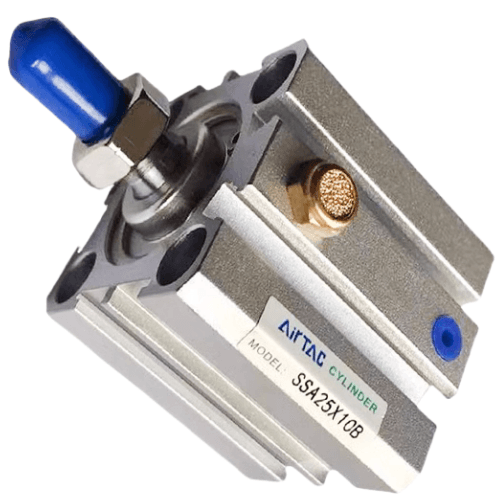
Airtac SSA Single-Acting Compact Cylinder SSA12X10SB
The AirTAC Airtac SSA Single-Acting Compact Cylinder SSA12X10SB is a genuine single-acting COMPACT cylinder (single acting, push type) with a Ø12mm bore and 10mm stroke. Air pushes the rod and an internal spring returns it, so one solenoid line drives the motion — ideal for short-stroke clamping and ejection in tight spaces.
- BoreØ12 mm
- Stroke10 mm
- Port sizeM5×0.8
- Acting typeSingle acting, push type
- Rod threadM3×0.5 (F) / M5×0.8 (B)
- CushionFixed NBR bumper
About the Airtac SSA Single-Acting Compact Cylinder SSA12X10SB
The AirTAC SSA12X10SB is a compact single-acting push-type cylinder where air pressure extends the rod and an internal spring retracts it. It generates about 46.5 N of net push force at 0.5 MPa, meaning the return spring's resistance is already subtracted from the raw air force. This 12 mm bore unit uses a short riveted body to minimize axial mounting depth in crowded machinery.
This specific model includes a built-in piston magnet for AirTAC reed or electronic switches, plus a male M5x0.8 threaded rod end for direct mounting. A fixed NBR bumper handles end-of-stroke deceleration. Because the spring drives the return, the cylinder cannot hold a mid-stroke load without live air pressure.
Airtac SSA Single-Acting Compact Cylinder SSA12X10SB Technical Specifications
| Model | Airtac SSA Single-Acting Compact Cylinder SSA12X10SB |
|---|---|
| Series | SSA compact single-acting cylinder |
| Bore size | Ø12 mm |
| Stroke | 10 mm |
| Acting type | Single acting, push type |
| Port size | M5×0.8 |
| Rod end thread | M3×0.5 female / M5×0.8 male (B) |
| Fluid | Air (filtered by 40µm element) |
|---|---|
| Operating pressure | 0.2 – 1.0 MPa |
| Proof pressure | 1.5 MPa |
| Temperature | -20 to +70 °C |
| Speed range | 50 – 500 mm/s |
| Cushion | Fixed NBR bumper |
| Max standard stroke | Up to 30 mm |
Specifications follow the official AirTAC SDA-family datasheet. Single-acting types start at 0.2 MPa (the spring must be overcome). Confirm against the product label before installation.
Net Output Force (Ø12mm, Push)
| Pressure | Push force (net) |
|---|---|
| 0.5 MPa | 47 N |
| 0.7 MPa | 69 N |
These are NET output forces — the return-spring force is already deducted. Single-acting push only; the spring performs the opposite stroke. Size with a safety margin.
Model Code: Airtac SSA Single-Acting Compact Cylinder SSA12X10SB
| SSA | Compact single acting, push type cylinder series. |
|---|---|
| 12 | Bore size in mm. |
| ×10 | Stroke length in mm (single-acting max 30 mm). |
| S | Built-in magnet for magnetic-switch sensing (omit = none). |
| B | Male-thread piston rod (omit = female thread). |
Thread: PT standard. SSA pushes out / spring returns; STA pulls in / spring extends. Related: SDA (double acting), SDAD (double rod), SDAJ (adjustable stroke).
Where the Airtac SSA Single-Acting Compact Cylinder SSA12X10SB Is Used
Small Part Ejection
Pushes lightweight molded components out of a machining fixture using its 46.5 N net force at 0.5 MPa.
Thin-Wall Clamping
Secures delicate sheet metal during a stamping process, relying on the spring to release the part safely.
Lab Dispenser Actuation
Moves a micro-valve or syringe plunger for precise fluid dispensing where axial mounting depth is severely restricted.
Is the Airtac SSA Single-Acting Compact Cylinder SSA12X10SB the Right Cylinder?
When sizing this 12 mm bore model, consider the neighboring SSA16, which raises the net push to 80.5 N at 0.5 MPa if your application requires more force. The SSA12X10SB itself provides a safe working load of roughly 28 N, or a vertical lift capacity of about 2.4 kg with a 2:1 safety margin. Operating pressure must be at least 0.2 MPa to overcome the internal spring, up to a maximum of 1.0 MPa.
This configuration features a 10 mm stroke, an M5x0.8 air port, and the -B option male M5x0.8 rod thread. The -S magnet code confirms compatibility with position sensing. Standard single-acting strokes are capped at 30 mm; exceeding this requires a non-standard configuration.
Quick checklist
- ✓ Net push force at your working pressure
- ✓ Stroke ≤ 30 mm (single-acting limit)
- ✓ Single air line saves a valve/port
- ✓ Magnet (S) for sensors?
- ✓ Female (blank) or male (B) rod thread
Installation & Maintenance Notes
- check Use clean air filtered to 40µm or finer.
- check Keep within 0.2 – 1.0 MPa operating pressure.
- check Remember the spring performs the return stroke.
- check Avoid side load on the short piston rod.
- check Front/rear covers are riveted — do not dismantle.
- check Installation by qualified personnel per AirTAC docs.
Airtac SSA Single-Acting Compact Cylinder SSA12X10SB FAQ
The net push force is 46.5 N at 0.5 MPa and 69.2 N at 0.7 MPa. These figures already account for the internal return spring resistance, giving you the actual usable output force.
Air pressure extends the rod, while an internal spring retracts it when air is released. You must supply at least 0.2 MPa of operating pressure to overcome the spring, and the cylinder will not hold a mid-stroke load without live air pressure.
Authorized Export Seller
Genuine AirTAC parts produced by AirTAC factory.
1-Year Warranty
Covers non-human-caused product damage.
Fast Dispatch
Standard models usually ship in 3-4 days.
Fast Reply
Most inquiries answered within 7-8 hours.
Related AirTAC SSA Cylinders
Request a Quote for Airtac SSA Single-Acting Compact Cylinder SSA12X10SB
Send us the quantity and destination. We confirm price, stock and lead time — usually within 7-8 hours.