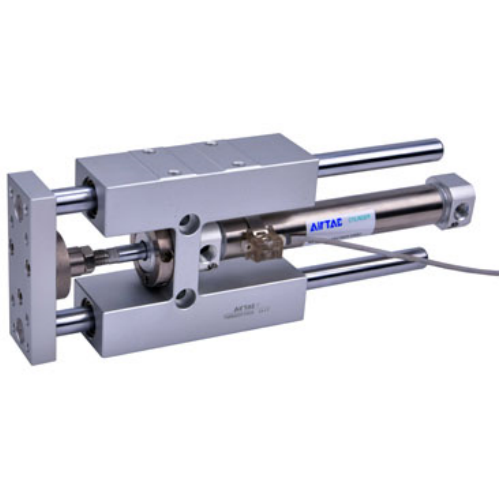
Airtac TMIC Guided Cylinder with Guide Unit TMICL16X75S
The AirTAC Airtac TMIC Guided Cylinder with Guide Unit TMICL16X75S is a genuine guide-frame (guided) pneumatic cylinder — a Ø16mm double-acting MI mini cylinder built into a twin-rod guide unit running on linear bearings. The guide frame absorbs side load and torque so the 75mm stroke stays true, giving you a ready-to-mount linear slide without a separate guide.
- BoreØ16 mm
- Stroke75 mm
- Port sizeM5×0.8
- BearingLinear bearing
- Acting typeDouble acting
- CushionVariable air cushion, both ends
About the Airtac TMIC Guided Cylinder with Guide Unit TMICL16X75S
Built around an MIC mini cylinder housed in a twin-rod aluminium guide frame, this double-acting TMICL16X75S slide runs on linear bearings for low-friction, high-precision travel. A needle-set variable air cushion at both ends absorbs high-speed shock, ensuring smooth and quiet deceleration without acting as a physical lock. Because the -S suffix denotes a built-in magnet, the unit is immediately ready for CMSG, DMSG or EMSG position sensing.
In the 16 mm bore class, the M5x0.8 ported cylinder generates 100.5 N push and 86.4 N pull at 0.5 MPa. For reliable vertical push-up moves, figure on a safe working thrust of roughly 60 N, or about 5.1 kg of lifting capacity with a 2:1 safety margin. Remember that the guide frame's actual carrying capacity depends on the load-offset distance, so always verify the allowable load against the maximum-load curves rather than relying on thrust alone.
Airtac TMIC Guided Cylinder with Guide Unit TMICL16X75S Technical Specifications
| Model | Airtac TMIC Guided Cylinder with Guide Unit TMICL16X75S |
|---|---|
| Series | TMIC guide-frame cylinder |
| Bore size | Ø16 mm |
| Stroke | 75 mm |
| Bearing type | Linear bearing (low friction, high precision) |
| Guide | Twin-rod guide frame, double-rod unit |
| Port size | M5×0.8 |
| Acting type | Double acting |
|---|---|
| Fluid | Air (filtered by 40µm element) |
| Operating pressure | 0.15 – 1.0 MPa |
| Proof pressure | 1.5 MPa |
| Temperature | -20 to +70 °C |
| Speed range | 30 – 500 mm/s |
| Cushion | Variable air cushion, both ends |
| Max standard stroke | Up to 200 mm |
Specifications follow the official AirTAC TMI/TMIC datasheet. Guide frame & fixed plate: aluminum alloy; matching cylinder: MI/MIC round-body mini cylinder. Allowable load depends on the load-offset distance — consult the TMI/TMIC maximum-load curves before final selection. Thread options: PT (blank) / G.
Theoretical Output Force (Ø16mm)
| Pressure | Push force | Pull force |
|---|---|---|
| 0.5 MPa | 101 N | 86 N |
| 0.7 MPa | 141 N | 121 N |
| Max (@1.0 MPa) | 21 kgf | |
Thrust equals the underlying MI cylinder. The usable load a guide frame can carry is limited by the load-offset curve, not by thrust alone — always check both. Actual force is lower than theoretical due to friction and back-pressure.
Model Code: Airtac TMIC Guided Cylinder with Guide Unit TMICL16X75S
| TMIC | Guide-frame cylinder with variable air cushion. |
|---|---|
| L | Linear bearing — low friction, high precision, best for push-up / high-load. |
| 16 | Bore size in mm. |
| ×75 | Stroke length in mm. |
| -S | Optional built-in magnet for CMSG / DMSG / EMSG sensors. |
TMI/TMIC family: TMI (bumper) / TMIC (cushion), bearing M (brass) / L (linear). Order the guide frame separately as F-TMICL16X75 when needed.
Where the Airtac TMIC Guided Cylinder with Guide Unit TMICL16X75S Is Used
Precision Vertical Lift
Leveraging the low-friction linear bearings, this cylinder provides accurate vertical push-up for small components, safely lifting around 5.1 kg within a 2:1 safety margin at 0.5 MPa.
High-Speed Part Transfer
The needle-set variable air cushion soaks up end-of-stroke shock during rapid 75 mm transfers, ensuring quiet, square stops without jarring the twin-rod guide frame.
Sensored Pick & Place
With the built-in -S magnet, CMSG or DMSG switches confirm mid-stroke positions for exact timing during automated electronic component handling tasks.
Is the Airtac TMIC Guided Cylinder with Guide Unit TMICL16X75S the Right Cylinder?
When sizing this 16 mm bore unit, compare it directly against its siblings: step down to a bumper-only TMIL if shock absorption is unnecessary, or move up to the brass-bearing TMICM if your application demands higher torsional stiffness over low-friction precision. The linear bearings here make this specific model the superior choice for smooth, accurate vertical push-up moves. At 0.5 MPa it yields 100.5 N of push force, whereas the next size up, the 20 mm bore, offers 157.0 N.
The variable air cushion is essential for high-speed strokes within the 30-500 mm/s guided range, preventing end-of-stroke impact. Always cross-reference your payload against the load-offset curve, as thrust does not dictate the frame's load limit. Note that while the -S magnet supports sensors, the frame does not hold position on air loss; add an external rod lock or pilot check valve if you need true load holding.
Quick checklist
- ✓ Required thrust at your working pressure
- ✓ Load and offset within the load curve
- ✓ Bearing: brass (torque) vs linear (precision)
- ✓ Stroke and mounting space
- ✓ Magnet (-S) for sensors?
Installation & Maintenance Notes
- check Use clean air filtered to 40µm or finer.
- check Keep within 0.15 – 1.0 MPa operating pressure.
- check Keep the load within the load-offset curve.
- check Mount on a flat, rigid surface using the fixed plate.
- check Do not exceed the rated speed (30-500 mm/s).
- check Installation by qualified personnel per AirTAC docs.
Airtac TMIC Guided Cylinder with Guide Unit TMICL16X75S FAQ
At 0.5 MPa it provides 100.5 N push and 86.4 N pull, increasing to 140.7 N push and 120.9 N pull at 0.7 MPa, with a theoretical maximum of 20.5 kgf at 1.0 MPa. Thrust is not the guided-load limit, however; the actual payload capacity depends entirely on the load-offset distance and must be verified using the TMI/TMIC maximum-load curves.
The linear bearings provide high precision and low friction, making the unit ideal for vertical push-up moves. The variable air cushion at both ends only decelerates the piston near stroke end to absorb shock; it is not a brake. On air loss the piston drifts, so for true load holding you must fit an external rod lock or pilot check valve. The -S magnet enables CMSG, DMSG and EMSG sensors.
Authorized Export Seller
Genuine AirTAC parts produced by AirTAC factory.
1-Year Warranty
Covers non-human-caused product damage.
Fast Dispatch
Standard models usually ship in 3-4 days.
Fast Reply
Most inquiries answered within 7-8 hours.
Related AirTAC TMIC Guide-Frame Cylinders
Request a Quote for Airtac TMIC Guided Cylinder with Guide Unit TMICL16X75S
Send us the quantity and destination. We confirm price, stock and lead time — usually within 7-8 hours.