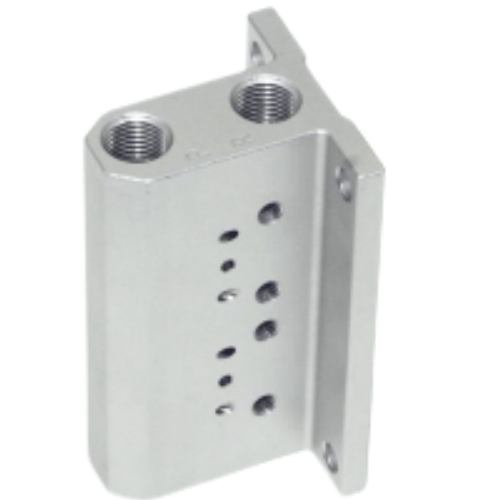
Airtac 3V2M-F Base 3V2M17F
The AirTAC Airtac 3V2M-F Base 3V2M17F is a genuine 3V2M manifold base for 17 stations on one shared air supply. A base is a machined block: it carries no coil and no solenoid, so the valves that sit on it are ordered separately.
- Valve type3/2-way (3-port, 2-position)
- Port size1/8 in
- Stations17
- Flow (Cv)0.1
- Series3V2M
About the Airtac 3V2M-F Base 3V2M17F
The 3V2M17F carries seventeen 3V2M 3/2 valves on a single machined block, and the count matters for your electrical side. On DC24V coils, seventeen stations all energised at once draw about 119 W, roughly 5 A at 24 V - size the power supply for that worst case, not for the average duty.
Electrically the base is inert; voltage, initial state and entry type belong to the valves you order separately. Air-side, one supply feeds all seventeen positions and one centralised exhaust vents them. PT is the standard base thread, with G and NPT offered as order options.
Airtac 3V2M-F Base 3V2M17F Technical Specifications
| Model | Airtac 3V2M-F Base 3V2M17F |
|---|---|
| Series | 3V2M |
| Item form | Manifold base (no coil, no solenoid, no initial state) |
| Stations | 17 |
| Exhaust | Centralised exhaust |
| Port size | 1/8 in |
| Thread | PT |
| Operating pressure | 0-0.8 MPa (0-114 psi) |
|---|---|
| Vacuum service | Not rated for vacuum |
| Flow coefficient | Cv 0.1 |
| Temperature | -20 to 70 C |
| Construction | Coaxial shut-off (poppet), base-mounted, spring return |
| Medium | Air, filtered by a 40 µm or finer element. Lubrication not required. |
Figures follow the official AirTAC 3V2M catalogue. Confirm coil voltage and thread (PT / NPT / G) against the product label before wiring.
Model Code: Airtac 3V2M-F Base 3V2M17F
| 3V2M | Body — sets the flow, the coil power and whether vacuum is rated. |
|---|---|
| 1/8 in | Port size. M5, 06 = 1/8 in, 08 = 1/4 in, 10 = 3/8 in. |
| 17F | 17 stations in one assembly, centralised exhaust. |
| PT | Port thread. PT ships from stock; G and NPT are available to order. |
What a 3/2 Valve Does
A 3/2 valve has three ports — supply, outlet and exhaust — and two states. It either feeds the outlet or vents it to exhaust, and that is the whole job.
That makes it the right valve for a single-acting (spring-return) cylinder, on/off air blow, a clamp, switching a vacuum generator or suction cup, and piloting a larger valve.
It cannot run a double-acting cylinder. A double-acting cylinder needs air alternately on two sides, which takes a 5-port valve — the AirTAC 4V series.
Where the Airtac 3V2M-F Base 3V2M17F Is Used
Machining-centre pallet clamps
Seventeen clamp points around an HMC pallet hold the fixture down, every clamp fed from its own valve position on the common manifold.
Case palletiser gripper fingers
Gripper fingers on an end-of-line palletiser act one at a time from seventeen valve stations sharing a single air drop.
Analytical sample-prep deck
Seventeen reagent lines on a laboratory autosampler open and vent through individual valve positions wired from one terminal strip.
Is the Airtac 3V2M-F Base 3V2M17F the Right Part?
Plan the bank around five choices: this base fixes the count at seventeen stations and the exhaust at centralised; the thread is PT as standard (G or NPT to order); then pick each valve's NC or NO state, coil voltage and DIN or flying-lead entry. The NC/NO state must be right at purchase - it cannot be converted afterwards.
Each station flows at Cv 0.1 through the manifold. Step up to a standalone 3V2 (Cv 0.18 at 1/8 inch) or 3V3 (Cv 0.62 at 1/4 inch; both vacuum-rated) where one circuit needs more, or drop to 3V1 at 3.0 W DC where the duty is small. For a double-acting cylinder, use the AirTAC 4V series instead of any 3/2 valve.
Confirm before you order
- ✓ Port size and thread (PT from stock; G / NPT to order)
- ✓ Initial state — NC or NO, ordered up front
- ✓ Coil voltage matches your controller output
- ✓ Electrical entry — DIN plug or flying lead
- ✓ Single valve, bare base, or complete assembly
- ✓ Single-acting duty, not double-acting
Installation & Wiring Notes
- check Use clean air filtered to 40µm or finer.
- check Stay within 0-0.8 MPa (0-114 psi) operating pressure.
- check Use the manual override to test before powering up.
- check Leave the exhaust port clear, or fit a silencer.
- check Blank any unused station on the base before pressurising.
- check Wiring by qualified personnel, per AirTAC documentation.
Airtac 3V2M-F Base 3V2M17F FAQ
With DC24V 3V2M coils at 7.0 W each, seventeen stations energised together total about 119 W, near 5 A at 24 V. AC coils draw 7 VA each. Other key figures: Cv 0.1 per valve, 0-0.8 MPa (0-114 psi) pressure, -20 to 70 C, 40 um filtration, PT1/8 ports, PT base thread standard.
The 3V2M system lets stations combine and expand freely, and NC and NO valves can be mixed on one base, but this block is machined for seventeen positions - growth beyond that needs another base. The state of each valve is fixed at ordering and cannot be changed in service.
Authorized Export Seller
Genuine AirTAC parts produced by the AirTAC factory.
1-Year Warranty
Covers non-human-caused product damage.
Fast Dispatch
Standard models usually ship in 3-4 days.
Fast Reply
Most inquiries answered within 7-8 hours.
Request a Quote for Airtac 3V2M-F Base 3V2M17F
Send us the quantity and destination. We confirm price, stock and lead time — usually within 7-8 hours.