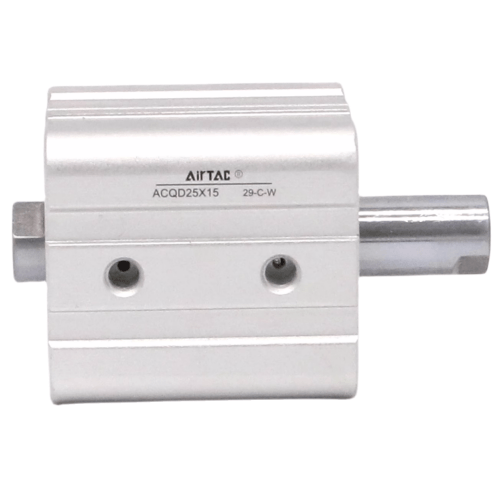
Airtac ACQD Double Acting Compact Cylinder ACQD63X150
The AirTAC Airtac ACQD Double Acting Compact Cylinder ACQD63X150 is a genuine double-acting COMPACT (JIS) cylinder with a piston rod out BOTH ends — a Ø63mm bore and 150mm stroke. The twin rods resist rotation and give equal push and pull force, so it carries and guides a tool platform without a separate anti-rotation guide.
- BoreØ63 mm
- Stroke150 mm
- Port sizePT1/4
- Acting typeDouble acting, double rod
- Rod threadM10×1.5 (F) / M18×1.5 (B)
- CushionBumper (both ends)
About the Airtac ACQD Double Acting Compact Cylinder ACQD63X150
The ACQD63X150 is a double-acting JIS compact cylinder featuring a 63mm bore and a 150mm stroke. Because twin rods exit both ends, the annular piston area is identical in each direction, yielding exactly 1401.5 N of force at 0.5 MPa for both extension and retraction. This symmetry is ideal for cycles demanding balanced push and pull energy.
This 150mm unit is a made-to-order long-stroke variant, exceeding the 100mm standard maximum for this bore size. It incorporates NBR elastomer bumpers fixed at both ends for end-of-stroke deceleration rather than adjustable air cushions. The Ø20mm rods provide extended guide length for tool platforms, while the PT1/4 porting handles the required pneumatic flow.
Airtac ACQD Double Acting Compact Cylinder ACQD63X150 Technical Specifications
| Model | Airtac ACQD Double Acting Compact Cylinder ACQD63X150 |
|---|---|
| Series | ACQD JIS compact double-rod cylinder |
| Bore size | Ø63 mm |
| Stroke | 150 mm |
| Acting type | Double acting, double rod |
| Port size | PT1/4 |
| Rod end thread | M10×1.5 female / M18×1.5 male (B) |
| Fluid | Air (filtered by 40µm element) |
|---|---|
| Operating pressure | 0.15 – 1.0 MPa |
| Proof pressure | 1.5 MPa |
| Temperature | -20 to +70 °C |
| Speed range | 30 – 500 mm/s |
| Cushion | Bumper (both ends) |
| Max standard stroke | Up to 100 mm |
Specifications follow the official AirTAC ACQD datasheet. A rod exits both ends, so both directions use the same annular area. Confirm against the product label before installation.
Theoretical Output Force (Ø63mm — equal both ways)
| Pressure | Push force | Pull force |
|---|---|---|
| 0.5 MPa | 1402 N | 1402 N |
| 0.7 MPa | 1962 N | 1962 N |
| Max (@1.0 MPa) | 286 kgf | |
Because a rod occupies both chambers, push and pull forces are EQUAL — the annular area applies in each direction. Actual usable force is lower due to friction; size with a safety margin.
Model Code: Airtac ACQD Double Acting Compact Cylinder ACQD63X150
| ACQD | JIS compact double-acting DOUBLE-ROD cylinder series. |
|---|---|
| 63 | Bore size in mm. |
| ×150 | Stroke length in mm. |
| S | Built-in magnet for magnetic-switch sensing (omit = none). |
| B | Male-thread piston rod (omit = female thread). |
Thread: PT standard (G / NPT available). The twin rods resist rotation and add guiding length. Related: ACQ (single rod), ACQJ (adjustable stroke), TACQ (guided).
Where the Airtac ACQD Double Acting Compact Cylinder ACQD63X150 Is Used
Symmetric Transfer Arms
Drives dual-sided pick-and-place arms in packaging machinery where equal push and pull forces prevent uneven wear on gripper joints.
Twin-Guided Pushers
Moves heavy pallets on a conveyor line without twisting, utilizing the inherent anti-rotation properties of the two protruding rods.
Dual-Station Actuation
Actuates two separate test fixtures simultaneously from a single body, using the second rod end to drive a secondary mechanism.
Is the Airtac ACQD Double Acting Compact Cylinder ACQD63X150 the Right Cylinder?
Selecting this 63mm bore provides 1962.2 N at 0.7 MPa; sizing down to a 50mm bore yields 824.6 N at 0.5 MPa, while sizing up to an 80mm bore provides 2267.8 N. If your assembly only needs one-sided actuation, a single-rod ACQ fits better. For heavy lateral loads, a guided TACQ offers extra support. When ordering, confirm the 150mm non-standard stroke, the default female M10x1.5 rod-end thread, and note this unit lacks a sensor magnet.
Quick checklist
- ✓ Equal force both ways at your pressure
- ✓ Anti-rotation needed (twin rods)?
- ✓ Both rod ends usable for tooling?
- ✓ Magnet (S) for sensors?
- ✓ Female (blank) or male (B) rod thread
Installation & Maintenance Notes
- check Use clean air filtered to 40µm or finer.
- check Keep within 0.15 – 1.0 MPa operating pressure.
- check Both rods share the load — keep force concentric.
- check Twin rods resist rotation but avoid heavy side load.
- check Handle the C-clip carefully; seat it fully in its groove.
- check Installation by qualified personnel per AirTAC docs.
Airtac ACQD Double Acting Compact Cylinder ACQD63X150 FAQ
This cylinder provides an equal push and pull force of 1401.5 N at 0.5 MPa and 1962.2 N at 0.7 MPa, with a maximum of 286 kgf at 1.0 MPa. The 150mm stroke is a non-standard long-stroke variant exceeding the 100mm standard maximum for a 63mm bore.
No, a plain ACQD does not hold position on air loss; the rod drifts and the fixed NBR bumper only decelerates near stroke end. For fail-safe load holding, an external rod lock or pilot-operated check valve is required.
Authorized Export Seller
Genuine AirTAC parts produced by AirTAC factory.
1-Year Warranty
Covers non-human-caused product damage.
Fast Dispatch
Standard models usually ship in 3-4 days.
Fast Reply
Most inquiries answered within 7-8 hours.
Related AirTAC ACQD Compact Cylinders
Request a Quote for Airtac ACQD Double Acting Compact Cylinder ACQD63X150
Send us the quantity and destination. We confirm price, stock and lead time — usually within 7-8 hours.