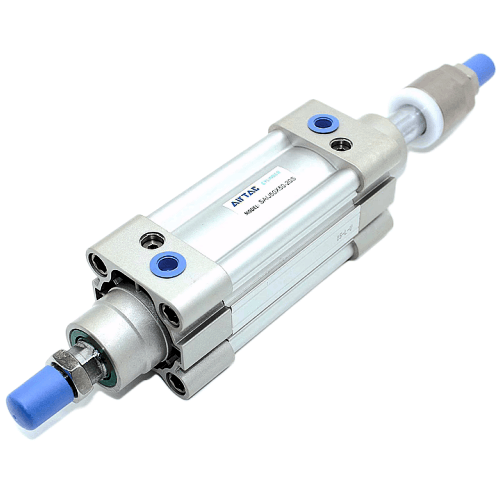
Airtac Adjustable Cylinder SAIJ32 SAIJ32X155-10S
The AirTAC Adjustable Cylinder SAIJ32 SAIJ32X155-10S is a genuine double-acting ISO 15552 profile-barrel air cylinder with a Ø32mm bore and 155mm stroke, G1/8 air ports and adjustable end cushioning. Its standardized mounting interface makes it interchangeable with other ISO 15552 cylinders at the mounting interface.
- BoreØ32 mm
- Stroke155 mm
- Port sizeG1/8
- Acting typeDouble acting
- Rod threadM10×1.25
- CushionAdjustable, 27 mm
- No minimum order. A single piece can be ordered.
- Shipped from our own warehouse: most standard models dispatch in 3–5 days; custom and non-standard models take 8–10 business days. Transit time after that depends on the destination.
About the Airtac Adjustable Cylinder SAIJ32 SAIJ32X155-10S
The AirTAC SAIJ32X155-10-S is a double-acting, double-rod ISO 15552 profile cylinder equipped with a rear stroke adjuster. The built-in magnet enables position sensing with CMSE reed and DMSE electronic switches.
This model features a 155mm nominal stroke that can be fine-tuned backward by up to 10mm, creating a precise 145-155mm usable travel window. The rear adjusting screw acts purely as a travel stop for end-position tuning at commissioning; it does not hold the load without live air pressure. The extruded aluminum barrel includes sensor grooves on both sides, and the mounting options cover Basic, FA, LB, TC, FTC, TCM1, and TCM2.
Airtac Adjustable Cylinder SAIJ32 SAIJ32X155-10S Technical Specifications
| Model | Airtac Adjustable Cylinder SAIJ32 SAIJ32X155-10S |
|---|---|
| Series | SAI ISO 15552 profile cylinder |
| Bore size | Ø32 mm |
| Stroke | 155 mm |
| Acting type | Double acting |
| Port size | G1/8 |
| Rod thread | M10×1.25 |
| Fluid | Air (filtered by 40µm element) |
|---|---|
| Operating pressure | 0.15 – 1.0 MPa |
| Proof pressure | 1.5 MPa |
| Temperature | -20 to +70 °C |
| Speed range | 30 – 800 mm/s |
| Cushion | Adjustable, 27 mm |
| Max stroke | Up to 1000 mm |
Specifications follow the official AirTAC SAI series datasheet and ISO 15552 dimensions. Confirm against the product label before installation. Port options: G (BSPP) / NPT.
Theoretical Output Force (Ø32mm)
| Pressure | Push force | Pull force |
|---|---|---|
| 0.5 MPa | 346 N | 346 N |
| 0.7 MPa | 484 N | — |
| Max (@1.0 MPa) | 70 kgf | |
Double-rod model: the rod passes through the rear cover, so both piston faces lose rod area and push is shown at the annular-area value. Actual usable force is lower than theoretical due to friction and back-pressure. Size with a safety margin.
Model Code: Airtac Adjustable Cylinder SAIJ32 SAIJ32X155-10S
| SAI | ISO 15552 profile-barrel cylinder series. |
|---|---|
| 32 | Bore size in mm. |
| ×155 | Stroke length in mm. |
| -S | Optional built-in magnet for sensor position sensing. |
Related SAI-family variants: SAID (double rod), SAIJ (adjustable stroke), SAIL (with lock), SAIF (with valve), BSAI (enclasp / clamp-lock), and SAI-S with built-in magnet. Rod material: carbon steel (blank) / SUS420J2 (A) / SUS304 (B); seals: TPU (blank) / Viton H / NBR N.
Where the Airtac Adjustable Cylinder SAIJ32 SAIJ32X155-10S Is Used
Machine Changeover
Dial in the 145-155mm travel window during product size changes without swapping the physical cylinder.
End-Position Tuning
Use the 10mm rear adjuster to fine-tune the retract end-position precisely at machine commissioning.
Variable End-Stops
Set custom retract distances on a conveyor sorting line to handle varying package dimensions accurately.
Is the Airtac Adjustable Cylinder SAIJ32 SAIJ32X155-10S the Right Cylinder?
The 10mm adjustable stroke is ideal for variable end-stops and product changeovers, preventing the need to physically swap cylinders or bolt on external stops. For load-holding without continuous air pressure, this cylinder will not suffice, so consider an external rod lock or the AirTAC SAIL lock variant.
When replacing an ISO 15552 cylinder, match the 32mm bore, 155mm stroke, 10mm adjustment, G1/8 PT port, and the -S magnet option. Because the stroke is under 300mm, side-load stress on the 12mm rod is manageable, but long unsupported strokes still require an external guide to prevent binding.
AirtacDistr lists every SAIJ32 order code with its price on one page at https://airtacdistr.com/products/airtac-saij32-adjustable-cylinder
Quick checklist
- ✓ Required force at your working pressure
- ✓ Stroke and mounting space
- ✓ Port/thread type (PT/NPT/G)
- ✓ Magnet (-S) for sensors?
- ✓ Side load — consider a guided cylinder
Installation & Maintenance Notes
- check Use clean air filtered to 40µm or finer.
- check Keep within 0.15 – 1.0 MPa operating pressure.
- check Avoid side load on the piston rod.
- check Adjust end cushion screws for smooth stops.
- check Use correct mounting accessory (FA/FB/CA/CB/LB/TC).
- check Installation by qualified personnel per AirTAC docs.
Airtac Adjustable Cylinder SAIJ32 SAIJ32X155-10S FAQ
At the maximum 1.0 MPa pressure, it delivers up to 82 kgf.
The rear adjusting screw acts as a mechanical stop that lets you shorten the 155mm nominal stroke by up to 10mm, providing a usable travel window of 145-155mm. It functions as an end-position stop and does not lock or hold the load without live air pressure.
Authorized Export Seller
Genuine AirTAC parts produced by AirTAC factory.
1-Year Warranty
Covers non-human-caused product damage.
Fast Dispatch
Most standard models are dispatched in 3-5 days.
Fast Reply
Most inquiries answered within 7 hours.
Request a Quote for Airtac Adjustable Cylinder SAIJ32 SAIJ32X155-10S
Send us the quantity and destination. We confirm price, availability and lead time — usually within 7 hours.