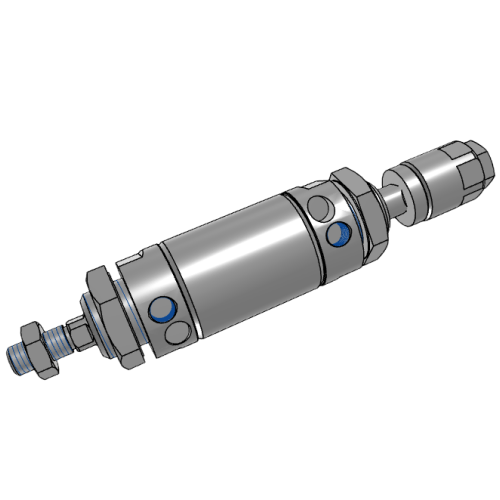
Airtac MBLCJ Adjustable Mini Cylinder MBLCJ20X75-75
The AirTAC Airtac MBLCJ Adjustable Mini Cylinder MBLCJ20X75-75 is a genuine double-acting aluminum-barrel mini cylinder with a Ø20mm bore, a 75mm nominal stroke and a rear adjustable-stroke stopper — trim up to 75mm for a usable window of 0–75mm. Adjustable air cushion (both ends).
- BoreØ20 mm
- Stroke75 mm
- Adjustable0–75 mm
- Port sizeG1/8
- Acting typeDouble acting
- Rod threadM8×1.25
- CushionAdjustable air cushion (both ends)
About the Airtac MBLCJ Adjustable Mini Cylinder MBLCJ20X75-75
The AirTAC MBLCJ20X75-75 is a compact double-acting aluminum mini cylinder featuring a rear travel stopper that yields a usable 0-75mm stroke window. It integrates a screw-tunable adjustable air cushion at both ends to decelerate payloads, protecting the end covers better than a fixed rubber bumper. Delivering 157N of push force and 132N of pull force at 0.5 MPa, it suits light-duty positioning. The G1/8 port and M8x1.25 rod end thread are set by the 20mm bore.
This SKU lacks a built-in magnet, meaning it cannot accept CMSG, DMSG, or EMSG position sensors. The rear adjuster sets the travel end but does not hold the load, as the cushion only decelerates and the rod drifts without live air. The riveted rolling-packed barrel and 20um hard-chrome plated carbon-steel rod provide durable sealing via a grease-retaining piston seal. Overall length equals A plus 2 times stroke plus the 75mm adjustment.
Airtac MBLCJ Adjustable Mini Cylinder MBLCJ20X75-75 Technical Specifications
| Model | Airtac MBLCJ Adjustable Mini Cylinder MBLCJ20X75-75 |
|---|---|
| Series | MBL aluminum-barrel mini round cylinder (adjustable stroke) |
| Bore size | Ø20 mm |
| Nominal stroke | 75 mm |
| Adjustable window | 0–75 mm (trim 75 mm) |
| Acting type | Double acting |
| Port size | G1/8 |
| Rod thread | M8×1.25 |
| Fluid | Air (filtered by 40µm element) |
|---|---|
| Operating pressure | 0.15 – 1.0 MPa |
| Proof pressure | 1.5 MPa |
| Temperature | -20 to +70 °C |
| Speed range | 30 – 800 mm/s |
| Cushion | Adjustable air cushion (both ends) |
| Max standard stroke | Up to 300 mm |
The rear stopper sets the end position — it is a travel stop, not a lock. Overall length = A + 2 × stroke + adjustable stroke. MBLJ/MBLCJ mounting is Basic / FA / LB only (no SDB, no back-cover code). Thread options: PT / G / NPT.
Theoretical Output Force (Ø20mm)
| Pressure | Push force | Pull force |
|---|---|---|
| 0.5 MPa | 157 N | 132 N |
| 0.7 MPa | 220 N | — |
| Max (@1.0 MPa) | 32 kgf | |
Actual usable force is lower than theoretical due to friction and back-pressure. Size with a margin.
Model Code: Airtac MBLCJ Adjustable Mini Cylinder MBLCJ20X75-75
| MBLCJ | MBLCJ aluminum-barrel adjustable-stroke mini cylinder with adjustable cushion. |
|---|---|
| 20 | Bore size in mm. |
| ×75 | Nominal stroke length in mm. |
| -75 | Adjustable-stroke amount (mm you can trim at the rear). |
| S | Optional built-in magnet for a CMSG/DMSG/EMSG sensor switch. |
Related: MBLJ (adjustable stroke, fixed bumper), MBL (fixed stroke), MBLD (double rod).
Where the Airtac MBLCJ Adjustable Mini Cylinder MBLCJ20X75-75 Is Used
PCB Depaneling Router
Provides 157N of push to separate routed circuit boards, using the 0-75mm stroke window to dial the exact cut depth.
Micro-Dispense Valve Actuation
Tunable air cushions soften the end-of-stroke impact on precision adhesive valves, preventing fluid splashing.
Light-Part Push-off Station
Ejects small molded silicone parts from a fixture, relying on the 132N pull force for a safe retraction.
Is the Airtac MBLCJ Adjustable Mini Cylinder MBLCJ20X75-75 the Right Cylinder?
If you need less force, no smaller bore exists in this series, but stepping up to the 25mm bore yields 245N push at 0.5 MPa. Compare this MBLCJ to the MBLJ if you prefer a fixed bumper over the tunable cushion, or the MBLC if your 75mm stroke is fixed. The rear stopper trims travel but is not a lock; use an external guide for side loads. Mounting is limited to Basic, FA, or LB with no SDB or back-cover options. For exact replacements, match the 20mm bore, 75mm stroke, 75mm adjust code, G1/8 PT thread, and no magnet.
Quick checklist
- ✓ Required force at your working pressure
- ✓ Adjustable window fits your end position
- ✓ Adjuster is a travel stop, not a lock
- ✓ Magnet (S) for sensors?
- ✓ Side load — add a guide on long strokes
Installation & Maintenance Notes
- check Use clean air filtered to 40µm or finer.
- check Keep within 0.15 – 1.0 MPa operating pressure.
- check Set the rear stopper for the end position (a travel stop, not a lock).
- check Avoid side load; add an external guide on long strokes.
- check Mounting: Basic / FA flange / LB foot (no SDB, no back-cover code).
- check Installation by qualified personnel per AirTAC docs.
Airtac MBLCJ Adjustable Mini Cylinder MBLCJ20X75-75 FAQ
At 0.5 MPa, this 20mm bore cylinder provides 157N push and 132N pull. At 0.7 MPa, push increases to 220N. The theoretical maximum is 32 kgf at 1.0 MPa.
No. Because this model lacks the -S code for a built-in magnet, it cannot accept AirTAC CMSG, DMSG, or EMSG position sensors. You would need the MBLCJ20X75-75S variant for sensor detection.
Authorized Export Seller
Genuine AirTAC parts produced by AirTAC factory.
1-Year Warranty
Covers non-human-caused product damage.
Fast Dispatch
Standard models usually ship in 3-4 days.
Fast Reply
Most inquiries answered within 7-8 hours.
Related AirTAC Adjustable-Stroke Cylinders
Request a Quote for Airtac MBLCJ Adjustable Mini Cylinder MBLCJ20X75-75
Send us the quantity and destination. We confirm price, stock and lead time — usually within 7-8 hours.