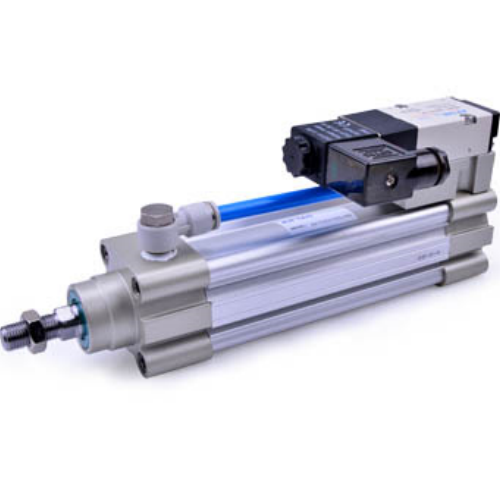
Airtac SAIF Series Standard Cylinder with Valve SAIF32X225S-06B
The AirTAC Airtac SAIF Series Standard Cylinder with Valve SAIF32X225S-06B is a genuine double-acting ISO 15552 cylinder with a Ø32mm bore, 225mm stroke and a built-in 4M210-06 5/2 solenoid valve — it switches itself from one coil signal, so no separate remote valve or extra plumbing is needed.
- BoreØ32 mm
- Stroke225 mm
- Built-in valve4M210-06
- Valve port1/8"
- CoilDC24V
- EntryTerminal
About the Airtac SAIF Series Standard Cylinder with Valve SAIF32X225S-06B
The AirTAC SAIF32X225S-06B is a double-acting profile cylinder with a built-in 4M210-06 5/2 solenoid valve, delivering a Cv of 0.78. Driven by a DC24V terminal entry coil consuming 3.0 W, it activates in 0.05 s with an IP65 rating. Because the cylinder body rates to 1.0 MPa but the integrated valve operates at 0.15-0.8 MPa, the practical working range for this assembled unit is 0.15-0.8 MPa. It generates 402 N of push force at 0.5 MPa.
This decentralized unit eliminates the need for a separate remote valve, reducing panel space and plumbing. The manifold connects the valve to the cylinder using O8 x O5 PU tubing, and the valve port (1/8) differs from the cylinder port (1/8). Factory set to retract the rod when the coil is energised, it can be reconfigured to extend-when-energised by repositioning the valve. The -S magnet works with CMSE reed and DMSE electronic sensors.
Airtac SAIF Series Standard Cylinder with Valve SAIF32X225S-06B Technical Specifications
| Model | Airtac SAIF Series Standard Cylinder with Valve SAIF32X225S-06B |
|---|---|
| Series | SAIF ISO 15552 cylinder with valve |
| Bore size | Ø32 mm |
| Stroke | 225 mm |
| Acting type | Double acting, self-valved |
| Cylinder port | G1/8 |
| Rod thread | M10×1.25 |
| PU tube | Ø8 × Ø5 |
| Built-in valve | 4M210-06 (5/2) |
|---|---|
| Valve flow | 14.0 mm² (Cv 0.78) |
| Max frequency | 5 cycle/sec |
| Coil voltage | DC24V · DC 3.0 W |
| Electrical entry | Terminal · IP65 · B class |
| Response time | 0.05 s and below |
| Operating pressure | 0.15 – 0.8 MPa (valve limit) |
| Speed range | 30 – 800 mm/s |
The cylinder rates to 1.0 MPa but the built-in valve operates 0.15–0.8 MPa, so run the assembled SAIF at 0.15–0.8 MPa. Default: rod retracts when the coil is energised (reconfigurable to extend). Specs follow the official AirTAC SAIF datasheet. Port options: PT / G.
Theoretical Output Force (Ø32mm)
| Pressure | Push force | Pull force |
|---|---|---|
| 0.5 MPa | 402 N | 346 N |
| 0.7 MPa | 563 N | — |
Sized within the valve's 0.15–0.8 MPa range. Actual usable force is lower than theoretical due to friction and back-pressure.
Model Code: Airtac SAIF Series Standard Cylinder with Valve SAIF32X225S-06B
| SAIF | ISO 15552 cylinder with built-in 4M valve. |
|---|---|
| 32×225 | Bore × stroke in mm. |
| -06 | Valve port 1/8" → 4M210-06. |
| B | Coil voltage DC24V. |
| I / (blank) | Terminal electrical entry. |
SAIF does not hold its load without air — the valve routes air, it is not a lock. For load-holding use a SAIL (lock) or BSAI (clamp-lock).
Where the Airtac SAIF Series Standard Cylinder with Valve SAIF32X225S-06B Is Used
Decentralized Stations
Ideal for large machines needing distributed actuation, driving the 32 mm bore directly from one DC24V coil signal without running long valve tubing.
Space-Tight Machines
Saves valuable panel and machine footprint by integrating the 4M210 valve and manifold directly onto the profile cylinder body.
Retrofit Automation
Perfect for upgrading existing setups where adding a remote valve bank is too costly, providing a self-switching 5/2 action in a compact envelope.
Is the Airtac SAIF Series Standard Cylinder with Valve SAIF32X225S-06B the Right Choice?
Choose this 32 mm bore if your application requires around 402 N push force at 0.5 MPa; step up to the 40 mm bore for 628 N if handling heavier loads. The self-contained SAIF design beats a separate cylinder plus remote valve in space-tight machines by cutting tubing and wiring. Because the 5/2 valve routes air without locking it, use SAIL for load-holding. This DC24V terminal entry configuration with PT threads requires a matching 32 mm bore, 225 mm stroke, 1/8 valve port, and -S magnet for replacement.
Quick checklist
- ✓ Force at 0.15–0.8 MPa
- ✓ Coil voltage matches panel
- ✓ Terminal vs grommet entry
- ✓ Retract- or extend-when-energised
- ✓ Load-holding → SAIL / BSAI
Airtac SAIF Series Standard Cylinder with Valve SAIF32X225S-06B FAQ
The 32 mm bore generates 402 N push and 345 N pull force at 0.5 MPa. The built-in 4M210-06 valve provides an effective area of 14.0 mm2 (Cv 0.78) with a max frequency of 5 cycles per second.
The 5/2 valve routes air but does not lock the load; for position holding, consider SAIL. Factory set to retract when energised, the DC24V valve can be repositioned to extend-when-energised, eliminating the need for a separate remote valve.
Related AirTAC Cylinders & Valves
Request a Quote for Airtac SAIF Series Standard Cylinder with Valve SAIF32X225S-06B
Send us the quantity and destination. We confirm price, stock and lead time — usually within 7-8 hours.