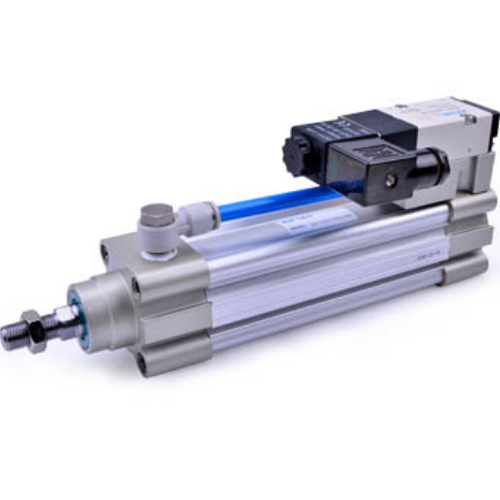
Airtac SAIF Series Standard Cylinder with Valve SAIF32X50S-06C
The AirTAC Airtac SAIF Series Standard Cylinder with Valve SAIF32X50S-06C is a genuine double-acting ISO 15552 cylinder with a Ø32mm bore, 50mm stroke and a built-in 4M210-06 5/2 solenoid valve — it switches itself from one coil signal, so no separate remote valve or extra plumbing is needed.
- BoreØ32 mm
- Stroke50 mm
- Built-in valve4M210-06
- Valve port1/8"
- CoilAC110V
- EntryTerminal
About the Airtac SAIF Series Standard Cylinder with Valve SAIF32X50S-06C
The AirTAC SAIF32X50S-06C is a double-acting ISO 15552 profile cylinder with a built-in 4M210-06 5/2 solenoid valve, delivering a Cv of 0.78 and a 14.0 mm2 orifice. Driven by an AC110V terminal-entry coil consuming 3.5 VA, it activates in 0.05 s with IP65 protection. The integrated valve operates at 0.15-0.8 MPa, setting the practical working range for the assembled unit, even though the bare cylinder rates to 1.0 MPa.
Generating 402 N of push force at 0.5 MPa, this 32 mm bore unit includes a magnet for CMSE reed and DMSE electronic sensors. By default, the piston rod retracts when the coil is energised, but you can reconfigure it to extend-when-energised by repositioning the valve. The manifold uses O8 x O5 PU tubing, and the valve port (1/8) differs from the cylinder port (1/8) — eliminating remote plumbing for decentralized installations.
Airtac SAIF Series Standard Cylinder with Valve SAIF32X50S-06C Technical Specifications
| Model | Airtac SAIF Series Standard Cylinder with Valve SAIF32X50S-06C |
|---|---|
| Series | SAIF ISO 15552 cylinder with valve |
| Bore size | Ø32 mm |
| Stroke | 50 mm |
| Acting type | Double acting, self-valved |
| Cylinder port | G1/8 |
| Rod thread | M10×1.25 |
| PU tube | Ø8 × Ø5 |
| Built-in valve | 4M210-06 (5/2) |
|---|---|
| Valve flow | 14.0 mm² (Cv 0.78) |
| Max frequency | 5 cycle/sec |
| Coil voltage | AC110V · AC 3.5 VA |
| Electrical entry | Terminal · IP65 · B class |
| Response time | 0.05 s and below |
| Operating pressure | 0.15 – 0.8 MPa (valve limit) |
| Speed range | 30 – 800 mm/s |
The cylinder rates to 1.0 MPa but the built-in valve operates 0.15–0.8 MPa, so run the assembled SAIF at 0.15–0.8 MPa. Default: rod retracts when the coil is energised (reconfigurable to extend). Specs follow the official AirTAC SAIF datasheet. Port options: PT / G.
Theoretical Output Force (Ø32mm)
| Pressure | Push force | Pull force |
|---|---|---|
| 0.5 MPa | 402 N | 346 N |
| 0.7 MPa | 563 N | — |
Sized within the valve's 0.15–0.8 MPa range. Actual usable force is lower than theoretical due to friction and back-pressure.
Model Code: Airtac SAIF Series Standard Cylinder with Valve SAIF32X50S-06C
| SAIF | ISO 15552 cylinder with built-in 4M valve. |
|---|---|
| 32×50 | Bore × stroke in mm. |
| -06 | Valve port 1/8" → 4M210-06. |
| C | Coil voltage AC110V. |
| I / (blank) | Terminal electrical entry. |
SAIF does not hold its load without air — the valve routes air, it is not a lock. For load-holding use a SAIL (lock) or BSAI (clamp-lock).
Where the Airtac SAIF Series Standard Cylinder with Valve SAIF32X50S-06C Is Used
Decentralized Stations
Eliminates remote valve banks on large machines by switching directly from the AC110V coil signal.
Compact Assembly
Fits 32mm ISO 15552 mounting interfaces where running separate valve tubing is costly or tight.
Sensor-Ready Actuation
The -S magnet pairs with CMSE and DMSE switches for precise end-of-stroke detection in automated lines.
Is the Airtac SAIF Series Standard Cylinder with Valve SAIF32X50S-06C the Right Choice?
Choose this self-valved SAIF32X50S-06C when decentralizing actuation across large machines saves panel space and wiring. If you need greater thrust, stepping up to the 40 mm bore yields 628 N of push force at 0.5 MPa. The AC110V terminal coil suits standard plant voltage, while the PT threaded ports match legacy pneumatic layouts.
Remember that the built-in 5/2 valve routes air but does not lock the load; if you need true position holding without live pressure, consider the SAIL lock or BSAI clamp-lock series. To replace this unit, match the 32 mm bore, 50 mm stroke, 06 valve port, AC110V voltage, terminal entry, PT thread, and -S magnet.
Quick checklist
- ✓ Force at 0.15–0.8 MPa
- ✓ Coil voltage matches panel
- ✓ Terminal vs grommet entry
- ✓ Retract- or extend-when-energised
- ✓ Load-holding → SAIL / BSAI
Airtac SAIF Series Standard Cylinder with Valve SAIF32X50S-06C FAQ
The 32mm bore generates 402 N of push force at 0.5 MPa and 724 N at 0.9 MPa. The built-in 4M210-06 5/2 valve provides a 14.0 mm2 effective area (Cv 0.78) with a maximum frequency of 5 cycles per second.
It uses an AC110V terminal-entry coil (3.5 VA, IP65). By factory default, the rod retracts when the coil is energised, but you can reconfigure it to extend-when-energised by repositioning the valve. This removes the need for a separate remote valve.
Request a Quote for Airtac SAIF Series Standard Cylinder with Valve SAIF32X50S-06C
Send us the quantity and destination. We confirm price, stock and lead time — usually within 7-8 hours.