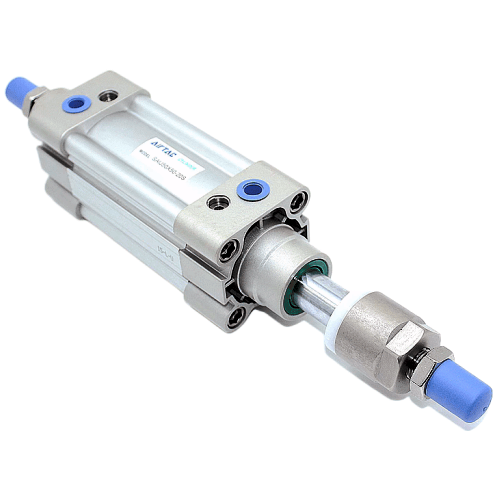
Airtac SAIJ100 Adjustable Cylinder SAIJ100BX175-30
The AirTAC Airtac SAIJ100 Adjustable Cylinder SAIJ100BX175-30 is a genuine double-acting ISO 15552 profile-barrel air cylinder with a Ø100mm bore and 175mm stroke, G1/2 air ports and adjustable end cushioning. Its standardized mounting interface makes it a drop-in replacement for other ISO 15552 cylinders in automation lines.
- BoreØ100 mm
- Stroke175 mm
- Port sizeG1/2
- Acting typeDouble acting
- Rod threadM20×1.5
- CushionAdjustable, 36 mm
About the Airtac SAIJ100 Adjustable Cylinder SAIJ100BX175-30
The AirTAC SAIJ100X175-30 is a double-acting ISO 15552 profile cylinder featuring a rear stroke adjuster that permits up to 30 mm of end-position trimming. This creates a usable travel window of 145 to 175 mm, allowing precise fine-tuning at commissioning without adding external stops. Delivering 7068 N of push force at 0.9 MPa, it fits heavy-duty positioning tasks.
This SKU features a SUS304 stainless steel rod for corrosion resistance and uses PT tapered port threads. It includes variable air cushions at both ends to absorb kinetic energy. The rear adjustment mechanism acts purely as a mechanical stop to set the travel end and does not hold the load without live air pressure.
Airtac SAIJ100 Adjustable Cylinder SAIJ100BX175-30 Technical Specifications
| Model | Airtac SAIJ100 Adjustable Cylinder SAIJ100BX175-30 |
|---|---|
| Series | SAI ISO 15552 profile cylinder |
| Bore size | Ø100 mm |
| Stroke | 175 mm |
| Acting type | Double acting |
| Port size | G1/2 |
| Rod thread | M20×1.5 |
| Fluid | Air (filtered by 40µm element) |
|---|---|
| Operating pressure | 0.15 – 1.0 MPa |
| Proof pressure | 1.5 MPa |
| Temperature | -20 to +70 °C |
| Speed range | 30 – 800 mm/s |
| Cushion | Adjustable, 36 mm |
| Max stroke | Up to 1500 mm |
Specifications follow the official AirTAC SAI series datasheet and ISO 15552 dimensions. Confirm against the product label before installation. Port options: G (BSPP) / NPT.
Theoretical Output Force (Ø100mm)
| Pressure | Push force | Pull force |
|---|---|---|
| 0.5 MPa | 3927 N | 3682 N |
| 0.7 MPa | 5498 N | — |
| Max (@1.0 MPa) | 801 kgf | |
Actual usable force is lower than theoretical due to friction and back-pressure. Size with a safety margin.
Model Code: Airtac SAIJ100 Adjustable Cylinder SAIJ100BX175-30
| SAI | ISO 15552 profile-barrel cylinder series. |
|---|---|
| 100 | Bore size in mm. |
| ×175 | Stroke length in mm. |
| -S | Optional built-in magnet for sensor position sensing. |
Related SAI-family variants: SAID (double rod), SAIJ (adjustable stroke), SAIL (with lock), SAIF (with valve), BSAI (enclasp / clamp-lock), and SAI-S with built-in magnet. Rod material: carbon steel (blank) / SUS420J2 (A) / SUS304 (B); seals: TPU (blank) / Viton H / NBR N.
Where the Airtac SAIJ100 Adjustable Cylinder SAIJ100BX175-30 Is Used
Machine Setup & Changeover
Dial in the exact end position within the 145-175 mm window during product line changeovers without physically swapping the cylinder.
Variable End-Stop Positioning
Fine-tune the retract end position by up to 30 mm at commissioning to perfect a process without adding bulky external stopper blocks.
Heavy-Duty Clamping
Leverage 7068 N of push force at 0.9 MPa to securely clamp large workpieces while adjusting the clamping depth for different material thicknesses.
Is the Airtac SAIJ100 Adjustable Cylinder SAIJ100BX175-30 the Right Cylinder?
Choose this 100 mm bore when the 80 mm variant (providing 4523 N push force at 0.9 MPa) is insufficient, but before stepping up to the 125 mm size. The adjustable stroke is ideal for product changeovers where the exact end-of-stroke position varies by up to 30 mm, eliminating the need to swap out a fixed-stroke SAI cylinder.
When matching this ISO 15552 cylinder for a replacement, verify the 100 mm bore, 175 mm stroke, 30 mm adjuster, PT G1/2 port, and the required mounting set (Basic, FA, LB, TC, FTC, TCM1, TCM2). Because the stroke is under 300 mm, side-load risks are moderate, but an external guide is still recommended for heavy loads.
Quick checklist
- ✓ Required force at your working pressure
- ✓ Stroke and mounting space
- ✓ Port/thread type (PT/NPT/G)
- ✓ Magnet (-S) for sensors?
- ✓ Side load — consider a guided cylinder
Installation & Maintenance Notes
- check Use clean air filtered to 40µm or finer.
- check Keep within 0.15 – 1.0 MPa operating pressure.
- check Avoid side load on the piston rod.
- check Adjust end cushion screws for smooth stops.
- check Use correct mounting accessory (FA/FB/CA/CB/LB/TC).
- check Installation by qualified personnel per AirTAC docs.
Airtac SAIJ100 Adjustable Cylinder SAIJ100BX175-30 FAQ
At an operating pressure of 0.9 MPa, this 100 mm bore cylinder generates 7068 N of push force and 5497 N of pull force. The maximum force at 1.0 MPa is 801 kgf.
The rear adjuster screw lets you shorten the nominal 175 mm stroke by up to 30 mm, providing a usable travel range of 145 to 175 mm. It functions as a travel stop and does not lock or hold the load without continuous air pressure.
Authorized Export Seller
Genuine AirTAC parts produced by AirTAC factory.
1-Year Warranty
Covers non-human-caused product damage.
Fast Dispatch
Standard models usually ship in 3-4 days.
Fast Reply
Most inquiries answered within 7-8 hours.
Related AirTAC SAI Cylinders
Request a Quote for Airtac SAIJ100 Adjustable Cylinder SAIJ100BX175-30
Send us the quantity and destination. We confirm price, stock and lead time — usually within 7-8 hours.