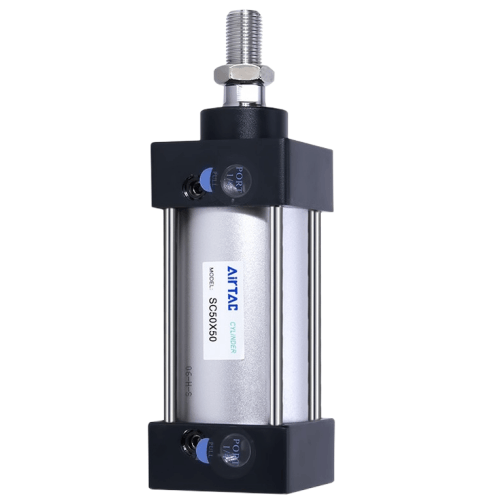
Airtac SC200-250 Tie-Rod Cylinder Aluminum Alloy SC200X900STC
The AirTAC Airtac SC200-250 Tie-Rod Cylinder Aluminum Alloy SC200X900STC is a genuine double-acting standard air cylinder with a Ø200mm bore and 900mm stroke, PT3/4 air ports and adjustable end cushioning. It is used for push, pull, lift and clamp motion in industrial automation.
- BoreØ200 mm
- Stroke900 mm
- Port sizePT3/4
- Acting typeDouble acting
- Rod threadM36×2
- CushionAdjustable, 33 mm
About the Airtac SC200-250 Tie-Rod Cylinder Aluminum Alloy SC200X900STC
The SC200X900STC is a large-bore double-acting pneumatic cylinder delivering 15708 N of push force at 0.5 MPa (28274 N at 0.9 MPa). With a 200 mm bore, 40 mm piston rod, and a 900 mm stroke, it is built for heavy industrial linear actuation where high force and moderate travel are required.
This model includes a built-in magnet (-S) for CMSG/DMSG/EMSG position sensors and a centre trunnion mount (TC) with TCM1 bracket, allowing the cylinder to pivot during operation. The 33 mm adjustable air cushion at each end decelerates the piston smoothly, protecting the end caps from impact at high cycle rates.
Airtac SC200-250 Tie-Rod Cylinder Aluminum Alloy SC200X900STC Technical Specifications
| Model | Airtac SC200-250 Tie-Rod Cylinder Aluminum Alloy SC200X900STC |
|---|---|
| Series | SC big-bore tie-rod cylinder (ISO 6430 class) |
| Bore size | Ø200 mm |
| Stroke | 900 mm |
| Acting type | Double acting |
| Port size | PT3/4 |
| Rod thread | M36×2 |
| Fluid | Air (filtered by 40µm element) |
|---|---|
| Operating pressure | 0.15 – 1.0 MPa |
| Proof pressure | 1.5 MPa |
| Temperature | -20 to +70 °C |
| Speed range | 30 – 500 mm/s |
| Cushion | Adjustable, 33 mm |
| Max stroke | Up to 1500 mm |
Specifications follow the official AirTAC SC series datasheet. Operating pressure 0.15–1.0 MPa, proof pressure 1.5 MPa, temperature −20 to +70 °C. Confirm against the product label before installation. Thread options: PT (standard) / G.
Theoretical Output Force (Ø200mm)
| Pressure | Push force | Pull force |
|---|---|---|
| 0.5 MPa | 15708 N | 15080 N |
| 0.7 MPa | 21991 N | — |
| Max (approx.) | 3204 kgf | |
Actual usable force is lower than theoretical due to friction and back-pressure. Size with a safety margin.
Model Code: Airtac SC200-250 Tie-Rod Cylinder Aluminum Alloy SC200X900STC
| SC | Standard tie-rod cylinder series. |
|---|---|
| 200 | Bore size in mm. |
| ×900 | Stroke length in mm. |
| -S | Optional built-in magnet for sensor position sensing. |
Related variants: SCD (double rod), SCJ (adjustable stroke), SCT (multi-position). Seals: TPU standard / H = Viton / N = NBR. Thread: blank = PT, G = G thread.
Where the Airtac SC200-250 Tie-Rod Cylinder Aluminum Alloy SC200X900STC Is Used
Sawmill Log Positioning
Drives carriage stops and log turners with 15.7 kN of force at 0.5 MPa, handling heavy timber in dusty, wet sawmill environments.
Heavy-Duty Baler Compression
Powers the main compression ram in industrial balers for cardboard, plastic, or agricultural waste, cycling reliably under continuous high-load operation.
Steel Fabrication Clamping
Operates large welding jigs and fixture clamps, holding structural steel members with 28274 N of force at 0.9 MPa for precise assembly.
Is the Airtac SC200-250 Tie-Rod Cylinder Aluminum Alloy SC200X900STC the Right Cylinder?
Select the SC200 when your application needs roughly 15.7 kN of push force at standard plant pressure. If you can work with about 10 kN, stepping down to the SC160 (10053 N at 0.5 MPa) reduces weight and air consumption. For strokes of 900 mm, always check side-load conditions: a 40 mm rod extending nearly a metre can bend under off-axis force. Use an external guide rail or a guided-cylinder assembly to protect the rod bearing and piston seals.
For a direct replacement, match five points: 200 mm bore, 900 mm stroke, PT port thread, centre trunnion (TC) mounting with F-SC200TC bracket, and the built-in magnet (-S) for barrel-mounted sensors. This is a tie-rod cylinder; it is not dimensionally interchangeable with ISO 15552 profile cylinders.
Quick checklist
- ✓ Required force at your working pressure
- ✓ Stroke and mounting space
- ✓ Port/thread type (PT/NPT/G)
- ✓ Magnet (-S) for sensors?
- ✓ Side load — consider a guided cylinder
Installation & Maintenance Notes
- check Use clean air filtered to 40µm or finer.
- check Keep within 0.15 – 1.0 MPa operating pressure.
- check Avoid side load on the piston rod.
- check Adjust end cushion screws for smooth stops.
- check Use correct mounting accessory (FA/FB/CA/CB/LB/TC).
- check Installation by qualified personnel per AirTAC docs.
Airtac SC200-250 Tie-Rod Cylinder Aluminum Alloy SC200X900STC FAQ
At 0.5 MPa, the cylinder produces 15708 N pushing and 15080 N pulling. At the maximum operating pressure of 0.9 MPa, push force reaches 28274 N. The theoretical maximum at 1.0 MPa is 3204 kgf (31400 N push).
No. The 40 mm diameter piston rod extending 900 mm is susceptible to bending under side load. You must install an external linear guide or couple the rod to a guided tooling plate to prevent premature rod bearing wear and seal failure.
Authorized Export Seller
Genuine AirTAC parts produced by AirTAC factory.
1-Year Warranty
Covers non-human-caused product damage.
Fast Dispatch
Standard models usually ship in 3-4 days.
Fast Reply
Most inquiries answered within 7-8 hours.
Request a Quote for Airtac SC200-250 Tie-Rod Cylinder Aluminum Alloy SC200X900STC
Send us the quantity and destination. We confirm price, stock and lead time — usually within 7-8 hours.