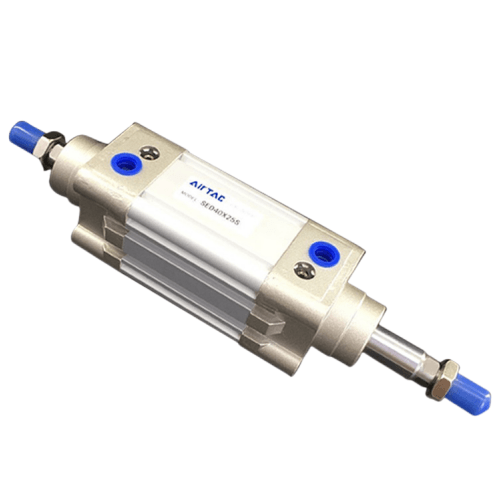
Airtac SED Double Rod Cylinder SED100X160S
The AirTAC Airtac SED Double Rod Cylinder SED100X160S is a genuine double-acting ISO 15552 double-rod cylinder: a Ø25mm piston rod exits BOTH ends of the Ø100mm bore, giving equal force and speed in both directions and letting you mount tooling or a sensor flag on the back rod. Stroke 160mm, PT1/2 ports, adjustable cushioning.
- BoreØ100 mm
- Stroke160 mm
- Port sizePT1/2
- ConfigurationDouble rod
- Rod threadM20×1.5
- CushionAdjustable, 36 mm
About the Airtac SED Double Rod Cylinder SED100X160S
The AirTAC SED100X160S is a double-acting, double-rod profile cylinder built to ISO 15552 dimensions. A Ø25 mm rod exits both end covers, yielding identical annulus areas. This means you get exactly 3681 N of output force at 0.5 MPa in both extend and retract directions.
The extruded aluminum barrel has no external tie rods. Because this variant includes the -S magnet, it supports DMSE electronic and CMSE reed sensors for end-of-stroke detection. Field-adjustable air cushions at both ends decelerate the 25 mm cushion stroke, while the rear rod end can mount a cam or secondary tooling.
Airtac SED Double Rod Cylinder SED100X160S Technical Specifications
| Model | Airtac SED Double Rod Cylinder SED100X160S |
|---|---|
| Series | SED ISO 15552 double-rod cylinder |
| Bore size | Ø100 mm |
| Stroke | 160 mm |
| Configuration | Double rod, double acting |
| Port size | PT1/2 |
| Rod thread | M20×1.5 |
| Fluid | Air (filtered by 40µm element) |
|---|---|
| Operating pressure | 0.15 – 1.0 MPa |
| Proof pressure | 1.5 MPa |
| Temperature | -20 to +70 °C (0–150 °C with FKM seals) |
| Speed range | 30 – 800 mm/s |
| Cushion | Adjustable, 36 mm |
| Max stroke | Up to 1500 mm |
Specifications follow the official AirTAC SED datasheet and ISO 15552 / VDMA 24562 dimensions. Confirm against the product label before installation. Port options: PT (standard) / G (BSPP).
Theoretical Output Force (Ø100mm)
| Pressure | Force (both directions) |
|---|---|
| 0.5 MPa | 3682 N |
| 0.7 MPa | 5154 N |
| Max (@1.0 MPa) | 751 kgf |
Because a rod exits both ends, the effective piston area — and therefore the force — is identical on extend and retract. Actual usable force is lower than theoretical; size with a safety margin.
Model Code: Airtac SED Double Rod Cylinder SED100X160S
| SED | ISO 15552 profile-barrel DOUBLE-ROD double-acting cylinder. |
|---|---|
| 100 | Bore size in mm. |
| ×160 | Stroke length in mm. |
| -S | Optional built-in magnet for CMSE / DMSE sensor sensing. |
Rod material: carbon steel (blank) / SUS420J2 (A) / SUS304 (B). Seals: TPU (blank) / FKM high-temp (H) / NBR (N). Thread: PT (blank) / G. Mounting (SED): Basic, LB, FA, TC, FTC, TCM1, TCM2. Related: SE (single rod), SEJ (double-rod adjustable stroke), BSED (double-rod rod lock).
Where the Airtac SED Double Rod Cylinder SED100X160S Is Used
Servo Press Sub-Assembly
Drives a 3681 N pressing head at 0.5 MPa while the rear rod simultaneously triggers a DMSE sensor, ensuring perfect cycle synchronization.
Multi-Axis Welding Fixture
Uses the twin-rod geometry to guide a heavy 100 mm clamp block against rotation, maintaining strict alignment during spot welding.
Pallet Diverting Gate
Actuates a heavy lane diverter with equal 5153 N force in both directions at 0.7 MPa, preventing stalling when pushing loaded pallets.
Is the Airtac SED Double Rod Cylinder SED100X160S the Right Cylinder?
Choose this 100 mm bore if you need 3681 N both ways at 0.5 MPa. Stepping down to the 80 mm bore drops the equal both-way force to 2268 N, while stepping up to the 125 mm bore raises it to 5734 N. Select the SED over a single-rod SE when your application demands anti-rotation guidance or rear-rod sensing.
This cylinder does not hold position on air loss; the piston will drift. For fail-safe holding, use an external rod lock or a BSED double-rod rod lock. To replace an ISO 15552 unit, match the 160 mm stroke, PT1/2 port, M20x1.5 rod thread, and mounting choice (Basic, FA, LB, TC, FTC, TCM1, or TCM2).
Quick checklist
- ✓ Equal force/speed both directions needed?
- ✓ Back-rod space for tooling or a flag
- ✓ Stroke and mounting space
- ✓ Port/thread type (PT/G)
- ✓ Magnet (-S) for CMSE/DMSE sensors?
Installation & Maintenance Notes
- check Use clean air filtered to 40µm or finer.
- check Keep within 0.15 – 1.0 MPa operating pressure.
- check Support both rod ends; avoid side load.
- check Adjust end cushion screws for smooth stops.
- check Use correct mounting accessory (LB/FA/TC/FTC/TCM1/TCM2).
- check Installation by qualified personnel per AirTAC docs.
Airtac SED Double Rod Cylinder SED100X160S FAQ
Because the double-rod design has equal piston areas on both sides, output force is identical in both directions: 3681 N at 0.5 MPa, 5153 N at 0.7 MPa, and a maximum of 751 kgf at 1.0 MPa.
The twin rods prevent rotation and allow you to mount tooling or a sensor flag on the rear rod end. It also provides equal extend and retract forces, making it ideal for symmetrical pushing and pulling tasks.
Authorized Export Seller
Genuine AirTAC parts produced by AirTAC factory.
1-Year Warranty
Covers non-human-caused product damage.
Fast Dispatch
Standard models usually ship in 3-4 days.
Fast Reply
Most inquiries answered within 7-8 hours.
Related AirTAC SED Cylinders
Request a Quote for Airtac SED Double Rod Cylinder SED100X160S
Send us the quantity and destination. We confirm price, stock and lead time — usually within 7-8 hours.