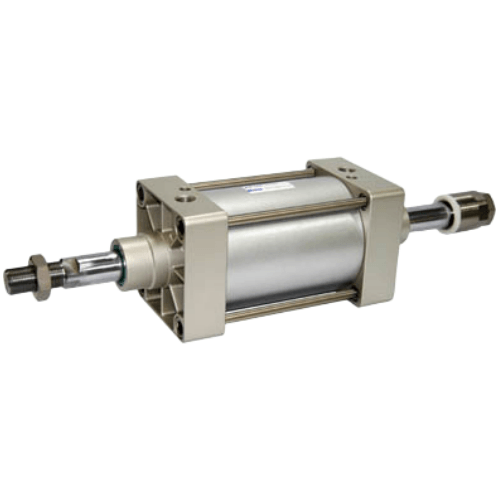
Airtac SGCJ125~160 Adjustable Cylinder SGCJ125X150-30
The AirTAC Airtac SGCJ125~160 Adjustable Cylinder SGCJ125X150-30 is a genuine double acting, adjustable stroke ISO 15552 (orig. ISO 6431) tie-rod air cylinder with a Ø125mm bore and 150mm stroke, G1/2 air ports and adjustable end cushioning. Its large-bore tie-rod build delivers high thrust and drops into standardized ISO 15552 mounting on heavy automation.
- BoreØ125 mm
- Stroke150 mm
- Port sizeG1/2
- Acting typeDouble acting, adjustable stroke
- Rod threadM27×2.0
- CushionAdjustable, 40 mm
About the Airtac SGCJ125~160 Adjustable Cylinder SGCJ125X150-30
Delivering 6136 N of push force at 0.5 MPa, this large-bore ISO 15552 tie-rod cylinder features a 125 mm bore and a 150 mm stroke. Four steel tie rods clamp the aluminum barrel to the covers, and the body drops into existing fixtures dimensionally interchangeable per the ISO 15552 mounting interface. The G1/2 port supplies air to the 32 mm rod, driving the unit at 30-500 mm/s.
The -30 code defines an external adjuster that lets you shorten the extend stroke on site by up to 30 mm, giving a usable extend range of 120-150 mm without changing the cylinder. This on-site tuning yields a safe working load of about 3682 N, which translates to roughly 313 kg lifted vertically with a 2:1 margin. The retract end remains fixed, and adjustable 40 mm air cushions at both ends decelerate the piston smoothly.
Airtac SGCJ125~160 Adjustable Cylinder SGCJ125X150-30 Technical Specifications
| Model | Airtac SGCJ125~160 Adjustable Cylinder SGCJ125X150-30 |
|---|---|
| Series | SGC ISO 15552 tie-rod cylinder |
| Bore size | Ø125 mm |
| Stroke | 150 mm |
| Acting type | Double acting, adjustable stroke |
| Port size | G1/2 |
| Rod thread | M27×2.0 |
| Fluid | Air (filtered by 40µm element) |
|---|---|
| Operating pressure | 0.15 – 1.0 MPa |
| Proof pressure | 1.5 MPa |
| Temperature | -20 to +70 °C |
| Speed range | 30 – 500 mm/s |
| Cushion | Adjustable, 40 mm |
| Max standard stroke | Up to 1500 mm |
Specifications follow the official AirTAC SGC datasheet and ISO 15552 dimensions. Confirm against the product label before installation. Thread options: PT (blank) / G. TPU seals are not available for the Ø250 bore (NBR / Viton only).
Theoretical Output Force (Ø125mm)
| Pressure | Push force | Pull force |
|---|---|---|
| 0.5 MPa | 6136 N | 5734 N |
| 0.7 MPa | 8590 N | — |
| Max (@1.0 MPa) | 1251 kgf | |
Actual usable force is lower than theoretical due to friction and back-pressure. Size with a safety margin.
Model Code: Airtac SGCJ125~160 Adjustable Cylinder SGCJ125X150-30
| SGCJ | ISO 15552 tie-rod cylinder (adjustable-stroke type). |
|---|---|
| 125 | Bore size in mm (125 / 160 / 200 / 250). |
| ×150 | Stroke length in mm. |
| -S | Optional built-in magnet for CMSG / DMSG / EMSG sensors. |
SGC-family variants: SGC (double acting), SGCD (double rod), SGCJ (adjustable stroke). Mounting: LB / FA / FB / CA / CB / CR / TC / FTC / TCM1 / TCM2. Seals: TPU (blank) / Viton H / NBR N.
Where the Airtac SGCJ125~160 Adjustable Cylinder SGCJ125X150-30 Is Used
Press Stroke Tuning
Dial in the exact 120-150 mm extend contact point on a light stamping press without swapping hardware.
Divertor Gate Adjustment
Fine-tune the extend reach of a sorting gate on-site to handle varying package sizes on the fly.
Pallet Stop Positioning
Set a precise 30 mm shorter stop position for different pallet depths using the external adjuster.
Is the Airtac SGCJ125~160 Adjustable Cylinder SGCJ125X150-30 the Right Cylinder?
Size this 125 mm bore against its neighbours: stepping up to 160 mm multiplies the 0.5 MPa push force to 10053 N, while dropping below 125 mm loses the ISO 15552 large-bore footprint. The adjustable stroke is ideal when you need fine end-position tuning across shared spares or varying machine setups. Mount using FA, LB, TC, FTC, TCM1 or TCM2 brackets. Because this 150 mm stroke is under 500 mm, side-load guides are less critical, but always guide the rod for rigid loads. Note this SKU lacks the -S magnet, so it cannot accept CMSG, DMSG or EMSG sensors.
Quick checklist
- ✓ Required force at your working pressure
- ✓ Stroke and mounting space
- ✓ Port/thread type (PT / G / NPT)
- ✓ Magnet (-S) for sensors?
- ✓ Long-stroke side load — support the rod end
Installation & Maintenance Notes
- check Use clean air filtered to 40µm or finer.
- check Keep within 0.15 – 1.0 MPa operating pressure.
- check Avoid side load; support long strokes at the rod end.
- check Set cushions to minimum, then release gradually.
- check Use correct mounting accessory (LB/FA/FB/CA/CB/CR/TC).
- check Installation by qualified personnel per AirTAC docs.
Airtac SGCJ125~160 Adjustable Cylinder SGCJ125X150-30 FAQ
At 0.5 MPa it provides 6136 N push and 5734 N pull. At 0.7 MPa it provides 8590 N push and 8028 N pull. The theoretical maximum force is 1251 kgf at 1.0 MPa.
The -30 means an external stop screw lets you shorten the extend stroke by up to 30 mm on site. The usable extend range is 120-150 mm, with 150 mm being the maximum. The retract end is fixed, and the stop only sets position—it does not lock the load.
Authorized Export Seller
Genuine AirTAC parts produced by AirTAC factory.
1-Year Warranty
Covers non-human-caused product damage.
Made to Order
Large-bore cylinders built to order — confirm lead time.
Fast Reply
Most inquiries answered within 7-8 hours.
Related AirTAC SGC Cylinders
Request a Quote for Airtac SGCJ125~160 Adjustable Cylinder SGCJ125X150-30
Send us the quantity and destination. We confirm price, stock and lead time — usually within 7-8 hours.