This model is discontinued
AirTAC has phased out the SI series. You can still order this code here: we ship the direct replacement SAI125BX260S, with the same bore, stroke, output force, port and mounting, so it fits the same application. The SAI replacement keeps the same ISO 15552 mounting interface, bore, stroke, output force and accessories, so it drops straight into existing fixtures. It is the current-production version of this cylinder with an upgraded piston seal.
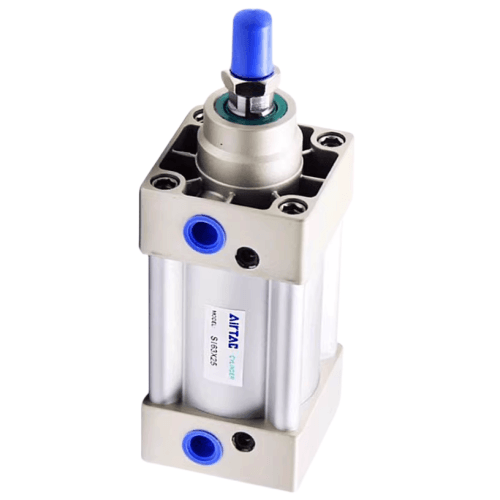
Airtac SI125 Standard Cylinder SI125BX260S
The AirTAC SI125 Standard Cylinder SI125BX260S is a double-acting ISO 15552 (orig. ISO 6431) profile-barrel cylinder with a Ø125mm bore and 260mm stroke, G1/2 air ports and adjustable end cushioning. This model is discontinued — the direct replacement is the SAI125BX260S, which matches its ISO interface, bore, stroke, force and mounting.
- BoreØ125 mm
- Stroke260 mm
- Port sizeG1/2
- Acting typeDouble acting
- Rod threadM27×2.0
- StatusDiscontinued → SAI125BX260S
- No minimum order. A single piece can be ordered.
- Ready in 3–5 business days. That is the time we take to process the order and hand it to the carrier. Transit time after that depends on the destination.
About the Airtac SI125 Standard Cylinder SI125BX260S
The AirTAC SI125BX260S is a discontinued double-acting ISO 15552 profile cylinder featuring a 125 mm bore, 260 mm stroke, and a SUS304 stainless steel rod. Delivering 6136 N push force at 0.5 MPa, it is replaced by the SAI125BX260S. This direct successor shares the exact ISO 15552 mounting interface, G1/2 port, and M27x2 rod thread.
The SAI upgrade features two Y-shaped one-way piston seals for low start-up pressure and long life. The SAI family adds SAIL, SAIF, and BSAI lock variants the SI lacked. Your -S magnet works with legacy CS1-B/DS1-B switches.
Airtac SI125 Standard Cylinder SI125BX260S Technical Specifications
| Model | Airtac SI125 Standard Cylinder SI125BX260S |
|---|---|
| Series | SI ISO 15552 profile cylinder (discontinued) |
| Replacement | SAI125BX260S |
| Bore size | Ø125 mm |
| Stroke | 260 mm |
| Acting type | Double acting |
| Port size | G1/2 |
| Rod thread | M27×2.0 |
| Fluid | Air (filtered by 40µm element) |
|---|---|
| Operating pressure | 0.15 – 1.0 MPa |
| Proof pressure | 1.5 MPa |
| Temperature | -20 to +70 °C |
| Speed range | 30 – 500 mm/s |
| Cushion | Adjustable, 40 mm |
| Max standard stroke | Up to 1500 mm |
Specifications follow the official AirTAC SI datasheet (now discontinued). The SAI125BX260S carries the same ISO 15552 ratings. Confirm against the product label before installation. Thread options: PT / G / NPT.
Theoretical Output Force (Ø125mm)
| Pressure | Push force | Pull force |
|---|---|---|
| 0.5 MPa | 6136 N | 5734 N |
| 0.7 MPa | 8590 N | — |
| Max (@1.0 MPa) | 1251 kgf | |
The SAI125BX260S produces the same force from the same bore. Actual usable force is lower than theoretical; size with a margin.
Model Code: Airtac SI125 Standard Cylinder SI125BX260S
| SI | ISO 15552 profile-barrel cylinder (discontinued). |
|---|---|
| 125 | Bore size in mm. |
| ×260 | Stroke length in mm. |
| -S | Optional built-in magnet for sensor position sensing. |
Legacy SI-family variants: SID (double rod), SIJ (adjustable stroke) — each maps to its SAI equivalent (SID→SAID, SIJ→SAIJ). Rod material: carbon steel (blank) / SUS420J2 (A) / SUS304 (B).
Where the Airtac SI125 Standard Cylinder SI125BX260S Is Used
Heavy Pressing
Drives large stamping and forming presses requiring 6136 N of push force at 0.5 MPa.
Pallet Handling
Indexes heavy loaded pallets along conveyors using the robust 32 mm stainless rod.
Clamp Systems
Secures oversized workpieces in machining fixtures where high pull force is needed.
Replacing the Airtac SI125 Standard Cylinder SI125BX260S with the SAI125BX260S
To replace the SI125BX260S, order the SAI125BX260S. Verify your ISO 15552 mounting accessories (LB, FA, TC, etc.), the G1/2 air port, and the -S magnet. If you need less force, the neighbouring 100 mm bore gives 3927 N push at 0.5 MPa; if you need more, the 160 mm bore yields 10053 N. A plain cylinder drifts on air loss—the cushion only decelerates—so for load holding use an external rod lock, pilot check valve, or the SAIL/BSAI lock variant. For 260 mm strokes, ensure guide rails prevent rod bending side-loads.
Replacement checklist
- ✓ Same ISO 15552 interface → SAI125BX260S
- ✓ Same bore / stroke / force
- ✓ Port/thread type (PT/G/NPT)
- ✓ Magnet (-S) for sensors?
- ✓ Mounting reused (FA/FB/CA/CB/CR/LB/TC)
Airtac SI125 Standard Cylinder SI125BX260S FAQ
Yes, the SI125BX260S is discontinued. The direct replacement is the SAI125BX260S. It is dimensionally interchangeable per ISO 15552, retaining the same 125 mm bore, 260 mm stroke, output force, G1/2 port, and mounting interface.
It has a G1/2 port. Force output is 6136 N push and 5734 N pull at 0.5 MPa, 8590 N push at 0.7 MPa, 11045 N push at 0.9 MPa, and a theoretical max of 1251 kgf at 1.0 MPa. Operating speed is 30-500 mm/s.
Related AirTAC SAI Cylinders
Request a Quote for the SAI125BX260S
Send us the quantity and destination. We confirm price, stock and lead time on the SAI125BX260S replacement — usually within 7-8 hours.