This model is discontinued
AirTAC has phased out the SI series. You can still order this code here: we ship the direct replacement SAID80X175, with the same bore, stroke, output force, port and mounting, so it fits the same application. The SAI replacement keeps the same ISO 15552 mounting interface, bore, stroke, output force and accessories, so it drops straight into existing fixtures. It is the current-production version of this cylinder with an upgraded piston seal.
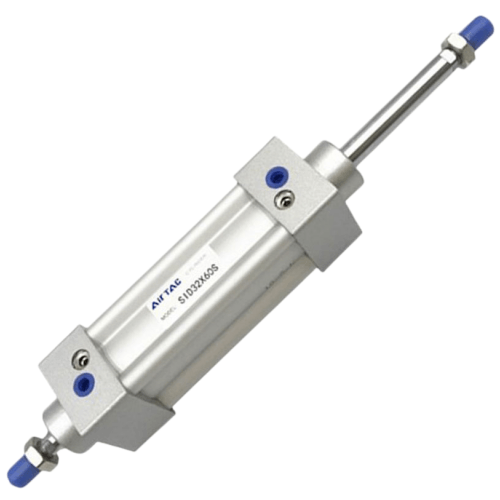
Airtac SID Series Double-Rod Cylinder SID80X175
The AirTAC Airtac SID Series Double-Rod Cylinder SID80X175 is a double-acting ISO 15552 (orig. ISO 6431) profile-barrel cylinder with a Ø80mm bore and 175mm stroke, G3/8 air ports and adjustable end cushioning. This model is discontinued — the direct replacement is the SAID80X175, which matches its ISO interface, bore, stroke, force and mounting.
- BoreØ80 mm
- Stroke175 mm
- Port sizeG3/8
- Acting typeDouble acting
- Rod threadM20×1.5
- StatusDiscontinued → SAID80X175
- No minimum order. A single piece can be ordered.
- Ready in 3–5 business days. That is the time we take to process the order and hand it to the carrier. Transit time after that depends on the destination.
About the Airtac SID Series Double-Rod Cylinder SID80X175
The AirTAC SID80X175 is a double-acting double-rod ISO 15552 cylinder where a rod exits both ends, making push and pull force equal at 2268 N @0.5 MPa. This SKU has no -S magnet and cannot take a sensor. It is discontinued; use the direct replacement SAID80X175 (same 80mm bore, 175mm stroke, G3/8 port, M20x1.5 thread, 36mm cushion).
The SAI upgrade uses a two-piece Y-shaped piston seal for low start-up pressure and long life. A double rod prevents rotation and can drive two tools. Cushions only decelerate; use SAIL or an external rod lock to hold loads.
Airtac SID Series Double-Rod Cylinder SID80X175 Technical Specifications
| Model | Airtac SID Series Double-Rod Cylinder SID80X175 |
|---|---|
| Series | SI ISO 15552 profile cylinder (discontinued) |
| Replacement | SAID80X175 |
| Bore size | Ø80 mm |
| Stroke | 175 mm |
| Acting type | Double acting |
| Port size | G3/8 |
| Rod thread | M20×1.5 |
| Fluid | Air (filtered by 40µm element) |
|---|---|
| Operating pressure | 0.15 – 1.0 MPa |
| Proof pressure | 1.5 MPa |
| Temperature | -20 to +70 °C |
| Speed range | 30 – 800 mm/s |
| Cushion | Adjustable, 36 mm |
| Max standard stroke | Up to 1500 mm |
Specifications follow the official AirTAC SI datasheet (now discontinued). The SAID80X175 carries the same ISO 15552 ratings. Confirm against the product label before installation. Thread options: PT / G / NPT.
Theoretical Output Force (Ø80mm)
| Pressure | Push force | Pull force |
|---|---|---|
| 0.5 MPa | 2513 N | 2268 N |
| 0.7 MPa | 3519 N | — |
| Max (@1.0 MPa) | 513 kgf | |
The SAID80X175 produces the same force from the same bore. Actual usable force is lower than theoretical; size with a margin.
Model Code: Airtac SID Series Double-Rod Cylinder SID80X175
| SI | ISO 15552 profile-barrel cylinder (discontinued). |
|---|---|
| 80 | Bore size in mm. |
| ×175 | Stroke length in mm. |
| -S | Optional built-in magnet for sensor position sensing. |
Legacy SI-family variants: SID (double rod), SIJ (adjustable stroke) — each maps to its SAI equivalent (SID→SAID, SIJ→SAIJ). Rod material: carbon steel (blank) / SUS420J2 (A) / SUS304 (B).
Where the Airtac SID Series Double-Rod Cylinder SID80X175 Is Used
Twin-Tool Machining Station
Drives two opposing spindles simultaneously from one piston, ensuring perfectly synchronized cutting cycles without phase delay.
Anti-Rotation Lift Elevator
Lifts a 100 kg platen vertically using both rods to prevent yaw and twist, maintaining strict parallelism during ascent.
Symmetrical Transfer Pusher
Pushes a workpiece forward while retracting an empty pallet backward at the exact same speed and equal 2268 N force.
Replacing the Airtac SID Series Double-Rod Cylinder SID80X175 with the SAID80X175
Replace the discontinued SID80X175 directly with the SAID80X175. The 80mm bore yields equal force both ways (2268 N @0.5 MPa, 3175 N @0.7, 4082 N @0.9). If sizing neighbours, a 63mm gives 1402 N and a 100mm gives 3681 N @0.5. Choose a double rod to prevent rotation or drive two tools. Reuse FA, LB or TC ISO 15552 mounts. This no-S SKU cannot fit sensors. For this 175mm stroke side-load is minimal, but for strokes >=300mm ensure guide alignment to prevent binding.
Replacement checklist
- ✓ Same ISO 15552 interface → SAID80X175
- ✓ Same bore / stroke / force
- ✓ Port/thread type (PT/G/NPT)
- ✓ Magnet (-S) for sensors?
- ✓ Mounting reused (FA/FB/CA/CB/CR/LB/TC)
Airtac SID Series Double-Rod Cylinder SID80X175 FAQ
Yes, the SID80X175 is discontinued. The direct replacement is the SAID80X175, which shares the identical ISO 15552 mounting interface, 80mm bore, 175mm stroke, G3/8 port, and equal-both-ways force.
Force is equal both ways: 2268 N @0.5 MPa, 3175 N @0.7 MPa, and 4082 N @0.9 MPa. The air port is G3/8, the rod is Ø25mm with an M20x1.5 thread, and speed is 30-800 mm/s.
Related AirTAC SAI Cylinders
Request a Quote for the SAID80X175
Send us the quantity and destination. We confirm price, stock and lead time on the SAID80X175 replacement — usually within 7-8 hours.