This model is discontinued
AirTAC has phased out the MAL series. The drop-in replacement is ACEJ20X110-75B — same bore, stroke, output force, port and mounting, so it fits the same application. Simply order the ACEJ20X110-75B in place of this model. The ACE replacement is a current-production ISO 21287 compact cylinder in the same bore, stroke and force class, with a matching short body and the same mounting-accessory family, so it fits the same envelope. Confirm mounting-interface dimensions against the ACE datasheet before ordering.
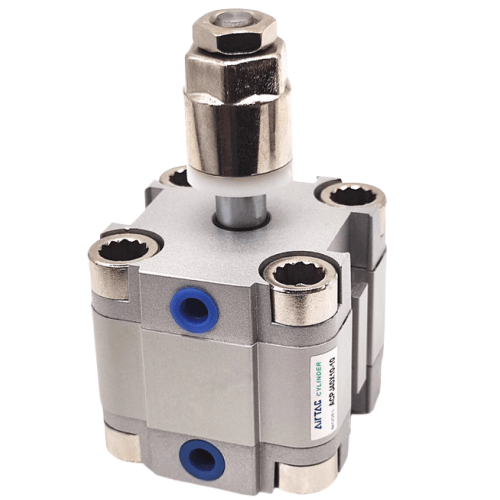
Airtac ACPJ Adjustable Compact Cylinder ACPJ20X110-75B
The AirTAC Airtac ACPJ Adjustable Compact Cylinder ACPJ20X110-75B is a double acting, adjustable stroke DIN-standard tight/compact air cylinder with a Ø20mm bore and 110mm stroke, M5×0.8 air ports and a hard-anodized aluminium body. This model is discontinued — the current-production replacement is the ACEJ20X110-75B (ISO 21287 ACE), in the same bore, stroke and force class.
- BoreØ20 mm
- Stroke110 mm
- Port sizeM5×0.8
- Acting typeDouble acting, adjustable stroke
- Rod threadM6×1.0
- StatusDiscontinued → ACEJ20X110-75B
- No minimum order. A single piece can be ordered.
- Ready in 3–5 business days. That is the time we take to process the order and hand it to the carrier. Transit time after that depends on the destination.
About the Airtac ACPJ Adjustable Compact Cylinder ACPJ20X110-75B
Double acting and adjustable, the ACPJ20X110-75B is a discontinued DIN-standard compact cylinder with a 20 mm bore and a 110 mm stroke that a stop screw trims by up to 75 mm, giving a usable extend range of 35-110 mm. At 0.5 MPa it pushes 157.1 N and pulls 117.8 N; at 0.7 MPa those rise to 219.9 N and 164.9 N, with a theoretical peak of 32 kgf at 1.0 MPa. The 110 mm stroke exceeds the 100 mm standard maximum for this bore, so it is made to order. AirTAC now builds the ACEJ20X110 as the current-production successor in the same bore, stroke and force class.
The short ISO 21287-class body saves roughly 50% of the mounting length of an ISO 15552 profile cylinder, which is why it suits cramped gantries and guarding. Because 0.6 of the push rating is a sensible working fraction, plan on about 94 N of real work, and halve the 16 kgf vertical equivalent to lift about 8 kg with margin. The rod carries a male thread (B code) and the ports are M5x0.8; no magnet is fitted, so the optional -S code is required before CMSE or DMSE switches can be used.
Airtac ACPJ Adjustable Compact Cylinder ACPJ20X110-75B Technical Specifications
| Model | Airtac ACPJ Adjustable Compact Cylinder ACPJ20X110-75B |
|---|---|
| Series | ACPJ DIN compact cylinder (discontinued) |
| Replacement | ACEJ20X110-75B |
| Bore size | Ø20 mm |
| Stroke | 110 mm |
| Acting type | Double acting, adjustable stroke |
| Port size | M5×0.8 |
| Rod thread | M6×1.0 |
| Fluid | Air (filtered by 40µm element) |
|---|---|
| Operating pressure | 0.15 – 1.0 MPa |
| Proof pressure | 1.5 MPa |
| Temperature | -20 to +70 °C |
| Speed range | 30 – 500 mm/s |
| Cushion | Fixed bumper (both ends) |
| Max standard stroke | Up to 100 mm |
Specifications follow the official AirTAC ACP datasheet (now discontinued). The ACEJ20X110-75B (ISO 21287) carries the same bore/stroke/force class; confirm mounting-interface dimensions against the ACE datasheet before installation. Rod type: female thread (blank) or male thread (B). Thread options: PT (blank) / G.
Theoretical Output Force (Ø20mm)
| Pressure | Push force | Pull force |
|---|---|---|
| 0.5 MPa | 157 N | 118 N |
| 0.7 MPa | 220 N | 165 N |
| Max (@1.0 MPa) | 32 kgf | |
The ACEJ20X110-75B produces the same force from the same bore. Actual usable force is lower than theoretical; size with a margin.
Model Code: Airtac ACPJ Adjustable Compact Cylinder ACPJ20X110-75B
| ACPJ | DIN compact cylinder (adjustable-stroke, discontinued). |
|---|---|
| 20 | Bore size in mm. |
| ×110 | Stroke length in mm. |
| -75 | Adjustable stroke window (mm the extend stroke can be shortened on site). |
| S | Optional built-in magnet for sensor position sensing (omit for no magnet). |
| B | Rod type: B = male thread; blank = female thread. |
Replacement mapping (swap P for E): ACP→ACE, ASP→ASE, ATP→ATE, ACPD→ACED, ACPJ→ACEJ. ACP-family: ACP (double acting), ASP / ATP (single acting push / pull), ACPD (double rod), ACPJ (adjustable stroke).
Where the Airtac ACPJ Adjustable Compact Cylinder ACPJ20X110-75B Is Used
Small-parts press fitting
The 157.1 N push at 0.5 MPa seats bushings and dowels in electronics fixtures, with the stop screw trimming the extend stroke from 110 mm down to 35 mm for shallow inserts.
Compact tray indexing
In a packaging machine where a full-length profile cylinder will not fit, the short body advances trays of vials within a 35-110 mm window at 30-500 mm/s.
Light vertical lift and lower
Halving the 16 kgf vertical equivalent gives about 8 kg of lift with margin, enough to raise small chutes or sensor brackets in a test rig.
Replacing the Airtac ACPJ Adjustable Compact Cylinder ACPJ20X110-75B with the ACEJ20X110-75B
Size against neighbours: the 16 mm bore gives 100.5 N push at 0.5 MPa, while stepping up to a larger bore buys proportionally more thrust if 157.1 N is marginal for your jig. Remember the stop screw only shortens the extend stroke within the 75 mm window - it is not a mid-stroke lock, and on air loss the piston still drifts. FA/FB flanges and LB feet bolt to the standard face, and the male rod thread suits I/Y knuckles. For new builds, order the ACEJ20X110 instead and confirm ISO 21287 mounting dimensions before swapping.
Replacement checklist
- ✓ Current-production ACE → ACEJ20X110-75B
- ✓ Same bore / stroke / force class
- ✓ Confirm ISO 21287 mounting dimensions
- ✓ Port/thread type (PT / G)
- ✓ Add -S for magnet if you need sensors
Airtac ACPJ Adjustable Compact Cylinder ACPJ20X110-75B FAQ
At 0.5 MPa it pushes 157.1 N and pulls 117.8 N; at 0.7 MPa it pushes 219.9 N and pulls 164.9 N, with a theoretical maximum of 32 kgf at 1.0 MPa. The -75 code sets a 75 mm adjustment window: an external stop screw shortens the 110 mm extend stroke on site, so the usable range is 35-110 mm. It cannot lengthen the stroke past 110 mm, and the stop is not a load-holding brake - on air loss the piston drifts. Operating pressure is 0.15-1.0 MPa (22-145 psi), proof 1.5 MPa (215 psi), speed 30-500 mm/s, with a fixed TPU bumper at both ends.
No - the ACPJ family is discontinued. The current-production drop-in is the ACEJ20X110, which matches the same bore, stroke and force class; confirm the ISO 21287 mounting dimensions before swapping because the ACP was built to a DIN standard. This unit has no magnet fitted, so position switches cannot be read unless you order the optional -S magnet code, which enables CMSE and DMSE reed or solid-state switches. Mounting uses FA/FB flanges or LB feet on the standard face, and the male rod thread takes I/Y knuckles.
Related AirTAC ACE Cylinders
Request a Quote for the ACEJ20X110-75B
Send us the quantity and destination. We confirm price, stock and lead time on the ACEJ20X110-75B replacement — usually within 7-8 hours.