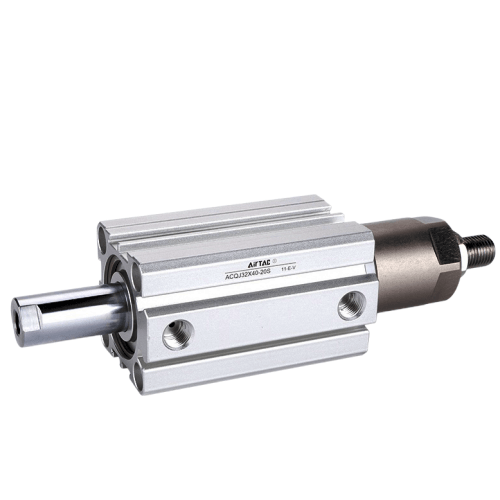
Airtac ACQJ125~160 Adjustable Compact Cylinder ACQJ125X250-50SB
The AirTAC Airtac ACQJ125~160 Adjustable Compact Cylinder ACQJ125X250-50SB is a genuine double-acting COMPACT (JIS) cylinder with an EXTERNAL adjustable stop on the extend stroke — a Ø125mm bore and 250mm full stroke. Turn the stop to fine-tune the end position on the machine without changing parts.
- BoreØ125 mm
- Full stroke250 mm
- Port sizePT3/8
- Adjuster threadM27×2.0
- No minimum order. A single piece can be ordered.
- Ready in 3–5 business days. That is the time we take to process the order and hand it to the carrier. Transit time after that depends on the destination.
About the Airtac ACQJ125~160 Adjustable Compact Cylinder ACQJ125X250-50SB
The AirTAC ACQJ125X250-50SB is a double-acting, single-rod JIS compact cylinder engineered for big-bore tasks up to 300mm stroke. An external threaded stop with a lock nut restricts the extend end position, yielding a usable extend range of 200-250mm. The retract stroke remains completely unaffected. Because the piston area is unchanged, the force output is identical to a standard ACQ of this bore.
This model includes a male piston rod end (M30x1.5) for direct load coupling and a built-in magnet (-S) compatible with reed or electronic solid-state switches. It uses PT3/8 ports, an M27x2.0 adjuster thread, and fixed elastomer bumpers at both ends. Note that a plain ACQ-type cylinder does not hold its load on air loss; the rod drifts, so an external rod lock is recommended for fail-safe holding.
Airtac ACQJ125~160 Adjustable Compact Cylinder ACQJ125X250-50SB Technical Specifications
| Model | Airtac ACQJ125~160 Adjustable Compact Cylinder ACQJ125X250-50SB |
|---|---|
| Series | ACQJ JIS compact adjustable-stroke cylinder |
| Bore size | Ø125 mm |
| Full stroke | 250 mm |
| Adjuster thread | M27×2.0 |
| Port size | PT3/8 |
| Fluid | Air (filtered by 40µm element) |
|---|---|
| Operating pressure | 0.15 – 1.0 MPa |
| Proof pressure | 1.5 MPa |
| Temperature | -20 to +70 °C |
| Speed range | 30 – 500 mm/s |
| Rod thread | M22×2.5 (F) / M30×1.5 (B) |
Specifications follow the official AirTAC ACQJ datasheet. The adjustable stop shortens the EXTEND stroke only; the piston area — and therefore the force — is the same as a standard ACQ of this bore. Adjustable window options: 10/20/30/40/50/75/100 mm.
Theoretical Output Force (Ø125mm)
| Pressure | Push force | Pull force |
|---|---|---|
| 0.5 MPa | 6136 N | 5734 N |
| 0.7 MPa | 8590 N | — |
| Max (@1.0 MPa) | 1251 kgf | |
Force equals a standard ACQ of the same bore — the adjuster changes stroke length, not piston area. Actual usable force is lower due to friction; size with a safety margin.
Model Code: Airtac ACQJ125~160 Adjustable Compact Cylinder ACQJ125X250-50SB
| ACQJ | JIS compact double-acting ADJUSTABLE-STROKE cylinder series. |
|---|---|
| 125 | Bore size in mm. |
| ×250 | Full stroke length in mm. |
| -0 | Adjustable window in mm (extend stroke can be shortened by up to this). |
| S / B | Magnet (S) / male-thread rod (B); omit for none / female thread. |
Thread: PT standard (G / NPT available). Related: ACQ (fixed stroke), ACQD (double rod), TACQ (guided / non-rotating).
Where the Airtac ACQJ125~160 Adjustable Compact Cylinder ACQJ125X250-50SB Is Used
Press Tonnage Setup
Dial in the exact extend position during heavy press changeovers to accommodate varying material thicknesses without machining new spacers.
Automotive Welding Stops
Fine-tune the extend limit on robotic welding clamps to set precise electrode gaps for different vehicle frame assemblies.
Pallet Forming Jigs
Adjust the extend stroke on the fly to match varying pallet dimensions during automated packaging line format changeovers.
Is the Airtac ACQJ125~160 Adjustable Compact Cylinder ACQJ125X250-50SB the Right Cylinder?
If your application requires less thrust, the adjacent ACQJ100 bore provides 3927.0N push at 0.5MPa, whereas stepping up is unnecessary as the 160mm bore offers 10053.1N. If exact end positioning is not required, a fixed-stroke ACQ cylinder suffices. When ordering this model, verify the 125mm bore, 250mm full stroke, 50mm adjuster window, the -S magnet option, and the -B male rod thread.
Quick checklist
- ✓ Need on-machine end-position tuning?
- ✓ Full stroke and adjust window (mm)
- ✓ Force at your working pressure
- ✓ Magnet (S) for sensors?
- ✓ Female (blank) or male (B) rod thread
Installation & Maintenance Notes
- check Use clean air filtered to 40µm or finer.
- check Keep within 0.15 – 1.0 MPa operating pressure.
- check Lock the adjuster nut after setting the stop.
- check The stop limits the EXTEND stroke only.
- check Avoid side load on the short piston rod.
- check Installation by qualified personnel per AirTAC docs.
Airtac ACQJ125~160 Adjustable Compact Cylinder ACQJ125X250-50SB FAQ
It delivers 6135.9N push and 5733.8N pull at 0.5MPa, 8590.3N push at 0.7MPa, with a maximum push of 1251kgf at 1.0MPa. The full stroke is 250mm, and the external stop allows the usable extend range to be adjusted from 200mm to 250mm.
No, the adjuster only changes the extend stroke length, not the piston area, so force remains identical to a standard ACQ. The cylinder uses fixed elastomer bumpers at each end rather than adjustable air cushions, and the -S magnet works with reed or electronic switches.
Authorized Export Seller
Genuine AirTAC parts produced by AirTAC factory.
1-Year Warranty
Covers non-human-caused product damage.
Fast Dispatch
Standard models are processed and dispatched in 3-5 business days.
Fast Reply
Most inquiries answered within 7-8 hours.
Related AirTAC ACQJ Compact Cylinders
Request a Quote for Airtac ACQJ125~160 Adjustable Compact Cylinder ACQJ125X250-50SB
Send us the quantity and destination. We confirm price, stock and lead time — usually within 7-8 hours.