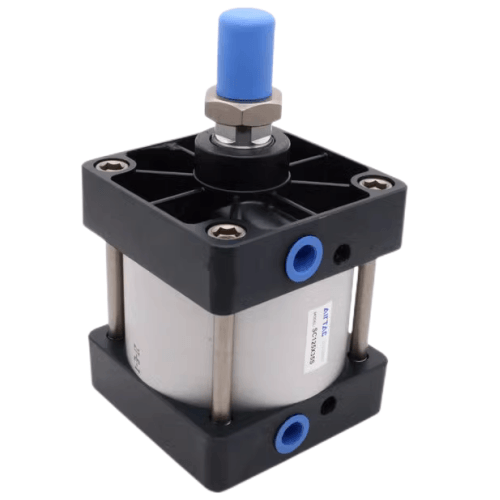
Airtac SC125-160 Standard Cylinder SC160X320S
The AirTAC Airtac SC125-160 Standard Cylinder SC160X320S is a genuine double-acting standard air cylinder with a Ø160mm bore and 320mm stroke, PT3/4 air ports and adjustable end cushioning. It is used for push, pull, lift and clamp motion in industrial automation.
- BoreØ160 mm
- Stroke320 mm
- Port sizePT3/4
- Acting typeDouble acting
- Rod threadM36×2
- CushionAdjustable, 29 mm
- No minimum order. A single piece can be ordered.
- Ready in 3–5 business days. That is the time we take to process the order and hand it to the carrier. Transit time after that depends on the destination.
About the Airtac SC125-160 Standard Cylinder SC160X320S
The AirTAC SC160X320S is a double-acting single-rod pneumatic cylinder delivering a substantial 10053 N push force at 0.5 MPa (18095 N at the 0.9 MPa maximum operating pressure). Its 40 mm diameter piston rod and 29 mm adjustable air cushion handle high-energy end-of-stroke deceleration, making it suitable for demanding industrial actuation.
This model features a built-in magnet (-S suffix) along the barrel, allowing direct mounting of CMSG, DMSG, or EMSG reed and solid-state sensors for precise, non-contact position feedback. With a 320 mm stroke, the total extended body length is approximately 559 mm, fitting into heavy-duty machinery where robust force and sensor integration are required.
Airtac SC125-160 Standard Cylinder SC160X320S Technical Specifications
| Model | Airtac SC125-160 Standard Cylinder SC160X320S |
|---|---|
| Series | SC big-bore tie-rod cylinder (ISO 6430 class) |
| Bore size | Ø160 mm |
| Stroke | 320 mm |
| Acting type | Double acting |
| Port size | PT3/4 |
| Rod thread | M36×2 |
| Fluid | Air (filtered by 40µm element) |
|---|---|
| Operating pressure | 0.15 – 1.0 MPa |
| Proof pressure | 1.5 MPa |
| Temperature | -20 to +70 °C |
| Speed range | 30 – 500 mm/s |
| Cushion | Adjustable, 29 mm |
| Max stroke | Up to 1500 mm |
Specifications follow the official AirTAC SC series datasheet. Operating pressure 0.15–1.0 MPa, proof pressure 1.5 MPa, temperature −20 to +70 °C. Confirm against the product label before installation. Thread options: PT (standard) / G.
Theoretical Output Force (Ø160mm)
| Pressure | Push force | Pull force |
|---|---|---|
| 0.5 MPa | 10053 N | 9425 N |
| 0.7 MPa | 14074 N | — |
| Max (approx.) | 2050 kgf | |
Actual usable force is lower than theoretical due to friction and back-pressure. Size with a safety margin.
Model Code: Airtac SC125-160 Standard Cylinder SC160X320S
| SC | Standard tie-rod cylinder series. |
|---|---|
| 160 | Bore size in mm. |
| ×320 | Stroke length in mm. |
| -S | Optional built-in magnet for sensor position sensing. |
Related variants: SCD (double rod), SCJ (adjustable stroke), SCT (multi-position). Seals: TPU standard / H = Viton / N = NBR. Thread: blank = PT, G = G thread.
Where the Airtac SC125-160 Standard Cylinder SC160X320S Is Used
Heavy Press & Clamping
Generates over 18 kN of clamping force at 0.9 MPa, ideal for hydraulic-to-pneumatic press conversions, holding large workpieces during machining, or injection mold clamping.
Pallet & Load Transfer
The 320 mm stroke and 10053 N push force reliably transfer heavy pallets, shift large crates on roller conveyors, or actuate lift tables in distribution centers.
Damper & Gate Actuation
Combined with the built-in magnet for end-of-stroke sensing, this cylinder actuates heavy industrial dampers, diverter gates, or chutes in material processing lines.
Is the Airtac SC125-160 Standard Cylinder SC160X320S the Right Cylinder?
For applications requiring slightly less force, stepping down to the 125 mm bore SC series provides 6136 N push at 0.5 MPa, while the 200 mm bore offers 15708 N. The SC160X320S is a tie-rod cylinder, shorter than an ISO 15552 profile, so replacement must match another AirTAC SC or tie-rod cylinder of identical 160 mm bore, 320 mm stroke, PT port thread, basic mounting, and integrated magnet. At this stroke length, ensure the rod is not subjected to significant side loading; an external guide or guided cylinder is recommended to prevent rod bearing wear and bending.
Quick checklist
- ✓ Required force at your working pressure
- ✓ Stroke and mounting space
- ✓ Port/thread type (PT/NPT/G)
- ✓ Magnet (-S) for sensors?
- ✓ Side load — consider a guided cylinder
Installation & Maintenance Notes
- check Use clean air filtered to 40µm or finer.
- check Keep within 0.15 – 1.0 MPa operating pressure.
- check Avoid side load on the piston rod.
- check Adjust end cushion screws for smooth stops.
- check Use correct mounting accessory (FA/FB/CA/CB/LB/TC).
- check Installation by qualified personnel per AirTAC docs.
Airtac SC125-160 Standard Cylinder SC160X320S FAQ
At 0.5 MPa air pressure, the theoretical push force is 10053 N and the pull force is 9425 N. At the maximum operating pressure of 0.9 MPa, push force increases to 18095 N. The theoretical maximum at 1.0 MPa is 2050 kgf.
Yes, the -S suffix indicates a built-in magnetic ring on the piston. This allows AirTAC CMSG, DMSG, or EMSG sensors to be clamped directly onto the cylinder barrel's tie-rod slots for contactless position detection without additional brackets.
Authorized Export Seller
Genuine AirTAC parts produced by AirTAC factory.
1-Year Warranty
Covers non-human-caused product damage.
Fast Dispatch
Standard models are processed and dispatched in 3-5 business days.
Fast Reply
Most inquiries answered within 7-8 hours.
Request a Quote for Airtac SC125-160 Standard Cylinder SC160X320S
Send us the quantity and destination. We confirm price, stock and lead time — usually within 7-8 hours.