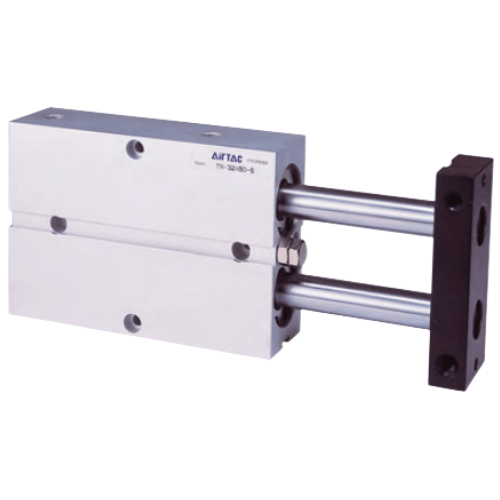
Airtac TN Double Axis Double Rod Cylinder TN10X30S
The AirTAC Airtac TN Double Axis Double Rod Cylinder TN10X30S is a genuine TN twin-rod (double-rod) double-acting cylinder, 10 mm bore. Two parallel rods on one plate resist bending and twisting and let the load mount without rotating. It delivers about 78.6 N of push at 0.5 MPa. A front bumper cushions the impact and adjusts the stroke over a -5 to 0 mm range.
- TypeTwin-rod, double acting
- Standardenterprise standard
- Bore10 mm
- Push thrust @0.5 MPa78.6 N
- Operating pressure0.2 - 1.0 MPa (29 - 145 psi)
- Port sizeM5x0.8
- CushionAdjustable bumper (-5 to 0 mm)
- MagnetStandard (sensor-ready)
- ThreadPT
- No minimum order. A single piece can be ordered.
- Ready in 3–5 business days. That is the time we take to process the order and hand it to the carrier. Transit time after that depends on the destination.
About the Airtac TN Double Axis Double Rod Cylinder TN10X30S
A twin-rod cylinder uses two parallel rods on a shared plate to resist bending and twisting, letting the load move without rotating. This AirTAC TN10X30S has a 10mm bore and 30mm stroke, delivering 39.3 N of push thrust at 0.5 MPa. It uses an adjustable bumper that cushions impact and allows a -5 to 0 mm stroke adjustment.
This is a genuine AirTAC part meeting the enterprise standard. It includes a standard magnet for switch slots and PT threading. We confirm dimensions and sizing from the datasheet on request.
Airtac TN Double Axis Double Rod Cylinder TN10X30S Technical Specifications
| Model | Airtac TN Double Axis Double Rod Cylinder TN10X30S |
|---|---|
| Type | Twin-rod cylinder, double acting |
| Series / standard | TN (enterprise standard) |
| Bore | 10 mm |
| Push thrust @0.5 MPa | 78.6 N |
| Port size | M5x0.8 (PT thread) |
| Fluid | Air, filtered to 40 um |
|---|---|
| Operating pressure | 0.2 - 1.0 MPa (29 - 145 psi) |
| Proof pressure | 1.5 MPa (215 psi) |
| Temperature | -20 to 70 C |
| Speed range | 30 - 500 mm/s |
| Cushion | Bumper, stroke adjustable -5 to 0 mm |
| Magnet | Standard (magnetic-switch slots around the body) |
Specifications follow the official AirTAC TN/TR twin-rod data. Operating pressure is set by bore (0.2 MPa minimum on the 6 and 10 mm bores). The front cover and piston are short, so avoid an over-long stroke. Overall dimensions vary per stroke and allowable side-load is published as curves — ask us and we confirm from the datasheet.
How to choose
Choose this 10mm bore twin-rod cylinder for applications needing 39.3 N of push thrust at 0.5 MPa. The TN series meets the enterprise standard with PT threading only, while the TR series offers a JIS standard with higher non-rotating precision. Keep strokes within the bore's table to avoid excessive side-load on the short cover. We can route specific side-load limits to you.
Applications
Pusher Station
Transfers small parts along a belt with stable, non-rotating push strokes that resist twisting.
Clamp Unit
Holds a workpiece securely in a machining fixture, using the twin rods to prevent rotation during clamping.
Transfer Gate
Moves a light diverter gate back and forth to route small components between two conveyor lines.
FAQ
What is the thrust of this 10mm bore cylinder?
At 0.5 MPa, the push thrust is 39.3 N. The pull thrust is lower, as the rod side area is smaller.
How does the bumper function?
The cylinder uses an external bumper that cushions impact and allows an adjustable stroke of -5 to 0 mm. It is not an air cushion.