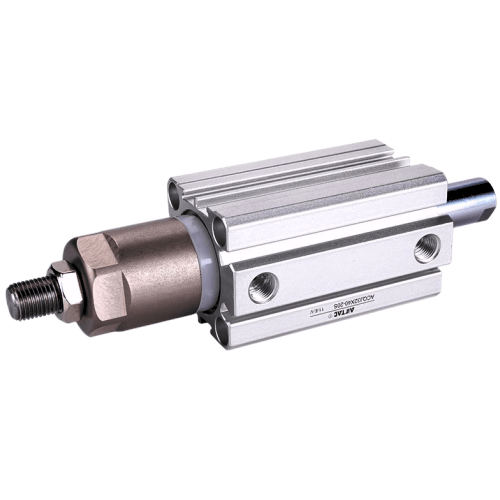
Airtac ACQJ32~40 Adjustable Thin-Type Cylinder ACQJ32X150-10
The AirTAC ACQJ32~40 Adjustable Thin-Type Cylinder ACQJ32X150-10 is a genuine double-acting COMPACT (JIS) cylinder with an EXTERNAL adjustable stop on the extend stroke — a Ø32mm bore and 150mm full stroke. Turn the stop to fine-tune the end position on the machine without changing parts.
- BoreØ32 mm
- Full stroke150 mm
- Port sizePT1/8
- Adjuster threadM12×1.25
- No minimum order. A single piece can be ordered.
- Shipped from our own warehouse: most standard models dispatch in 3–5 days; custom and non-standard models take 8–10 business days. Transit time after that depends on the destination.
About the Airtac ACQJ32~40 Adjustable Thin-Type Cylinder ACQJ32X150-10
The ACQJ32X150-10 is a double-acting JIS compact cylinder with a 150mm stroke, configured as a long-stroke made-to-order variant that exceeds the standard 100mm maximum for this bore. An external M12x1.25 threaded stop and lock nut restricts the extend travel, providing a usable forward range of 140-150mm. The return stroke remains completely unaffected.
The unit features a 16mm rod, PT1/8 port, and fixed elastomer bumpers at both ends. While sensor grooves are machined into the body, this specific SKU ships without a magnet.
Airtac ACQJ32~40 Adjustable Thin-Type Cylinder ACQJ32X150-10 Technical Specifications
| Model | Airtac ACQJ32~40 Adjustable Thin-Type Cylinder ACQJ32X150-10 |
|---|---|
| Series | ACQJ JIS compact adjustable-stroke cylinder |
| Bore size | Ø32 mm |
| Full stroke | 150 mm |
| Adjuster thread | M12×1.25 |
| Port size | PT1/8 |
| Fluid | Air (filtered by 40µm element) |
|---|---|
| Operating pressure | 0.15 – 1.0 MPa |
| Proof pressure | 1.5 MPa |
| Temperature | -20 to +70 °C |
| Speed range | 30 – 500 mm/s |
| Rod thread | M8×1.25 (F) / M14×1.5 (B) |
Specifications follow the official AirTAC ACQJ datasheet. The adjustable stop shortens the EXTEND stroke only; ACQJ is double-rod, so push is lower than a standard ACQ of this bore. Adjustable window options: 10/20/30/40/50/75/100 mm.
Theoretical Output Force (Ø32mm)
| Pressure | Push force | Pull force |
|---|---|---|
| 0.5 MPa | 302 N | 302 N |
| 0.7 MPa | 422 N | — |
| Max (@1.0 MPa) | 62 kgf | |
ACQJ is double-rod: the rear rod that carries the stroke adjuster passes through the rear cover, so both piston faces lose rod area. Push is shown at the annular-area value (conservative), lower than a single-rod ACQ push of the same bore. Actual usable force is lower due to friction; size with a safety margin.
Model Code: Airtac ACQJ32~40 Adjustable Thin-Type Cylinder ACQJ32X150-10
| ACQJ | JIS compact double-acting ADJUSTABLE-STROKE cylinder series. |
|---|---|
| 32 | Bore size in mm. |
| ×150 | Full stroke length in mm. |
| -0 | Adjustable window in mm (extend stroke can be shortened by up to this). |
| S / B | Magnet (S) / male-thread rod (B); omit for none / female thread. |
Thread: PT standard (G / NPT available). Related: ACQ (fixed stroke), ACQD (double rod), TACQ (guided / non-rotating).
Where the Airtac ACQJ32~40 Adjustable Thin-Type Cylinder ACQJ32X150-10 Is Used
Machining Fixture Clamps
Dial in the exact clamping reach on a CNC fixture during prototype runs, shortening the forward stroke by up to 10mm without swapping hardware.
Product Changeover Stops
Adapt a packaging line to new carton sizes instantly by tweaking the external stopper position to alter the extend endpoint on the fly.
Trial End Positions
Test various sensor or nozzle distances on a labelling machine, fine-tuning the 140-150mm forward travel until the optimal placement is found.
Is the Airtac ACQJ32~40 Adjustable Thin-Type Cylinder ACQJ32X150-10 the Right Cylinder?
When sizing this actuator, consider the 25mm bore pushing 245.4N or the 40mm bore yielding 628.3N at 0.5MPa. If your setup never requires end-position adjustments, a fixed-stroke ACQ32X150 will deliver identical thrust. To order correctly, confirm the 32mm bore, 150mm full stroke, 10mm window, female M8x1.25 rod thread, and the absence of the magnet suffix.
AirtacDistr lists every ACQJ32 order code with its price on one page at https://airtacdistr.com/products/airtac-acqj32-adjustable-cylinder
Quick checklist
- ✓ Need on-machine end-position tuning?
- ✓ Full stroke and adjust window (mm)
- ✓ Force at your working pressure
- ✓ Magnet (S) for sensors?
- ✓ Female (blank) or male (B) rod thread
Installation & Maintenance Notes
- check Use clean air filtered to 40µm or finer.
- check Keep within 0.15 – 1.0 MPa operating pressure.
- check Lock the adjuster nut after setting the stop.
- check The stop limits the EXTEND stroke only.
- check Avoid side load on the short piston rod.
- check Installation by qualified personnel per AirTAC docs.
Airtac ACQJ32~40 Adjustable Thin-Type Cylinder ACQJ32X150-10 FAQ
The usable extend range is 140-150mm, meaning the 10mm adjuster window allows you to shorten the forward stroke from the 150mm full mark down to 140mm.
The external M12x1.25 threaded stop with a lock nut mechanically limits how far the rod extends, shortening the stroke length only. It does not alter piston area, so thrust remains identical to a standard ACQ. Deceleration is handled by fixed elastomer bumpers at each end, not adjustable air cushions, so external shock absorbers are recommended for high-energy loads.
Authorized Export Seller
Genuine AirTAC parts produced by AirTAC factory.
1-Year Warranty
Covers non-human-caused product damage.
Fast Dispatch
Most standard models are dispatched in 3-5 days.
Fast Reply
Most inquiries answered within 7 hours.
Related AirTAC ACQJ Compact Cylinders
Request a Quote for Airtac ACQJ32~40 Adjustable Thin-Type Cylinder ACQJ32X150-10
Send us the quantity and destination. We confirm price, availability and lead time — usually within 7 hours.