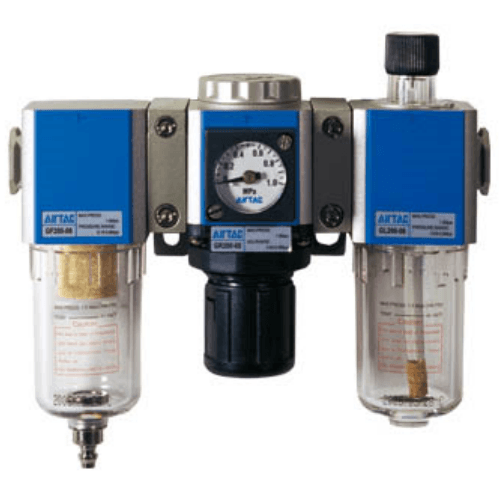
AirTAC GC300-15 FRL Unit (GC30015MF3WT)
The AirTAC GC300-15 FRL Unit (GC30015MF3WT) is a genuine G-series three-unit F.R.L. combination: a separate filter, a separate regulator and a separate lubricator assembled as one air-preparation station. It has PT1/2" ports, a 5 µm element, a manual drain and regulates 0.05 - 0.9 MPa (7 - 130 psi).
- TypeF.R.L. combination (3 units)
- Port sizePT1/2"
- Regulating range0.05 - 0.9 MPa (7 - 130 psi)
- Filtering grade5 µm
- DrainManual drain
- Bowl materialPC
- Pressure gaugeFitted
- ThreadNPT
- No minimum order. A single piece can be ordered.
- Shipped from our own warehouse: most standard models dispatch in 3–5 days; custom and non-standard models take 8–10 business days. Transit time after that depends on the destination.
About the AirTAC GC300-15 FRL Unit (GC30015MF3WT)
GC30015MF3WT is an AirTAC G-series three-unit F.R.L. combination: separate filter, regulator and lubricator units for a 1/2 in. NPT port. This configuration carries a manual drain on the filter bowl, the finer 5 um filter element, and an embedded square pressure gauge scaled in bar. The lubricator meters an oil mist into the downstream air for cylinders, valves and air tools that run on lubricated supply.
This is a genuine AirTAC part in the GC300 size. The G-series runs from size 200 to 600 with larger ports and higher flow, and the F.R.L. is offered with a choice of drain type, 40 or 5 um filtration, gauge shape and scale (MPa, psi or bar), three thread types (NPT on this code), and an optional bracket. Flow is published as curves rather than a single rating, so we confirm datasheet and sizing figures on request.
AirTAC GC300-15 FRL Unit (GC30015MF3WT) Technical Specifications
| Model | AirTAC GC300-15 FRL Unit (GC30015MF3WT) |
|---|---|
| Series | GC300 F.R.L. combination |
| Composition | Filter + regulator + lubricator (3 units) |
| Port size | PT1/2" (NPT thread) |
| Filtering grade | 5 µm |
| Regulating range | 0.05 - 0.9 MPa (7 - 130 psi) |
| Pressure type | Standard type |
| Fluid | Compressed air |
|---|---|
| Max. working pressure | 1.0 MPa (145 psi) |
| Temperature range | -5 to +70 °C (unfreeze) |
| Drain type | Manual drain |
| Bowl material | PC |
| Pressure gauge | Fitted — square, bar scale |
| Reflux valve | Not fitted |
Specifications follow the official AirTAC G-series air-preparation data. The regulating band is set by the drain type: automatic and differential-pressure drains regulate 0.15 - 0.9 MPa, a manual drain regulates 0.05 - 0.9 MPa. Standard type, regulating 0.05 - 0.9 MPa (7 - 130 psi). The combination has no separate bracket code — the three units couple together with their own mounting hardware. Flow curves, weight and outline dimensions are not published in our data set — ask us and we will confirm from the factory datasheet.
Model Code: AirTAC GC300-15 FRL Unit (GC30015MF3WT)
| GC300 | G-series F.R.L. combination, 300 body — sets the port range. |
|---|---|
| 15 | Port size PT1/2". This body offers 08 = PT1/4", 10 = PT3/8", 15 = PT1/2". |
| M | Drain: Manual drain — this also sets the regulating band (0.05 - 0.9 MPa (7 - 130 psi)). |
| (blank) | Standard type. Blank is standard, L is the low-pressure type. |
| (blank) | Pressure gauge fitted (blank). |
| F | Gauge shape: Square. C is round, F is square. |
| 3 | Gauge scale: bar. 1 is MPa, 2 is psi, 3 is bar. |
| W | Filtering grade 5 µm. Only 40 µm (blank) and 5 µm (W) exist. |
| T | NPT thread. PT is the default; G is BSPP and T is NPT. |
| (blank) | No reverse-flow valve (the default). |
Field order is size, port, drain, type, gauge, shape, scale, grade, thread, reflux — there is no bracket position on a combination. Constituent units, orderable separately as spares: GF300-15 filter, GR300-15 regulator and GL300-15 lubricator.
Size Class & How It Differs From GFC
- GC200PT1/8" - PT1/4"
- GC300PT1/4" - PT1/2"
- GC400PT3/8" - PT1/2"
- GC600PT3/4" - PT1"
A GC is three separate units, so the filter and the regulator can each be serviced or replaced on their own. A GFC is the two-unit set, where filtering and regulating share one body — shorter, but the two functions come as one part. Both filter, regulate and lubricate.
| This model | GC300 · PT1/2" · 5 µm |
|---|---|
| One size down | GC200 |
| One size up | GC400 |
| Two-unit equivalent | GFC300-15 |
| Build order | Filter → regulator → lubricator |
Where the AirTAC GC300-15 FRL Unit (GC30015MF3WT) Is Used
Robotic welding cell grip circuits
Conditions air for the gripper cylinders and weld-gun clamps on a robotic spot-welding cell, with the 5 um element protecting the pilot valves on each robot axis.
Grain handling gate and diverter valves
Prepares the air supply for slide gates and diverter valves on a grain elevator's 1/2 in. actuation drops, keeping the lobby control panel valves clean and lubricated.
Stone and glass fabrication bench tools
Feeds lubricated air to radial-arm saws, water-fed cutters' pneumatic clamps and air nibblers along a fabrication shop's overhead drop, with one regulated setting for the bench.
Is the AirTAC GC300-15 FRL Unit (GC30015MF3WT) the Right Station?
GC300 with a 1/2 in. NPT port is the mid-large step of the G-series; choose GC200 for smaller drops or GC400/600 for larger ones. The 5 um element here is the finer of the two grades and suits airlines feeding sensitive valves; the 40 um standard grade covers general plant air. Manual drain keeps the filter bowl emptied by an operator at inspection intervals; automatic and differential-pressure drains are alternatives. The standard-type regulator adjusts 0.05-0.9 MPa (7-130 psi) on this manual-drain version, read on a square bar gauge; round gauges and MPa or psi scales are also on offer. This order code has NPT ports (the T in the code); the PT and G versions are separate order codes. Flow is published as curves only, so ask us to confirm sizing against your application before ordering.
Quick checklist
- ✓ Body size for your peak flow (PT1/2" here)
- ✓ Element 40 µm or 5 µm
- ✓ Drain sets the regulating band
- ✓ Gauge fitted, shape and scale
- ✓ Three-unit (GC) or two-unit (GFC) layout
- ✓ Oil mist acceptable downstream
Installation & Maintenance Notes
- check Install with the airflow arrow: filter first, lubricator last.
- check Mount vertically, bowls down.
- check Keep inlet pressure at or below 1.0 MPa (145 psi).
- check Adjust only within 0.05 - 0.9 MPa (7 - 130 psi).
- check Drain condensate before the bowl fills; check the oil level.
- check Keep the station above freezing (-5 to +70 °C, unfreeze).
The PC bowls must not be cleaned with solvents — wipe them with a dry cloth. The lubricator adds an oil mist downstream of the regulator. If any branch of the line must stay oil-free, take that branch off before the lubricator, or use a GR300-15 regulator with a GF300-15 filter on that branch.
AirTAC GC300-15 FRL Unit (GC30015MF3WT) FAQ
AirTAC publishes G-series flow only as curves, not as a single rated number, so we do not quote a rating here. Share your demand in your preferred units and we will confirm the datasheet curve and suitability on request.
The F3 in the code sets a square gauge scaled in bar. The same combination is available with an MPa or psi scale and with a round external gauge, so pick the scale your maintenance team reads most easily.
T selects NPT port threads, the North American taper pipe standard. Without it the same order code has PT (Rc) ports, and with G it has G (BSPP) ports; body, function and dimensions do not change.
Authorized Export Seller
Genuine AirTAC parts produced by AirTAC factory.
1-Year Warranty
Covers non-human-caused product damage.
Fast Dispatch
Most standard models are dispatched in 3-5 days.
Fast Reply
Most inquiries answered within 7 hours.
Related AirTAC Air-Preparation Units
Request a Quote for AirTAC GC300-15 FRL Unit (GC30015MF3WT)
Send us the quantity, thread type (PT / G / NPT), gauge scale and destination. We confirm price, availability and lead time — usually within 7 hours.