This model is discontinued
AirTAC has phased out the MAL series. The drop-in replacement is ACEJ16X70-50S — same bore, stroke, output force, port and mounting, so it fits the same application. Simply order the ACEJ16X70-50S in place of this model. The ACE replacement is a current-production ISO 21287 compact cylinder in the same bore, stroke and force class, with a matching short body and the same mounting-accessory family, so it fits the same envelope. Confirm mounting-interface dimensions against the ACE datasheet before ordering.
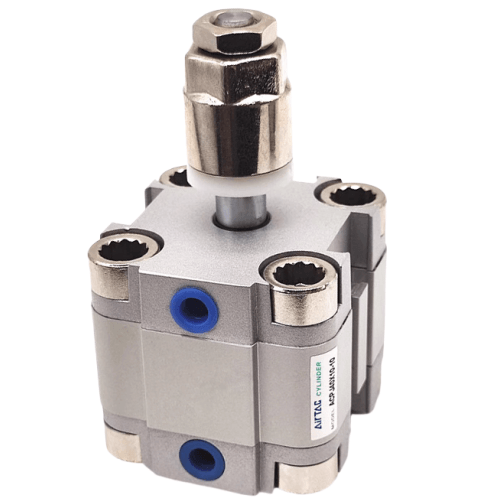
Airtac ACPJ Adjustable Compact Cylinder ACPJ16X70-50S
The AirTAC Airtac ACPJ Adjustable Compact Cylinder ACPJ16X70-50S is a double acting, adjustable stroke DIN-standard tight/compact air cylinder with a Ø16mm bore and 70mm stroke, M5×0.8 air ports and a hard-anodized aluminium body. This model is discontinued — the current-production replacement is the ACEJ16X70-50S (ISO 21287 ACE), in the same bore, stroke and force class.
- BoreØ16 mm
- Stroke70 mm
- Port sizeM5×0.8
- Acting typeDouble acting, adjustable stroke
- Rod threadM4×0.7
- StatusDiscontinued → ACEJ16X70-50S
About the Airtac ACPJ Adjustable Compact Cylinder ACPJ16X70-50S
Double acting and adjustable in stroke, the ACPJ16X70-50S is a discontinued DIN-standard compact cylinder with a 16 mm bore and a 70 mm stroke that an external stop screw trims by up to 50 mm, giving a usable extend range of 20-70 mm. Push force is 100.5 N and pull 75.4 N at 0.5 MPa, rising to 140.7 N at 0.7 MPa. The -S code means the magnet is fitted, so CMSE / DMSE reed or solid-state switches can be clamped onto the hard-anodized aluminium body for end-of-stroke signalling.
In practice, plan on roughly 60 N of real work at 0.5 MPa (about 0.6 of the rated push), which lifts about 5 kg vertically with a 2:1 margin. The short ISO 21287-class body saves about 50% of the mounting length of an ISO 15552 profile cylinder, and FA/FB flange or LB foot mounts bolt straight to the face. This model is discontinued: the current-production drop-in is the ACEJ16X70, so confirm ISO 21287 mounting dimensions before swapping.
Airtac ACPJ Adjustable Compact Cylinder ACPJ16X70-50S Technical Specifications
| Model | Airtac ACPJ Adjustable Compact Cylinder ACPJ16X70-50S |
|---|---|
| Series | ACPJ DIN compact cylinder (discontinued) |
| Replacement | ACEJ16X70-50S |
| Bore size | Ø16 mm |
| Stroke | 70 mm |
| Acting type | Double acting, adjustable stroke |
| Port size | M5×0.8 |
| Rod thread | M4×0.7 |
| Fluid | Air (filtered by 40µm element) |
|---|---|
| Operating pressure | 0.15 – 1.0 MPa |
| Proof pressure | 1.5 MPa |
| Temperature | -20 to +70 °C |
| Speed range | 30 – 500 mm/s |
| Cushion | Fixed bumper (both ends) |
| Max standard stroke | Up to 75 mm |
Specifications follow the official AirTAC ACP datasheet (now discontinued). The ACEJ16X70-50S (ISO 21287) carries the same bore/stroke/force class; confirm mounting-interface dimensions against the ACE datasheet before installation. Rod type: female thread (blank) or male thread (B). Thread options: PT (blank) / G.
Theoretical Output Force (Ø16mm)
| Pressure | Push force | Pull force |
|---|---|---|
| 0.5 MPa | 101 N | 75 N |
| 0.7 MPa | 141 N | 106 N |
| Max (@1.0 MPa) | 21 kgf | |
The ACEJ16X70-50S produces the same force from the same bore. Actual usable force is lower than theoretical; size with a margin.
Model Code: Airtac ACPJ Adjustable Compact Cylinder ACPJ16X70-50S
| ACPJ | DIN compact cylinder (adjustable-stroke, discontinued). |
|---|---|
| 16 | Bore size in mm. |
| ×70 | Stroke length in mm. |
| -50 | Adjustable stroke window (mm the extend stroke can be shortened on site). |
| S | Optional built-in magnet for sensor position sensing (omit for no magnet). |
| B | Rod type: B = male thread; blank = female thread. |
Replacement mapping (swap P for E): ACP→ACE, ASP→ASE, ATP→ATE, ACPD→ACED, ACPJ→ACEJ. ACP-family: ACP (double acting), ASP / ATP (single acting push / pull), ACPD (double rod), ACPJ (adjustable stroke).
Where the Airtac ACPJ Adjustable Compact Cylinder ACPJ16X70-50S Is Used
Small-part ejection on assembly fixtures
The 20-70 mm trimmed extend range and 100.5 N push at 0.5 MPa suit knocking plastic caps or terminal blocks out of a nest on an electronics assembly bench.
Light clamping of machined blanks
About 60 N of usable clamping force at 0.5 MPa holds aluminium or brass workpieces in a drilling jig, with the fitted magnet feeding a CMSE switch to the PLC for cycle confirmation.
Compact indexing in tight gantries
The short body saves about 50% of the mounting length of an ISO 15552 profile cylinder, letting the 70 mm stroke fit inside shallow guarding or a pick-and-place gantry where a full-length cylinder will not.
Replacing the Airtac ACPJ Adjustable Compact Cylinder ACPJ16X70-50S with the ACEJ16X70-50S
Size both ways: a 12 mm bore gives 56.5 N push at 0.5 MPa, while a 20 mm bore reaches 157.1 N, so the 16 mm at 100.5 N sits between them for light clamping and indexing. The stop screw shortens the extend stroke only within the 50 mm window; it is a mechanical end stop, not a mid-stroke lock, so the rod can still drift if air is lost. The fitted -S magnet pairs with CMSE / DMSE switches, and FA/FB flange or LB foot mounting suits standard fixtures. For new builds, order the ACEJ16X70, the current ISO 21287 replacement in the same bore, stroke and force class.
Replacement checklist
- ✓ Current-production ACE → ACEJ16X70-50S
- ✓ Same bore / stroke / force class
- ✓ Confirm ISO 21287 mounting dimensions
- ✓ Port/thread type (PT / G)
- ✓ Add -S for magnet if you need sensors
Airtac ACPJ Adjustable Compact Cylinder ACPJ16X70-50S FAQ
At 0.5 MPa it pushes 100.5 N and pulls 75.4 N; at 0.7 MPa push rises to 140.7 N and pull to 105.6 N, with a theoretical maximum of 20.5 kgf at 1.0 MPa. The -50 code sets a 50 mm adjustment window: a stop screw shortens the 70 mm extend stroke on site to any value from 20 mm to 70 mm. It shortens the stroke only and never lengthens it, and it is an end stop, not a load-holding lock. Operating pressure is 0.15-1.0 MPa (22-145 psi) and speed 30-500 mm/s.
No, the ACPJ family is discontinued. The current-production drop-in is the ACEJ16X70, which swaps the P for an E and matches the same 16 mm bore, 70 mm stroke and force class in the ISO 21287 short-body format. Because the ACPJ was built to a DIN-standard compact pattern, confirm the ISO 21287 mounting dimensions against your fixture before swapping. The -S magnet on this model accepts CMSE / DMSE switches, and the fixed TPU bumper at both ends simply decelerates the piston at each end of travel.
Related AirTAC ACE Cylinders
Request a Quote for the ACEJ16X70-50S
Send us the quantity and destination. We confirm price, stock and lead time on the ACEJ16X70-50S replacement — usually within 7-8 hours.