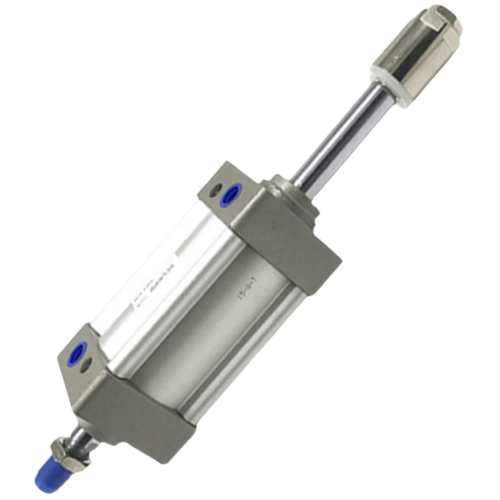
Airtac JSIJ32~50 Adjustable Cylinder JSIJ50X700-50
The AirTAC Airtac JSIJ32~50 Adjustable Cylinder JSIJ50X700-50 is a genuine double acting, adjustable stroke JIS-standard air cylinder with a Ø50mm bore and 700mm stroke, G1/4 air ports and adjustable end cushioning. Its no-tie-rod, hard-anodized profile barrel is more compact than an ISO 15552 cylinder of the same bore — a space-saver on tight machines.
- BoreØ50 mm
- Stroke700 mm
- Port sizeG1/4
- Acting typeDouble acting, adjustable stroke
- Rod threadM18×1.5
- CushionAdjustable, 20.5 mm
About the Airtac JSIJ32~50 Adjustable Cylinder JSIJ50X700-50
Generating 982 N of push force at 0.5 MPa, this 50 mm bore pneumatic actuator brings on-site flexibility to long-stroke automation. The hard-anodized aluminum profile barrel keeps the overall body shorter and more compact than a same-bore ISO 15552 unit. It handles about 589 N of real work safely, which translates to lifting roughly 50 kg vertically with a 2:1 margin.
The external stop screw provides a 50 mm adjustment window, letting you trim the usable extend stroke down from the 700 mm maximum to 650 mm without changing the cylinder itself. The retract end remains fixed, and the G1/4 port feeds the adjustable air cushions at both ends. Because this is a plain SKU without a magnet, it cannot take a CMSE or DMSE sensor.
Airtac JSIJ32~50 Adjustable Cylinder JSIJ50X700-50 Technical Specifications
| Model | Airtac JSIJ32~50 Adjustable Cylinder JSIJ50X700-50 |
|---|---|
| Series | JSI JIS-standard profile cylinder |
| Bore size | Ø50 mm |
| Stroke | 700 mm |
| Acting type | Double acting, adjustable stroke |
| Port size | G1/4 |
| Rod thread | M18×1.5 |
| Fluid | Air (filtered by 40µm element) |
|---|---|
| Operating pressure | 0.15 – 1.0 MPa |
| Proof pressure | 1.5 MPa |
| Temperature | -20 to +70 °C |
| Speed range | 30 – 800 mm/s |
| Cushion | Adjustable, 20.5 mm |
| Max standard stroke | Up to 1200 mm |
Specifications follow the official AirTAC JSI (JIS standard) datasheet. Confirm against the product label before installation. Thread options: PT (blank) / G. Barrel: hard-anodized aluminum profile (no tie rods).
Theoretical Output Force (Ø50mm)
| Pressure | Push force | Pull force |
|---|---|---|
| 0.5 MPa | 982 N | 825 N |
| 0.7 MPa | 1374 N | — |
| Max (@1.0 MPa) | 200 kgf | |
Actual usable force is lower than theoretical due to friction and back-pressure. Size with a safety margin.
Model Code: Airtac JSIJ32~50 Adjustable Cylinder JSIJ50X700-50
| JSIJ | JIS-standard profile cylinder (adjustable-stroke type). |
|---|---|
| 50 | Bore size in mm (32 / 40 / 50 / 63 / 80 / 100 / 125). |
| ×700 | Stroke length in mm. |
| -S | Optional built-in magnet for CMSE / DMSE sensors. |
JSI-family variants: JSI (double acting), JSID (double rod), JSIJ (adjustable stroke). Mounting: LB / FA / FB / CA / CB / CR / TC / TCM1 / TCM2. Thread PT (blank) / G.
Where the Airtac JSIJ32~50 Adjustable Cylinder JSIJ50X700-50 Is Used
Long-Reach Diversion
Pushes packages across a wide sorting lane, using the 50 mm adjuster to dial the exact extend reach without swapping the actuator.
Pallet Stopper Tuning
Halts inbound pallets on a transfer line, allowing on-site stroke reduction to accommodate varying pallet depths.
Material Alignment
Squares long metal profiles in a fabrication cell, tweaking the end position to adapt to different part widths.
Is the Airtac JSIJ32~50 Adjustable Cylinder JSIJ50X700-50 the Right Cylinder?
When sizing, the neighboring 40 mm bore yields 628 N push at 0.5 MPa while the 63 mm bore steps up to 1559 N, so the 50 mm bore at 982 N sits right in the middle for medium-duty cycles. The 50 mm adjustable window is ideal when you need to fine-tune the extend end position on-site or want a shared spare across slightly different stroke variants. You can mount it via FA, LB, TC, TCM1, or TCM2 brackets. Because the 700 mm stroke is quite long, always use an external guide to prevent rod bending and side-load damage. Note that this non-magnetized version cannot support position sensing.
Quick checklist
- ✓ Required force at your working pressure
- ✓ Stroke and mounting space
- ✓ Port/thread type (PT / G / NPT)
- ✓ Magnet (-S) for sensors?
- ✓ Side load — consider a guided cylinder
Installation & Maintenance Notes
- check Use clean air filtered to 40µm or finer.
- check Keep within 0.15 – 1.0 MPa operating pressure.
- check Avoid side load on the piston rod.
- check Set cushions to minimum, then release gradually.
- check Use correct mounting accessory (LB/FA/FB/CA/CB/TC).
- check Installation by qualified personnel per AirTAC docs.
Airtac JSIJ32~50 Adjustable Cylinder JSIJ50X700-50 FAQ
At 0.5 MPa it pushes 982 N and pulls 825 N. At 0.7 MPa it pushes 1374 N and pulls 1154 N. The theoretical maximum force is 200 kgf at 1.0 MPa. The air port is G1/4.
The nominal 700 mm stroke is the maximum. An external stop screw lets you shorten the extend stroke on-site by up to 50 mm, giving a usable extend range of 650 to 700 mm. The retract end is fixed. This stop only sets the end position; it does not lock the load.
Authorized Export Seller
Genuine AirTAC parts produced by AirTAC factory.
1-Year Warranty
Covers non-human-caused product damage.
Fast Dispatch
Standard models usually ship in 3-4 days.
Fast Reply
Most inquiries answered within 7-8 hours.
Related AirTAC JSI Cylinders
Request a Quote for Airtac JSIJ32~50 Adjustable Cylinder JSIJ50X700-50
Send us the quantity and destination. We confirm price, stock and lead time — usually within 7-8 hours.