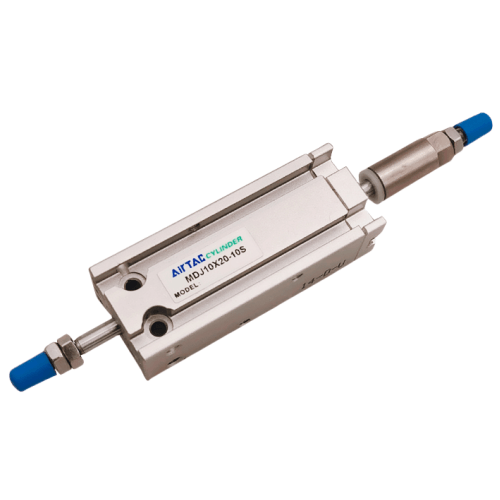
Airtac MDJ Adjustable Cylinder MDJ16X20-10
The AirTAC Airtac MDJ Adjustable Cylinder MDJ16X20-10 is a genuine MD multi-mount cylinder (adjustable stroke), 16 mm bore. Its compact square body fixes from six directions and mounts side by side to save space. It delivers about 100.5 N of push force at 0.5 MPa. A bumper cushions the impact.
- TypeMulti-mount, adjustable stroke
- SeriesMD (standard)
- Bore16 mm
- Push thrust @0.5 MPa100.5 N
- Operating pressure0.15 - 1.0 MPa (22 - 145 psi)
- Port sizeM5x0.8
- CushionBumper
- MagnetWithout magnet
- ThreadPT
- No minimum order. A single piece can be ordered.
- Ready in 3–5 business days. That is the time we take to process the order and hand it to the carrier. Transit time after that depends on the destination.
About the Airtac MDJ Adjustable Cylinder MDJ16X20-10
The MDJ16X20-10 is an adjustable-stroke model in AirTAC's multi-mount cylinder series, a compact square-body air cylinder that fixes from 6 directions - front, back, left, right, top and bottom - and mounts side by side with other cylinders to save space. This double-acting bore 16 unit has a 20 mm base stroke plus a 10 mm adjustable range, letting you trim the effective stroke to suit the station. At 0.5 MPa it delivers a theoretical push force of 100.5 N, suited to light clamping, locating and stopper tasks, and cushioning is provided by a bumper.
This is a genuine AirTAC part in the standard MD family, where the rod can rotate under load - if your application needs a rod that must not turn, the no-rotating MK family is the alternative. The code carries no trailing S, so this SKU is without the position magnet, though magnetic-switch slots are still machined around the body. We can confirm dimensions and sizing from the datasheet on request.
Airtac MDJ Adjustable Cylinder MDJ16X20-10 Technical Specifications
| Model | Airtac MDJ Adjustable Cylinder MDJ16X20-10 |
|---|---|
| Type | Multi-mount cylinder, adjustable stroke |
| Series | MD (standard) |
| Bore | 16 mm |
| Push thrust @0.5 MPa | 100.5 N |
| Port size | M5x0.8 (PT thread) |
| Magnet | Without magnet |
| Fluid | Air, filtered to 40 um |
|---|---|
| Operating pressure | 0.15 - 1.0 MPa (22 - 145 psi) |
| Proof pressure | 1.5 MPa (215 psi) |
| Temperature | -20 to 70 C |
| Speed range | 30 - 500 mm/s |
| Cushion | Bumper |
| Mounting | Fix from 6 directions; mountable side by side |
Specifications follow the official AirTAC MD/MK multi-mount data. The front cover and piston are short, so avoid an over-long stroke. An optional high-temperature seal material extends the range to 0 to 150 C. Overall dimensions vary per stroke and allowable side-load is published as curves — ask us and we confirm from the datasheet.
How to choose
Choose bore 16 when you need around 100.5 N of theoretical push at 0.5 MPa; bore 20 gives 157.1 N and bore 10 gives 39.3 N if your force budget points elsewhere. This is the MD standard body, which allows rod rotation - the MK no-rotating family prevents it. Acting is double acting (air extends and retracts the rod); single-push, single-pull and double-rod options exist elsewhere in the range.
The 20 mm stroke is comfortably within the bore 16 double-acting table limit of 50 mm, and the MDJ suffix adds a 10/20/30 mm adjustable range - this SKU carries the 10 mm range. No trailing S means no magnet is fitted on this SKU; select an S-suffixed code if you need switch detection. Ports are M5x0.8 with PT thread standard and G available. Keep strokes short on this compact body - an over-long stroke on a short cover is the common mis-selection - and send side-load questions to us, since that is a datasheet figure.
Applications
Light press-fit and clinch stations
Apply the 100.5 N push at 0.5 MPa to seat small clips, pins or bearings in compact bench-top press stations, with the 10 mm adjustable range used to set the stop height.
Gate and stopper on small conveyors
Extend and retract a gate or stopper blade on a compact conveyor line, using the 6-direction body fixing to bolt the cylinder onto the conveyor side rail where space is tight.
Pick-and-place z-axis lift
Provide the short vertical lift stroke on a small pick-and-place head, where the side-by-side mounting lets several cylinders pack into one compact gantry column.
FAQ
How do I choose between the MD and MK versions of this cylinder?
The MD body is the standard multi-mount cylinder and allows the rod to rotate unless your tooling prevents it. The MK body is the no-rotating version, which uses a plate, bushing and fixed rod to stop the rod turning - choose MK when a load or tool must keep a fixed orientation. Acting type and bores are otherwise comparable.
Is there a limit on how long a stroke I should run on this compact body?
Yes - the short covers of the multi-mount body are designed for compact duties, and the bore 16 double-acting stroke table tops out at 50 mm. An over-long stroke on a short cover is the usual mis-selection, and allowable side-load is a datasheet figure, so confirm both with us before finalising the design.