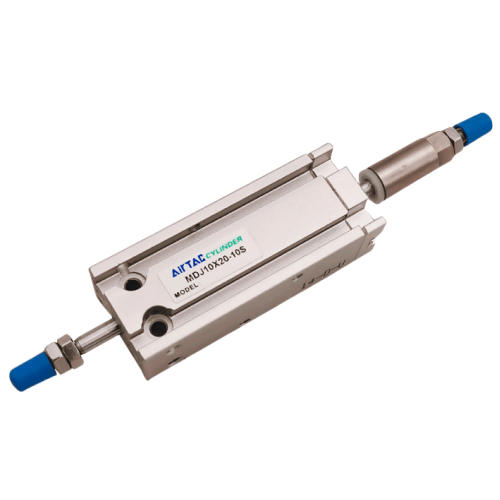
Airtac MDJ Adjustable Cylinder MDJ16X40-10S
The AirTAC Airtac MDJ Adjustable Cylinder MDJ16X40-10S is a genuine MD multi-mount cylinder (adjustable stroke), 16 mm bore. Its compact square body fixes from six directions and mounts side by side to save space. It delivers about 100.5 N of push force at 0.5 MPa. A bumper cushions the impact.
- TypeMulti-mount, adjustable stroke
- SeriesMD (standard)
- Bore16 mm
- Push thrust @0.5 MPa100.5 N
- Operating pressure0.15 - 1.0 MPa (22 - 145 psi)
- Port sizeM5x0.8
- CushionBumper
- MagnetWith magnet (sensor-ready)
- ThreadPT
- No minimum order. A single piece can be ordered.
- Ready in 3–5 business days. That is the time we take to process the order and hand it to the carrier. Transit time after that depends on the destination.
About the Airtac MDJ Adjustable Cylinder MDJ16X40-10S
The AirTAC MDJ16X40-10S is an adjustable-stroke multi-mount cylinder: a compact square-body, double-acting unit that fixes from six directions and mounts side by side to save space in dense machine layouts. Its 16 mm bore produces about 100.5 N of theoretical push force at 0.5 MPa over a 40 mm stroke with a 10 mm adjustable range for precise end-of-stroke setting, and the cushion is a bumper. The magnet is built in, so a switch seated in the slots around the body can signal end positions. Speed range is 30-500 mm/s, with high guide precision and no added lubricant needed.
This is a genuine AirTAC part in the MD standard series, where the rod may rotate unless externally guided; for rotation prevention, the MK family adds a built-in no-rotating plate. Medium is air filtered to 40 um, operating pressure 0.15-1.0 MPa (22-145 psi), proof pressure 1.5 MPa (215 psi), and the temperature range is -20 to 70 C (0 to 150 C only with the optional high-temperature seal material). Overall dimensions and detailed sizing are per the datasheet, which we confirm on request.
Airtac MDJ Adjustable Cylinder MDJ16X40-10S Technical Specifications
| Model | Airtac MDJ Adjustable Cylinder MDJ16X40-10S |
|---|---|
| Type | Multi-mount cylinder, adjustable stroke |
| Series | MD (standard) |
| Bore | 16 mm |
| Push thrust @0.5 MPa | 100.5 N |
| Port size | M5x0.8 (PT thread) |
| Magnet | With magnet (S) |
| Fluid | Air, filtered to 40 um |
|---|---|
| Operating pressure | 0.15 - 1.0 MPa (22 - 145 psi) |
| Proof pressure | 1.5 MPa (215 psi) |
| Temperature | -20 to 70 C |
| Speed range | 30 - 500 mm/s |
| Cushion | Bumper |
| Mounting | Fix from 6 directions; mountable side by side |
Specifications follow the official AirTAC MD/MK multi-mount data. The front cover and piston are short, so avoid an over-long stroke. An optional high-temperature seal material extends the range to 0 to 150 C. Overall dimensions vary per stroke and allowable side-load is published as curves — ask us and we confirm from the datasheet.
How to choose
Bore 16 is the thrust point: about 100.5 N of theoretical push at 0.5 MPa with the pull side lower, so choose a 20 or 25 mm bore for heavier clamping. MD (this model) suits jobs where rod rotation is acceptable; MK is the choice when rotation must be prevented. Acting types run from double, single push (MSD/MSK) and single pull (MTD/MTK) to double rod (MDD/MKD) and adjustable stroke (MDJ/MKJ, which adds a 10 mm adjustable range to the 40 mm stroke here). Bore 16 strokes go up to 50 mm, and a short stroke relative to the cover is the stable pick because an over-long stroke reduces rigidity; treat side-load as a datasheet question to confirm with us. Magnet is ordered with the S suffix (as on this SKU), and thread is PT (default) or G.
Applications
Small-parts clamp
Banked side by side on a fixture plate, these 16 mm cylinders clamp small housings or terminals in place; the magnet and body slots give a clamped/released signal for the PLC without external sensing hardware.
Vertical lift-and-lower stopper
Fixed from the top or bottom face of the body, the cylinder raises and lowers a light stopper in a vertical feed chute, and the adjustable range trims the lift height so parts stop level at the pick position.
Gate hold-back on an assembly line
The bumper cushion takes the shock as the cylinder holds back or releases parts at a manual work gate, and side-by-side mounting keeps the mechanism within a narrow pitch on crowded line tooling.
FAQ
How much force does the MDJ16X40-10S produce, and what does the S add?
The 16 mm bore gives about 100.5 N of theoretical push force at 0.5 MPa, with the pull side somewhat lower, so size the bore to the load. The trailing S means the cylinder is built with a magnet, so a switch placed in the slots around the body can report stroke-end positions; the same model without the S (MDJ16X40-10) is supplied magnet-free.
Can I shorten the stroke to suit my fixture?
Yes. As an MDJ adjustable-stroke cylinder it adds a 10 mm adjustable range on top of the 40 mm stroke, so the effective end position can be trimmed during setup. Do keep the stroke short relative to the cover on a compact body, because an over-long stroke costs stability; exact dimensions and allowable side-load come from the datasheet, so confirm them with us.