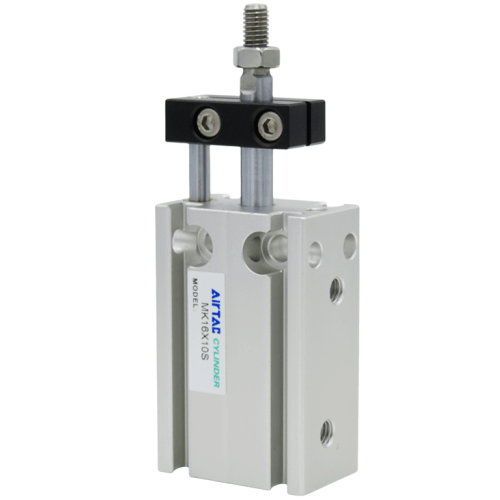
Airtac MK Series Multi-position Locking Cylinder MK25X35
The AirTAC Airtac MK Series Multi-position Locking Cylinder MK25X35 is a genuine MK multi-mount cylinder (double acting), 25 mm bore. Its compact square body fixes from six directions and mounts side by side to save space. It delivers about 245.4 N of push force at 0.5 MPa. A bumper cushions the impact. As an MK unit a fixed rod stops the piston rod rotating.
- TypeMulti-mount, double acting
- SeriesMK (no-rotating)
- Bore25 mm
- Push thrust @0.5 MPa245.4 N
- Operating pressure0.15 - 1.0 MPa (22 - 145 psi)
- Port sizeM5x0.8
- CushionBumper
- MagnetWithout magnet
- ThreadPT
- No minimum order. A single piece can be ordered.
- Ready in 3–5 business days. That is the time we take to process the order and hand it to the carrier. Transit time after that depends on the destination.
About the Airtac MK Series Multi-position Locking Cylinder MK25X35
The AirTAC MK25X35 is a 25mm bore, 35mm stroke no-rotating multi-mount cylinder. Its compact square body fixes from six directions (front, back, left, right, top and bottom), so you can bolt cylinders side by side to save space, with magnetic-switch slots around the body and high guide precision without added lubricant. Double acting at 25mm bore, it delivers a theoretical push thrust of 245.4 N at 0.5 MPa (206.2 N on the pull side), cushioned by a bumper, and runs on filtered air at 0.15-1.0 MPa (22-145 psi) from -20 to 70 C.
This is a genuine AirTAC part in the MK family, where a no-rotating plate, brass bushing and fixed rod stop the piston rod from turning - ideal where a plate or fixture must stay square. This SKU is supplied WITHOUT a magnet, as shown by the absence of the S suffix. Dimensions and sizing are per stroke; we can confirm them from the datasheet on request.
Airtac MK Series Multi-position Locking Cylinder MK25X35 Technical Specifications
| Model | Airtac MK Series Multi-position Locking Cylinder MK25X35 |
|---|---|
| Type | Multi-mount cylinder, double acting |
| Series | MK (no-rotating) |
| Bore | 25 mm |
| Push thrust @0.5 MPa | 245.4 N |
| Port size | M5x0.8 (PT thread) |
| Magnet | Without magnet |
| Fluid | Air, filtered to 40 um |
|---|---|
| Operating pressure | 0.15 - 1.0 MPa (22 - 145 psi) |
| Proof pressure | 1.5 MPa (215 psi) |
| Temperature | -20 to 70 C |
| Speed range | 30 - 500 mm/s |
| Cushion | Bumper |
| Mounting | Fix from 6 directions; mountable side by side |
Specifications follow the official AirTAC MD/MK multi-mount data. The front cover and piston are short, so avoid an over-long stroke. An optional high-temperature seal material extends the range to 0 to 150 C. Overall dimensions vary per stroke and allowable side-load is published as curves — ask us and we confirm from the datasheet.
How to choose
Choose the 25mm bore when you need roughly 245 N of theoretical push at 0.5 MPa on the push side (206.2 N pull side); smaller bores give less thrust and 32mm gives more. MK differs from MD: rotation of the rod is prevented, not merely allowed, so pick MK for plates and stops. This is the double acting MK version; the family also offers single acting push (MSK), single acting pull (MTK), double rod (MKD) and adjustable stroke (MKJ) variants. The 35mm stroke sits well inside the 60mm maximum for this bore - the short square cover cautions against over-long strokes, so keep strokes compact. This SKU has no magnet (no S suffix) and PT thread; a magnet (S suffix) and G thread are available on other SKUs. Confirm side-load capability from the datasheet.
Applications
Non-rotating stopper gate
Mount the MK25X35 from the side or top of a conveyor line as a stopper for parts on pallets; the fixed rod keeps the stop plate square to the flow while 245 N of push thrust at 0.5 MPa holds parts firmly.
Fixture clamping in jigs
Fix the square body from six directions on a machining jig and clamp workpieces with a face plate that cannot rotate, keeping clamp orientation identical across every cylinder mounted side by side.
Indexing in tight stations
Bolt multiple MK25X35 cylinders side by side in a compact indexing station where each unit advances a part by 35mm; the no-rotating plate keeps pushers aligned without extra guides.
FAQ
Why choose the MK25X35 instead of the standard MD25X35?
Both are 25mm bore, 35mm stroke multi-mount cylinders, but the MK is the no-rotating version: a no-rotating plate, brass bushing and fixed rod stop the piston rod from turning. Use MK when a plate, stopper or fixture must stay square to the body; use MD when rotation is acceptable and cost matters most.
Can I mount this cylinder in any orientation?
Yes. The multi-mount square body fixes from six directions - front, back, left, right, top and bottom - and cylinders can be mounted side by side to save space. The 35mm stroke suits this compact format; keep strokes within the bore's table because the short cover cautions against over-long strokes. Overall dimensions per stroke and side-load figures come from the datasheet.