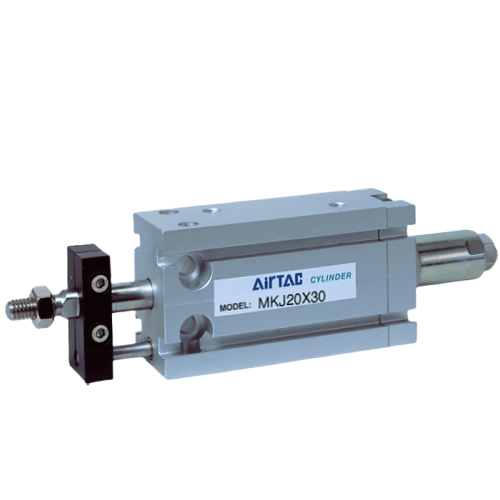
Airtac MKJ Adjustable Cylinder MKJ32X60-30S
The AirTAC Airtac MKJ Adjustable Cylinder MKJ32X60-30S is a genuine MK multi-mount cylinder (adjustable stroke), 32 mm bore. Its compact square body fixes from six directions and mounts side by side to save space. It delivers about 402.1 N of push force at 0.5 MPa. A bumper cushions the impact. As an MK unit a fixed rod stops the piston rod rotating.
- TypeMulti-mount, adjustable stroke
- SeriesMK (no-rotating)
- Bore32 mm
- Push thrust @0.5 MPa402.1 N
- Operating pressure0.15 - 1.0 MPa (22 - 145 psi)
- Port size1/8"
- CushionBumper
- MagnetWith magnet (sensor-ready)
- ThreadPT
- No minimum order. A single piece can be ordered.
- Ready in 3–5 business days. That is the time we take to process the order and hand it to the carrier. Transit time after that depends on the destination.
About the Airtac MKJ Adjustable Cylinder MKJ32X60-30S
The MKJ32X60-30S is an AirTAC MKJ multi-mount cylinder: a double acting, no-rotating cylinder with a 32 mm bore, 60 mm stroke and a further 30 mm adjustable range, and with a magnet built in for position-switch detection. A fixed rod and plate keep the piston rod from turning, so the load stays square to the body - exactly what a stopper, clamp plate or jig drive needs. The square body fixes from 6 directions (front, back, left, right, top, bottom), so cylinders mount side by side to save space, with magnetic-switch slots machined around the body. Cushioning is a bumper, no added lubricant is required, and the bore develops 402.1 N of theoretical push-side thrust at 0.5 MPa.
This is a genuine AirTAC part. The MK family prevents rod rotation, unlike the MD multi-mount family where rotation is allowed; MKJ adds stroke adjustability. This SKU carries the magnet (S at the end of the code) and PT thread. We confirm exact dimensions, weights and sizing from the datasheet on request.
Airtac MKJ Adjustable Cylinder MKJ32X60-30S Technical Specifications
| Model | Airtac MKJ Adjustable Cylinder MKJ32X60-30S |
|---|---|
| Type | Multi-mount cylinder, adjustable stroke |
| Series | MK (no-rotating) |
| Bore | 32 mm |
| Push thrust @0.5 MPa | 402.1 N |
| Port size | 1/8" (PT thread) |
| Magnet | With magnet (S) |
| Fluid | Air, filtered to 40 um |
|---|---|
| Operating pressure | 0.15 - 1.0 MPa (22 - 145 psi) |
| Proof pressure | 1.5 MPa (215 psi) |
| Temperature | -20 to 70 C |
| Speed range | 30 - 500 mm/s |
| Cushion | Bumper |
| Mounting | Fix from 6 directions; mountable side by side |
Specifications follow the official AirTAC MD/MK multi-mount data. The front cover and piston are short, so avoid an over-long stroke. An optional high-temperature seal material extends the range to 0 to 150 C. Overall dimensions vary per stroke and allowable side-load is published as curves — ask us and we confirm from the datasheet.
How to choose
Start with the bore: this 32 mm bore delivers 402.1 N theoretical push-side thrust at 0.5 MPa (345.6 N pull side). Pick MK over MD when the rod must not rotate; MKJ is the adjustable-stroke variant, alongside double acting (MK), single-acting push (MSK), single-acting pull (MTK) and double rod (MKD). The coded stroke is 60 mm with a 30 mm adjustable range on top, so the stroke can be trimmed after mounting. The trailing S means this model includes the magnet; the same code without S omits it. Thread is PT, with G available. Keep the stroke inside the bore's stroke table - a longer stroke means longer covers and a longer body - and ask us for side-load guidance.
Applications
Jig positioning on fixtures
Drive a positioning pin or jig stop where the rod must stay square to the fixture. The no-rotating plate keeps orientation cycle after cycle, and the built-in magnet lets switches confirm the set position in the slots around the body.
Indexing fixture advance
Advance an indexing pallet a fixed distance, then retract. Units sit side by side on crowded fixture plates because the square body fixes from 6 directions, and the bumper cushions each end of travel.
Lane gate on conveyors
Fit a short gate to divert or release parts on a conveyor line. The magnet signals gate position to the controller, and the adjustable range lets the stroke be trimmed to the lane width after installation.
FAQ
What does the S at the end of MKJ32X60-30S mean?
The trailing S means this cylinder is supplied with a magnet, so reed or solid-state switches seated in the slots around the body can detect piston position. The same model without the S, MKJ32X60-30, is ordered without the magnet. The rest of the code decodes as a 32 mm bore, 60 mm stroke with a 30 mm adjustable range, PT thread.
Can this cylinder take a side load, and how long is the body?
Side-load capability depends on the mounting and the application, so we confirm the limit from the datasheet rather than quoting a number here. Overall dimensions also change with the stroke, so request the datasheet figures before detailing your mounting - and remember the bumper cushion needs its end-of-stroke space.