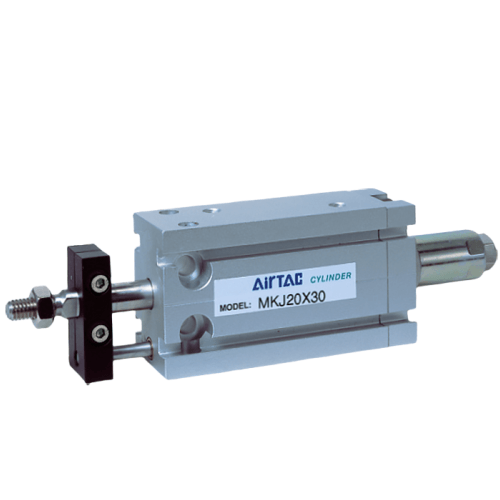
Airtac MKJ Adjustable Cylinder MKJ6X25-30
The AirTAC Airtac MKJ Adjustable Cylinder MKJ6X25-30 is a genuine MK multi-mount cylinder (adjustable stroke), 6 mm bore. Its compact square body fixes from six directions and mounts side by side to save space. It delivers about 14.1 N of push force at 0.5 MPa. A bumper cushions the impact. As an MK unit a fixed rod stops the piston rod rotating.
- TypeMulti-mount, adjustable stroke
- SeriesMK (no-rotating)
- Bore6 mm
- Push thrust @0.5 MPa14.1 N
- Operating pressure0.2 - 1.0 MPa (28 - 145 psi)
- Port sizeM5x0.8
- CushionBumper
- MagnetWithout magnet
- ThreadPT
- No minimum order. A single piece can be ordered.
- Ready in 3–5 business days. That is the time we take to process the order and hand it to the carrier. Transit time after that depends on the destination.
About the Airtac MKJ Adjustable Cylinder MKJ6X25-30
The MKJ6X25-30 is an AirTAC MKJ no-rotating multi-mount cylinder: a compact square body that fixes from six directions (front, back, left, right, top and bottom) and mounts side by side to save space. This 6 mm bore double-acting model has a 25 mm stroke plus a 30 mm adjustable-stroke range, and at 0.5 MPa it produces a theoretical push thrust of 14.1 N - enough for light-duty clamping, stopping and positioning of very small parts. Cushioning is a bumper, and magnetic-switch slots surround the body.
This is a genuine AirTAC part supplied without a magnet - the SKU carries no S suffix, and the magnet is an optional feature on this range. The MKJ family adds a no-rotating plate, brass bushing and fixed rod so the rod cannot turn; the MD family is the standard type where rotation is allowed. Operating pressure is 0.2-1.0 MPa (28-145 psi) for this bore, the medium is air filtered to 40 um, and speed range is 30-500 mm/s. We confirm dimensions and sizing from the datasheet on request.
Airtac MKJ Adjustable Cylinder MKJ6X25-30 Technical Specifications
| Model | Airtac MKJ Adjustable Cylinder MKJ6X25-30 |
|---|---|
| Type | Multi-mount cylinder, adjustable stroke |
| Series | MK (no-rotating) |
| Bore | 6 mm |
| Push thrust @0.5 MPa | 14.1 N |
| Port size | M5x0.8 (PT thread) |
| Magnet | Without magnet |
| Fluid | Air, filtered to 40 um |
|---|---|
| Operating pressure | 0.2 - 1.0 MPa (28 - 145 psi) |
| Proof pressure | 1.5 MPa (215 psi) |
| Temperature | -20 to 70 C |
| Speed range | 30 - 500 mm/s |
| Cushion | Bumper |
| Mounting | Fix from 6 directions; mountable side by side |
Specifications follow the official AirTAC MD/MK multi-mount data. The front cover and piston are short, so avoid an over-long stroke. An optional high-temperature seal material extends the range to 0 to 150 C. Overall dimensions vary per stroke and allowable side-load is published as curves — ask us and we confirm from the datasheet.
How to choose
At 6 mm bore this is the light-thrust option in the range: 14.1 N theoretical push at 0.5 MPa, with larger bores such as 16 mm offering 100.5 N if the job needs more. Choose MKJ when the rod must not rotate and the stroke must be adjustable - here the 30 mm adjustable range sits on top of the 25 mm base stroke. Stroke options for this bore in double acting run to 35 mm, and the short compact covers mean an over-long stroke is rarely sensible. The SKU has no S, so it ships without a magnet; the thread is PT. Allowable side-load figures come from the datasheet - check with us before applying side loads.
Applications
Indexing fixture actuation
Advance a small indexing pin or detent on a rotary or linear indexing fixture. The no-rotating plate holds the pin square to the fixture, the adjustable range lets you tune the index depth within a 25 to 55 mm span, and the body bolts to the fixture from any of six faces.
Small-parts ejection
Push tiny formed or moulded parts off a nest or out of a die. The 6 mm bore's 14.1 N push at 0.5 MPa suits light ejection, the bumper softens end-of-stroke contact, and the square body mounts side by side where a tie-rod cylinder would not fit.
Compact low-force clamping
Clamp thin boards, covers or flexible circuits in a test or soldering fixture. The rod stays rotation-free thanks to the MK no-rotating plate, and the 30 mm adjustable range lets one body serve several fixture depths by screwing the nut to set stroke.
FAQ
Does the MKJ6X25-30 include a position magnet for switches?
No. This SKU has no trailing S, so it is supplied without a magnet. The body still has the magnetic-switch slots, and magnet versions of the same size are available - choose the S variant of the model if you want to drive proximity switches without mounting external brackets.
Why is the stroke listed as 25 mm when the code ends in -30?
The MKJ is an adjustable-stroke cylinder: 25 mm is the base stroke and the -30 adds a 30 mm adjustable range on top, so effective stroke is set anywhere from 25 mm to 55 mm using the adjustment nut. Keep the chosen stroke within the bore's table and confirm exact body dimensions from the datasheet before laying out the mounting.