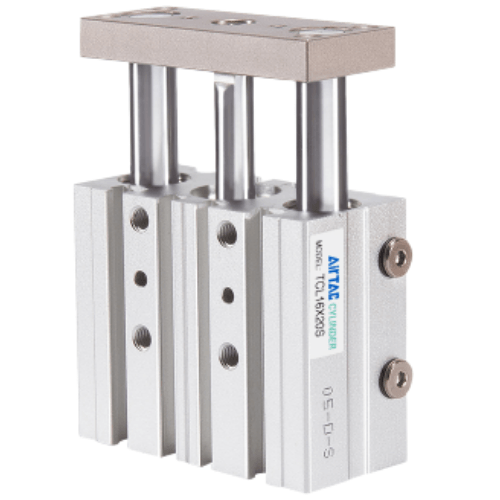
Airtac TCL Triple Axis Cylinder TCL20X90-S
The AirTAC Airtac TCL Triple Axis Cylinder TCL20X90-S is a genuine JIS-standard guided cylinder with a Ø20mm bore and 90mm stroke on twin guide rods. Its integrated steel-ball linear bearing gives low-friction, high-precision travel — well suited to vertical lifts and high-load, high-accuracy moves, holding the tool square to ±0.06° of rotation without any external linear guide.
- BoreØ20 mm
- Stroke90 mm
- Port size1/8"
- BearingSteel-ball linear bearing
- Non-rotating±0.06°
- CushionRubber bumper
- No minimum order. A single piece can be ordered.
- Ready in 3–5 business days. That is the time we take to process the order and hand it to the carrier. Transit time after that depends on the destination.
About the Airtac TCL Triple Axis Cylinder TCL20X90-S
The AirTAC TCL20X90-S is a JIS-standard twin-rod guided cylinder that integrates a drive piston between two guide rods in a single body. Because the guide unit itself prevents rotation and absorbs side load, you can skip mounting an external linear rail. The steel-ball linear bearing provides low-friction, high-precision travel with no stick-slip, making it well suited to vertical lifts and accurate high-cycle positioning. Delivering 157 N of push at 0.5 MPa, this 20 mm bore, 90 mm stroke model keeps tools square under off-centre loads thanks to a tight ±0.06° non-rotating tolerance.
Plumbing is flexible: two independent port groups on the upper face and side let you feed air from whichever direction is clear, while the Ø10 mm piston rod uses 1/8" ports. Stroke ends are damped by fixed elastomer pads rather than an adjustable cushion. A standard built-in magnet works with CS1 reed or DS1 electronic switches in any of the four sensor slots, and precision locating holes mean you can remove and re-fit the unit without re-teaching your position.
Airtac TCL Triple Axis Cylinder TCL20X90-S Technical Specifications
| Model | Airtac TCL Triple Axis Cylinder TCL20X90-S |
|---|---|
| Series | TCL JIS guided (twin-rod) cylinder |
| Bore size | Ø20 mm |
| Stroke | 90 mm |
| Acting type | Double acting |
| Bearing | Steel-ball linear bearing |
| Port size | 1/8" |
| Fluid | Air (filtered by 40µm element) |
|---|---|
| Operating pressure | 0.15 – 1.0 MPa |
| Proof pressure | 1.5 MPa |
| Temperature | -20 to +70 °C |
| Speed range | 30 – 500 mm/s |
| Non-rotating tolerance | ±0.06° (retracted) |
| Cushion | Rubber bumper |
| Max std stroke | Up to 250 mm |
Specifications follow the official AirTAC TCL/TCM series datasheet (JIS standard). Confirm against the product label before installation. Thread options: PT (blank) / G / NPT. Every TC model ships with a built-in magnet for sensor switches.
Theoretical Output Force (Ø20mm)
| Pressure | Push force | Pull force |
|---|---|---|
| 0.5 MPa | 157 N | 118 N |
| 0.7 MPa | 220 N | — |
| Max | 32 kgf | |
Force is set by the bore and piston rod (Ø10 mm); the twin guide rods carry side load and torque, not thrust. Actual usable force is lower than theoretical due to friction and back-pressure.
Model Code: Airtac TCL Triple Axis Cylinder TCL20X90-S
| TC | Tri-rod (guided, twin-rod) cylinder, double acting. |
|---|---|
| L | Bearing: Steel-ball linear bearing (L = linear ball). |
| 20 | Bore size in mm. |
| ×90 | Stroke length in mm. |
| S | Built-in magnet (standard on TC) for a magnetic sensor switch. |
Sister type: TCM20X90 (brass sliding bearing, more impact/dust tolerant). Thread codes: blank = PT · G · T = NPT.
Where the Airtac TCL Triple Axis Cylinder TCL20X90-S Is Used
Vertical Panel Lift
Lifting a light panel on a packaging line uses the 157 N push at 0.5 MPa, while the low-friction steel-ball bearing ensures smooth vertical travel without stick-slip.
Off-Centre Gripper Transfer
Moving an asymmetric part keeps the gripper square under load thanks to the ±0.06° non-rotating tolerance, eliminating the need for a separate external guide rail.
Welding-Fixture Actuation
Positioning a small welding clamp over a 90 mm stroke benefits from the rigid twin-rod body and the four sensor slots for repeatable CS1 reed switch feedback.
Is the Airtac TCL Triple Axis Cylinder TCL20X90-S the Right Cylinder?
This 20 mm bore strikes a useful middle ground, generating 157 N of thrust at 0.5 MPa. If your application requires less force, the Ø12 bore provides about 57 N; stepping up to the Ø25 bore yields roughly 245 N for heavier pushing. Choose the sibling TCM series with its brass sliding bearing instead if your duty cycle involves severe impacts or heavy dusty radial loads, as the TCL’s steel-ball bearing targets smooth precision rather than shock absorption. To drop-proof a vertical load, remember that the guide resists rotation but not gravity—add an external rod lock or pilot-operated check valve, since the rod will drift if air pressure is lost. Replacement match: 20 mm bore, 90 mm stroke, 1/8" PT ports, standard S magnet.
Quick checklist
- ✓ Required force at your working pressure
- ✓ Side load / torque the guide must carry
- ✓ TCL (precision, low friction) vs TCM (impact, radial load)
- ✓ Stroke & mounting face (top / bottom / rear)
- ✓ Port/thread type (PT/NPT/G)
Installation & Maintenance Notes
- check Use clean air filtered to 40µm or finer.
- check Keep within 0.15 – 1.0 MPa operating pressure.
- check The guide unit takes side load & torque — but do not exceed the max safe load/torque for your stroke.
- check Mount from the top, bottom (screw or T-slot) or rear face; use the precision locating holes.
- check Do not disassemble the fixing block or guide unit — factory-set precision.
- check Fit CS1 / DS1 magnetic switches in the four sensor slots as needed.
Airtac TCL Triple Axis Cylinder TCL20X90-S FAQ
At 0.5 MPa it provides 157 N of push and 118 N of pull; at 0.7 MPa the push increases to 220 N. The theoretical maximum force is 32 kgf at 1.0 MPa, and the operating speed ranges from 30 to 500 mm/s.
No, each end lands on a fixed TPU bumper that softens the stop. There is no adjustable air-cushion screw to set on the TC series, which simplifies setup but means the end-of-stroke impact is managed by the rubber bumper alone.
Authorized Export Seller
Genuine AirTAC parts produced by AirTAC factory.
1-Year Warranty
Covers non-human-caused product damage.
Fast Dispatch
Standard models are processed and dispatched in 3-5 business days.
Fast Reply
Most inquiries answered within 7-8 hours.
Related AirTAC TCL Cylinders
Request a Quote for Airtac TCL Triple Axis Cylinder TCL20X90-S
Send us the quantity and destination. We confirm price, stock and lead time — usually within 7-8 hours.