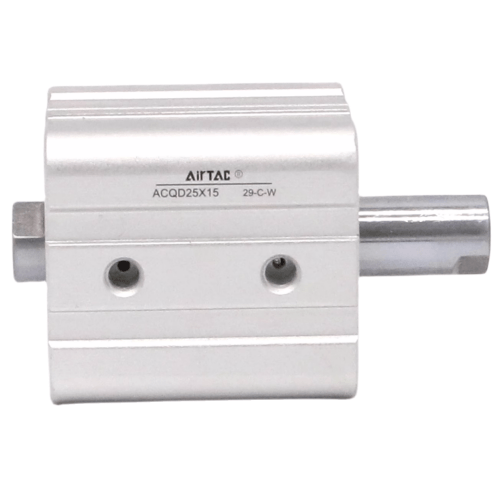
Airtac ACQD Double Acting Compact Cylinder ACQD63X90B
The AirTAC Airtac ACQD Double Acting Compact Cylinder ACQD63X90B is a genuine double-acting COMPACT (JIS) cylinder with a piston rod out BOTH ends — a Ø63mm bore and 90mm stroke. The twin rods resist rotation and give equal push and pull force, so it carries and guides a tool platform without a separate anti-rotation guide.
- BoreØ63 mm
- Stroke90 mm
- Port sizePT1/4
- Acting typeDouble acting, double rod
- Rod threadM10×1.5 (F) / M18×1.5 (B)
- CushionBumper (both ends)
About the Airtac ACQD Double Acting Compact Cylinder ACQD63X90B
The AirTAC ACQD63X90B is a double-acting JIS compact cylinder featuring twin Ø20mm rods exiting both ends. Because a rod occupies each chamber, the annular area is identical in both directions, yielding equal push and pull forces of 1401.5N at 0.5MPa and 1962.2N at 0.7MPa. The male M18x1.5 rod-end threads couple directly to your tooling.
Twin rods inherently resist rotation and provide a long guide length, eliminating the need for an external anti-rotation guide. The riveted body includes integrated sensor grooves, though this specific unit ships without a magnet. Deceleration is handled by fixed NBR bumpers at both ends, rated for a maximum standard stroke of 100mm and speeds of 30-500mm/s.
Airtac ACQD Double Acting Compact Cylinder ACQD63X90B Technical Specifications
| Model | Airtac ACQD Double Acting Compact Cylinder ACQD63X90B |
|---|---|
| Series | ACQD JIS compact double-rod cylinder |
| Bore size | Ø63 mm |
| Stroke | 90 mm |
| Acting type | Double acting, double rod |
| Port size | PT1/4 |
| Rod end thread | M10×1.5 female / M18×1.5 male (B) |
| Fluid | Air (filtered by 40µm element) |
|---|---|
| Operating pressure | 0.15 – 1.0 MPa |
| Proof pressure | 1.5 MPa |
| Temperature | -20 to +70 °C |
| Speed range | 30 – 500 mm/s |
| Cushion | Bumper (both ends) |
| Max standard stroke | Up to 100 mm |
Specifications follow the official AirTAC ACQD datasheet. A rod exits both ends, so both directions use the same annular area. Confirm against the product label before installation.
Theoretical Output Force (Ø63mm — equal both ways)
| Pressure | Push force | Pull force |
|---|---|---|
| 0.5 MPa | 1402 N | 1402 N |
| 0.7 MPa | 1962 N | 1962 N |
| Max (@1.0 MPa) | 286 kgf | |
Because a rod occupies both chambers, push and pull forces are EQUAL — the annular area applies in each direction. Actual usable force is lower due to friction; size with a safety margin.
Model Code: Airtac ACQD Double Acting Compact Cylinder ACQD63X90B
| ACQD | JIS compact double-acting DOUBLE-ROD cylinder series. |
|---|---|
| 63 | Bore size in mm. |
| ×90 | Stroke length in mm. |
| S | Built-in magnet for magnetic-switch sensing (omit = none). |
| B | Male-thread piston rod (omit = female thread). |
Thread: PT standard (G / NPT available). The twin rods resist rotation and add guiding length. Related: ACQ (single rod), ACQJ (adjustable stroke), TACQ (guided).
Where the Airtac ACQD Double Acting Compact Cylinder ACQD63X90B Is Used
Symmetric Transfer
Drives a dual-sided packaging shuttle where equal push and pull force prevents skewed movement during rapid part transfer.
Twin-Guided Pusher
Pushes a machining fixture without an external guide, using the second rod end to mount a sensor flag for position confirmation.
Dual-Station Actuation
Powers a two-station assembly dial where the extra rod end directly drives a secondary clamping mechanism on an automated line.
Is the Airtac ACQD Double Acting Compact Cylinder ACQD63X90B the Right Cylinder?
This 63mm bore delivers 1401.5N both ways; sizing down to a 50mm bore yields 824.6N, while stepping up to an 80mm bore provides 2267.8N. Choose a single-rod ACQ if symmetric force and twin guiding are unnecessary. If a fail-safe hold is required on air loss, add an external rod lock, as the fixed bumper only decelerates near stroke end. Confirm the PT1/4 port and male M18x1.5 rod threads when ordering.
Quick checklist
- ✓ Equal force both ways at your pressure
- ✓ Anti-rotation needed (twin rods)?
- ✓ Both rod ends usable for tooling?
- ✓ Magnet (S) for sensors?
- ✓ Female (blank) or male (B) rod thread
Installation & Maintenance Notes
- check Use clean air filtered to 40µm or finer.
- check Keep within 0.15 – 1.0 MPa operating pressure.
- check Both rods share the load — keep force concentric.
- check Twin rods resist rotation but avoid heavy side load.
- check Handle the C-clip carefully; seat it fully in its groove.
- check Installation by qualified personnel per AirTAC docs.
Airtac ACQD Double Acting Compact Cylinder ACQD63X90B FAQ
It generates equal push and pull forces of 1401.5N at 0.5MPa and 1962.2N at 0.7MPa, with a maximum capacity of 286kgf at 1.0MPa. Push equals pull due to the twin rods creating identical annular areas. The 90mm stroke is within the 100mm maximum standard stroke limit.
No, it uses fixed NBR bumpers at both ends for end-of-stroke deceleration, not adjustable air cushions. Also, while the body has sensor grooves, this model ships without a magnet; for reed or solid-state switches, an -S suffix version is required.
Authorized Export Seller
Genuine AirTAC parts produced by AirTAC factory.
1-Year Warranty
Covers non-human-caused product damage.
Fast Dispatch
Standard models usually ship in 3-4 days.
Fast Reply
Most inquiries answered within 7-8 hours.
Related AirTAC ACQD Compact Cylinders
Request a Quote for Airtac ACQD Double Acting Compact Cylinder ACQD63X90B
Send us the quantity and destination. We confirm price, stock and lead time — usually within 7-8 hours.