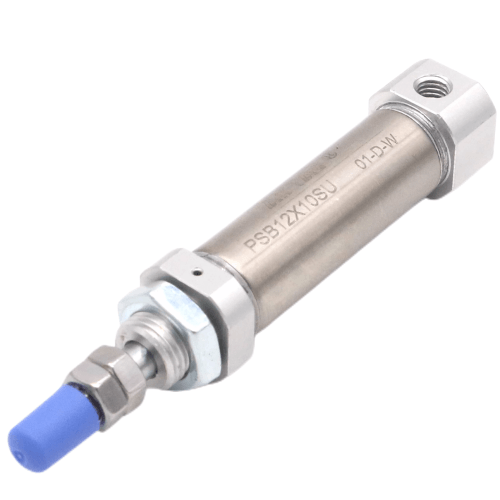
Airtac PSB Single Acting Compact Cylinder PSB10X60U
The AirTAC Airtac PSB Single Acting Compact Cylinder PSB10X60U is a single acting, push type (spring return) pen-size mini cylinder with a Ø10mm bore and 60mm stroke. A single air port drives the push stroke; the built-in return spring resets the rod when air is released, so only one solenoid line is needed.
- BoreØ10 mm
- Stroke60 mm
- Port sizeM5×0.8
- Acting typePush, single acting
- Rod threadM8×1.0
- ReturnSpring
About the Airtac PSB Single Acting Compact Cylinder PSB10X60U
The AirTAC PSB10X60U is a JIS pen-size single-acting push cylinder with a 60 mm stroke. Air entering the M5x0.8 port extends the Ø4 mm rod, while an internal spring retracts it on exhaust, ensuring a fail-safe home position if air pressure drops. Because the spring opposes the stroke, it provides 29.8 N of net push at 0.5 MPa and 45.5 N at 0.7 MPa.
This variant uses a U-style 90-degree side inlet for flat plumbing in confined spaces. The SUS304 stainless barrel and slim body suit damp or tight jigs. A fixed TPU bumper cushions the ends, and since there is no -S suffix, it lacks a sensor magnet.
Airtac PSB Single Acting Compact Cylinder PSB10X60U Technical Specifications
| Model | Airtac PSB Single Acting Compact Cylinder PSB10X60U |
|---|---|
| Series | PSB JIS pen-size mini cylinder |
| Bore size | Ø10 mm |
| Rod diameter | Ø4 mm |
| Stroke | 60 mm |
| Acting type | Single acting, push type (spring return) |
| Port size | M5×0.8 |
| Fluid | Air (filtered by 40µm element) |
|---|---|
| Operating pressure | 0.2 – 0.7 MPa |
| Proof pressure | 1.2 MPa |
| Temperature | -20 to +70 °C |
| Speed range | 50 – 800 mm/s |
| Return | Return spring (push by air) |
| Max standard stroke | Up to 60 mm |
The spring holds the rod retracted; applying air pushes the rod out, and removing air lets the spring return it. Forces below are the NET spring-deducted values from the AirTAC thrust table. Confirm against the product label before installation.
Net Push Force (Ø10mm)
| Pressure | Net push force |
|---|---|
| 0.5 MPa | 29.8 N |
| 0.7 MPa (max) | 45.5 N |
These are the usable push forces after the return spring is subtracted, taken directly from the AirTAC single-acting thrust table. Minimum operating pressure is set by the spring, so this model needs at least the lower pressure shown to move.
Model Code: Airtac PSB Single Acting Compact Cylinder PSB10X60U
| PSB | JIS pen-size single acting, push type (spring return) mini-cylinder series. |
|---|---|
| 10 | Bore size in mm. |
| ×60 | Stroke length in mm. |
| S | Built-in magnet for magnetic-switch position sensing (omit = no magnet). |
| R / U / CB | Back cover: R axial inlet, U 90° side inlet, CB double clevis (bore-dependent). |
Mounting accessories: LB, FA, CJ. Related PB-family variants: PB (double acting), PTB (single-acting pull), PBD (double rod), PBR (front-mount).
Where the Airtac PSB Single Acting Compact Cylinder PSB10X60U Is Used
Part Ejection
Pushes machined components off a fixture; the spring safely pulls the rod back when air is cut.
Gate Diverter
Acts as a lightweight diverter arm on a packaging line, using the 90-degree inlet for tight frame clearances.
Test Probe
Applies a consistent 18 N safe contact force against electronic samples before retracting automatically.
Is the Airtac PSB Single Acting Compact Cylinder PSB10X60U the Right Cylinder?
At the maximum 60 mm stroke for this bore, the slender Ø4 mm rod requires an external guide or linear bearing to prevent side-load damage. Plan for a safe working load of about 18 N (roughly 60% of the 0.5 MPa figure) to account for seal friction. If you need less push, step down to the Ø6 bore which yields 10.6 N at 0.5 MPa; if you need more force, the Ø12 bore provides 42.9 N. The internal spring sets a 0.2 MPa minimum pressure before motion begins. Confirm your bore, stroke, U side inlet, and mounting bracket when ordering.
Quick checklist
- ✓ Net push force at your working pressure
- ✓ Only one air line / solenoid needed
- ✓ Fail-safe retract on air loss
- ✓ Magnet (S) for sensors?
- ✓ Stroke ≤ 60 mm (single-acting limit)
- ✓ Keep the load coaxial — avoid side load
Installation & Maintenance Notes
- check Use clean air filtered to 40µm or finer.
- check Keep within 0.2 – 0.7 MPa operating pressure.
- check Allow for spring force in the stroke direction.
- check Do not add an external return mechanism.
- check Keep the load coaxial; avoid side load on the thin rod.
- check Do not dismantle the front or back cover.
Airtac PSB Single Acting Compact Cylinder PSB10X60U FAQ
The net push force is 29.8 N at 0.5 MPa and 45.5 N at the 0.7 MPa maximum. The internal return spring requires a minimum of 0.2 MPa before the rod begins to move, and the cylinder fails safe to the retracted position on air loss.
It uses a fixed TPU bumper at each end to decelerate the last few millimeters of travel. Because the bumper is not adjustable, you should meter-out the exhaust or add an external shock absorber when moving real tooling mass at higher speeds to prevent bottoming out.
Authorized Export Seller
Genuine AirTAC parts produced by AirTAC factory.
1-Year Warranty
Covers non-human-caused product damage.
Fast Dispatch
Standard models usually ship in 3-4 days.
Fast Reply
Most inquiries answered within 7-8 hours.
Related AirTAC PSB Pen-Size Cylinders
Request a Quote for Airtac PSB Single Acting Compact Cylinder PSB10X60U
Send us the quantity and destination. We confirm price, stock and lead time — usually within 7-8 hours.