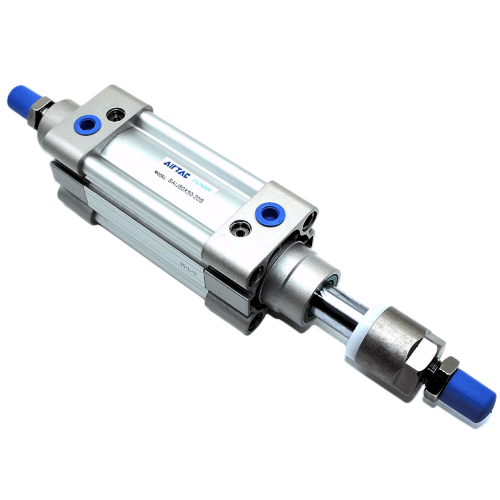
Airtac SAIJ125 Adjustable Cylinder SAIJ125AX80-75
The AirTAC Airtac SAIJ125 Adjustable Cylinder SAIJ125AX80-75 is a genuine double-acting ISO 15552 profile-barrel air cylinder with a Ø125mm bore and 80mm stroke, G1/2 air ports and adjustable end cushioning. Its standardized mounting interface makes it a drop-in replacement for other ISO 15552 cylinders in automation lines.
- BoreØ125 mm
- Stroke80 mm
- Port sizeG1/2
- Acting typeDouble acting
- Rod threadM27×2
- CushionAdjustable, 40 mm
About the Airtac SAIJ125 Adjustable Cylinder SAIJ125AX80-75
The AirTAC SAIJ125X80-75 is a double-acting ISO 15552 profile cylinder featuring a rear mechanical stroke adjuster. With a nominal 80 mm stroke and a 75 mm adjustment range, it provides a highly flexible 5-80 mm usable travel window. This allows precise end-position tuning at commissioning without swapping hardware. Delivering 8590 N push force at 0.7 MPa, it handles heavy positioning tasks easily.
This model uses a SUS420J2 stainless steel rod (option A) for improved corrosion resistance. It features PT tapered port threads (G1/2) and lacks a standard magnet, meaning position sensing requires adding a magnet (-S) for CMSE reed or DMSE electronic switches. The rear adjuster acts purely as a travel stop, so an external guide is recommended for side-load stability.
Airtac SAIJ125 Adjustable Cylinder SAIJ125AX80-75 Technical Specifications
| Model | Airtac SAIJ125 Adjustable Cylinder SAIJ125AX80-75 |
|---|---|
| Series | SAI ISO 15552 profile cylinder |
| Bore size | Ø125 mm |
| Stroke | 80 mm |
| Acting type | Double acting |
| Port size | G1/2 |
| Rod thread | M27×2 |
| Fluid | Air (filtered by 40µm element) |
|---|---|
| Operating pressure | 0.15 – 1.0 MPa |
| Proof pressure | 1.5 MPa |
| Temperature | -20 to +70 °C |
| Speed range | 30 – 500 mm/s |
| Cushion | Adjustable, 40 mm |
| Max stroke | Up to 1500 mm |
Specifications follow the official AirTAC SAI series datasheet and ISO 15552 dimensions. Confirm against the product label before installation. Port options: G (BSPP) / NPT.
Theoretical Output Force (Ø125mm)
| Pressure | Push force | Pull force |
|---|---|---|
| 0.5 MPa | 6136 N | 5734 N |
| 0.7 MPa | 8590 N | — |
| Max (@1.0 MPa) | 1251 kgf | |
Actual usable force is lower than theoretical due to friction and back-pressure. Size with a safety margin.
Model Code: Airtac SAIJ125 Adjustable Cylinder SAIJ125AX80-75
| SAI | ISO 15552 profile-barrel cylinder series. |
|---|---|
| 125 | Bore size in mm. |
| ×80 | Stroke length in mm. |
| -S | Optional built-in magnet for sensor position sensing. |
Related SAI-family variants: SAID (double rod), SAIJ (adjustable stroke), SAIL (with lock), SAIF (with valve), BSAI (enclasp / clamp-lock), and SAI-S with built-in magnet. Rod material: carbon steel (blank) / SUS420J2 (A) / SUS304 (B); seals: TPU (blank) / Viton H / NBR N.
Where the Airtac SAIJ125 Adjustable Cylinder SAIJ125AX80-75 Is Used
Variable End-Stop Setup
Dial in the exact 5-80 mm travel window during machine commissioning to accommodate multiple product sizes without external physical stops.
Heavy Product Changeover
Leverage the 8590 N push force at 0.7 MPa to shift heavy pallets or fixtures, adjusting the rear stopper quickly when line formats change.
Position Tuning
Fine-tune the retract end position to achieve precise alignment without machining custom spacers or replacing the entire cylinder.
Is the Airtac SAIJ125 Adjustable Cylinder SAIJ125AX80-75 the Right Cylinder?
Choose this 125 mm bore when 50 mm bore cylinders (1374 N at 0.7 MPa) lack the thrust for heavy product changeovers, but a 160 mm bore (14074 N at 0.7 MPa) is excessive. The 75 mm adjustment window is ideal for varying end-stops on a single line. For load-holding without live air, note the SAIJ adjuster is a stop, not a lock; consider SAIL or BSAI cylinders instead.
As a dimensionally interchangeable ISO 15552 cylinder, it matches standard mounting footprints. Configuration: 125 mm bore, 80 mm stroke, 75 mm adjust, PT G1/2 ports, SUS420J2 rod, no magnet, and mounting options limited to Basic, FA, LB, TC, FTC, TCM1, and TCM2 (omitting FB/CA/CB/CR).
Quick checklist
- ✓ Required force at your working pressure
- ✓ Stroke and mounting space
- ✓ Port/thread type (PT/NPT/G)
- ✓ Magnet (-S) for sensors?
- ✓ Side load — consider a guided cylinder
Installation & Maintenance Notes
- check Use clean air filtered to 40µm or finer.
- check Keep within 0.15 – 1.0 MPa operating pressure.
- check Avoid side load on the piston rod.
- check Adjust end cushion screws for smooth stops.
- check Use correct mounting accessory (FA/FB/CA/CB/LB/TC).
- check Installation by qualified personnel per AirTAC docs.
Airtac SAIJ125 Adjustable Cylinder SAIJ125AX80-75 FAQ
The rear adjusting screw acts as a mechanical stop, allowing you to trim the effective travel back from the 80 mm nominal stroke down to as little as 5 mm, creating a 5-80 mm usable window.
It delivers a push force of 6136 N at 0.5 MPa and 8590 N at 0.7 MPa. The maximum push force is 1251 kgf at 1.0 MPa.
Authorized Export Seller
Genuine AirTAC parts produced by AirTAC factory.
1-Year Warranty
Covers non-human-caused product damage.
Fast Dispatch
Standard models usually ship in 3-4 days.
Fast Reply
Most inquiries answered within 7-8 hours.
Related AirTAC SAI Cylinders
Request a Quote for Airtac SAIJ125 Adjustable Cylinder SAIJ125AX80-75
Send us the quantity and destination. We confirm price, stock and lead time — usually within 7-8 hours.