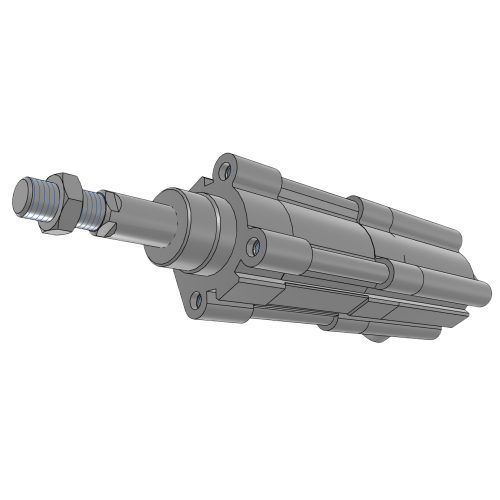
Airtac BSAID Clamp Cylinder BSAID100X125S
The AirTAC Airtac BSAID Clamp Cylinder BSAID100X125S is a genuine double-acting ISO 15552 cylinder with a Ø100mm bore, 125mm stroke and a spring-applied, air-released clamp-lock that holds the rod at ANY position along its travel — with a static holding force of 5500 N.
- BoreØ100 mm
- Stroke125 mm
- Cylinder portG1/2
- TypeDouble rod (BSAID)
- Enclasp portG1/8
- Rod threadM20×1.5
About the Airtac BSAID Clamp Cylinder BSAID100X125S
The AirTAC BSAID100X125-S is a double-acting ISO 15552 extruded aluminum profile cylinder featuring a double-rod configuration and a built-in spring-applied, air-released clamp-lock. It secures the piston rod at any position along its 125 mm stroke, delivering a robust static holding force of 5500 N. Because it is a double-rod actuator, the thrust is equal in both directions at 3681 N (based on 0.5 MPa pull). Buyers must distinguish this holding force from the cylinder's thrust: the clamp resists external static loads independently of the pneumatic propulsion force.
A defining feature of this double-rod design is the ability to mount a workpiece on one end and a guide, counterweight, or position flag on the opposite end, providing dual-side guidance and anti-rotation. The clamp mechanism relies on a third G1/8 enclasp port to release the rod, requiring a balanced air pressure between 0.15-0.7 MPa to unlock safely. Remember that the variable air cushions only decelerate the piston near the stroke ends; the mechanical clamp is the sole device holding the load.
Airtac BSAID Clamp Cylinder BSAID100X125S Technical Specifications
| Model | Airtac BSAID Clamp Cylinder BSAID100X125S |
|---|---|
| Series | BSAI ISO 15552 clamp-lock cylinder |
| Bore size | Ø100 mm |
| Stroke | 125 mm |
| Type | Double rod (BSAID), double acting |
| Cylinder port | G1/2 |
| Rod thread | M20×1.5 |
| Lock type | Spring-applied, air-released clamp (any position) |
|---|---|
| Static holding force | 5500 N |
| Enclasp / unlock port | G1/8 |
| Operating pressure | 0.15 – 0.7 MPa |
| Temperature | -20 to +70 °C |
| Speed range | 30 – 500 mm/s |
| Max stroke | Up to 1000 mm |
Specifications follow the official AirTAC BSAI datasheet (ISO 15552). Operating pressure is 0.15–0.7 MPa (lower than a plain SAI). Port options: PT / G.
How the Clamp-Lock Holds
static holding force (Ø100 mm)
A spring-applied gripper clamps the rod and holds the load at any position in the stroke — not just at the stroke end (that is a SAIL) — and it is bidirectional: it holds whether the rod was extending or retracting.
Theoretical Output Force (Ø100mm)
| Pressure | Push force | Pull force |
|---|---|---|
| 0.5 MPa | 3927 N | 3682 N |
| 0.7 MPa (max) | 5498 N | — |
Equal force both directions (double rod). Rated to the 0.7 MPa operating maximum for this series. The clamp holding force (5500 N) is separate from cylinder thrust. Size with a margin.
Where the Airtac BSAID Clamp Cylinder BSAID100X125S Is Used
Vertical Load Suspension
Holds heavy vertical payloads at any point in the travel range without relying on continuous air pressure, preventing sudden drops during power loss.
Machining Position Hold
Locks a double-rod workpiece firmly in place for machining or inspection operations, using the second rod end for a guiding flag.
Emergency Power-Loss Hold
Spring-applied clamping engages instantly upon air loss to freeze the mechanism mid-stroke, providing a fail-safe holding barrier.
Is the Airtac BSAID Clamp Cylinder BSAID100X125S the Right Clamp-Lock?
Choose this 100 mm bore model when an application demands substantial mid-stroke holding and equal push/pull forces. If your load is lighter, stepping down to the 80 mm bore offers 2268 N of thrust and a 3600 N holding force, conserving space. Conversely, the 125 mm bore provides 5734 N of thrust and 8600 N of holding force for heavier assemblies. The BSAID100X125-S surpasses a stroke-end-only SAIL cylinder because it enclaps the rod anywhere, whereas a plain SAID suffices if no mid-stroke locking is required.
As a replacement match, verify the double-rod layout, 100 mm bore, 125 mm stroke, and PT port threads. The mounting set for this double-rod variant includes Basic, FA, LB, TC, TCM1, and TCM2 (omitting FB, CA, CB, and CR). The -S suffix indicates an internal magnet for precise position sensing with AirTAC CMSE reed or DMSE solid-state switches. Always note that the clamp locks only after the rod stops and cannot brake a moving load; safety-critical applications require an independent secondary safety measure.
Quick checklist
- ✓ Hold needed at any position?
- ✓ Or stroke-end only → use SAIL
- ✓ Holding force ≥ your load
- ✓ Balanced-pressure unlock circuit
- ✓ Extra safety measure for people
Airtac BSAID Clamp Cylinder BSAID100X125S FAQ
The integrated clamp-lock provides a static holding force of 5500 N. It can secure the load at any position along the 125 mm stroke, but it only locks after the rod has completely stopped moving.
The clamp is released via a third G1/8 enclasp port, but only when the air pressures on both sides of the piston are balanced. If pressures are not balanced, the rod can move abruptly upon release, so an independent safety measure is required for human-safety loads.
Related AirTAC Lock & Standard Cylinders
Request a Quote for Airtac BSAID Clamp Cylinder BSAID100X125S
Send us the quantity and destination. We confirm price, stock and lead time — usually within 7-8 hours.