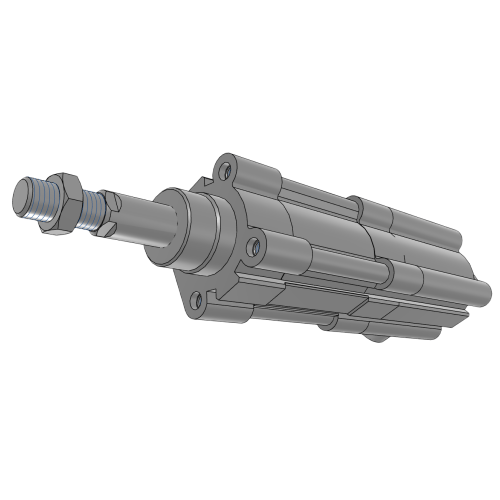
Airtac BSAID Clamp Cylinder BSAID50X175S
The AirTAC Airtac BSAID Clamp Cylinder BSAID50X175S is a genuine double-acting ISO 15552 cylinder with a Ø50mm bore, 175mm stroke and a spring-applied, air-released clamp-lock that holds the rod at ANY position along its travel — with a static holding force of 1400 N.
- BoreØ50 mm
- Stroke175 mm
- Cylinder portG1/4
- TypeDouble rod (BSAID)
- Enclasp portG1/8
- Rod threadM16×1.5
About the Airtac BSAID Clamp Cylinder BSAID50X175S
The AirTAC BSAID50X175-S is a double-acting ISO 15552 profile cylinder featuring a rod out both ends and a built-in spring-applied, air-released clamp-lock. It delivers a bidirectional holding force of 1400 N at any position along its 175 mm travel. Because it is a double-rod unit, its thrust is equal in both directions at 825 N (0.5 MPa pull value). It is vital to distinguish this static holding force from the cylinder thrust: you must size the 1400 N clamp capacity against your static load, not the 825 N motive force.
The clamping mechanism relies on a third G1/8 enclasp port to release the rod, functioning separately from the variable air cushions which only decelerate the piston near stroke ends. This BSAID configuration is specifically chosen when a second rod end is required to mount a counterweight, a position flag, or a secondary tool, providing dual-side guidance and anti-rotation. The carbon steel rod and M16x1.5 thread offer robust side-load handling, and the integrated -S magnet supports precise end-position sensing with AirTAC CMSE reed and DMSE solid-state switches.
Airtac BSAID Clamp Cylinder BSAID50X175S Technical Specifications
| Model | Airtac BSAID Clamp Cylinder BSAID50X175S |
|---|---|
| Series | BSAI ISO 15552 clamp-lock cylinder |
| Bore size | Ø50 mm |
| Stroke | 175 mm |
| Type | Double rod (BSAID), double acting |
| Cylinder port | G1/4 |
| Rod thread | M16×1.5 |
| Lock type | Spring-applied, air-released clamp (any position) |
|---|---|
| Static holding force | 1400 N |
| Enclasp / unlock port | G1/8 |
| Operating pressure | 0.15 – 0.7 MPa |
| Temperature | -20 to +70 °C |
| Speed range | 30 – 800 mm/s |
| Max stroke | Up to 1000 mm |
Specifications follow the official AirTAC BSAI datasheet (ISO 15552). Operating pressure is 0.15–0.7 MPa (lower than a plain SAI). Port options: PT / G.
How the Clamp-Lock Holds
static holding force (Ø50 mm)
A spring-applied gripper clamps the rod and holds the load at any position in the stroke — not just at the stroke end (that is a SAIL) — and it is bidirectional: it holds whether the rod was extending or retracting.
Theoretical Output Force (Ø50mm)
| Pressure | Push force | Pull force |
|---|---|---|
| 0.5 MPa | 982 N | 825 N |
| 0.7 MPa (max) | 1374 N | — |
Equal force both directions (double rod). Rated to the 0.7 MPa operating maximum for this series. The clamp holding force (1400 N) is separate from cylinder thrust. Size with a margin.
Where the Airtac BSAID Clamp Cylinder BSAID50X175S Is Used
Vertical Axis Load Holding
Secures a vertically lifted workpiece at any point in the 175 mm travel, preventing gravity-driven drops during a power loss.
Machining Position Hold
Clamps the double-rod assembly firmly mid-stroke to immobilize a part for drilling or inspection, using the second rod end for a position flag.
Dual-Side Tooling Guidance
Utilizes the rod extending from both ends to mount a primary workpiece on one side and a counterweight or anti-rotation guide on the other.
Is the Airtac BSAID Clamp Cylinder BSAID50X175S the Right Clamp-Lock?
Select this double-rod model when your mechanism requires equal push/pull thrust and multi-side mounting. If you need greater holding capacity, stepping up to the 63 mm bore provides a 2200 N clamp force and 1402 N thrust at 0.5 MPa; conversely, a 40 mm bore drops the hold to 900 N. Choose this BSAID over a stroke-end-only SAIL when you must secure the load mid-travel. If mid-stroke locking is unnecessary, a plain SAID double-rod cylinder suffices.
For safe operation, remember the clamp locks only after the rod has stopped, so it cannot act as a moving-rod brake. It must be unlocked with balanced air pressures (0.15-0.7 MPa) across the piston to prevent abrupt rod jumps. Safety-critical applications require an additional independent measure. This replacement features PT tapered ports (1/4 cylinder, G1/8 enclasp), a 175 mm stroke, and accepts Basic, FA, LB, TC, TCM1, or TCM2 mounts (omitting FB/CA/CB/CR).
Quick checklist
- ✓ Hold needed at any position?
- ✓ Or stroke-end only → use SAIL
- ✓ Holding force ≥ your load
- ✓ Balanced-pressure unlock circuit
- ✓ Extra safety measure for people
Airtac BSAID Clamp Cylinder BSAID50X175S FAQ
The clamp-lock provides a static holding force of 1400 N. It engages via spring pressure to hold the double-rod at any position along the stroke, operating independently of the 825 N pneumatic thrust.
The clamp only engages after the cylinder has stopped; it cannot brake a moving rod. To release it safely, apply 0.15-0.7 MPa to the G1/8 enclasp port only after the air pressures on both sides of the piston are balanced, preventing abrupt rod movement.
Related AirTAC Lock & Standard Cylinders
Request a Quote for Airtac BSAID Clamp Cylinder BSAID50X175S
Send us the quantity and destination. We confirm price, stock and lead time — usually within 7-8 hours.