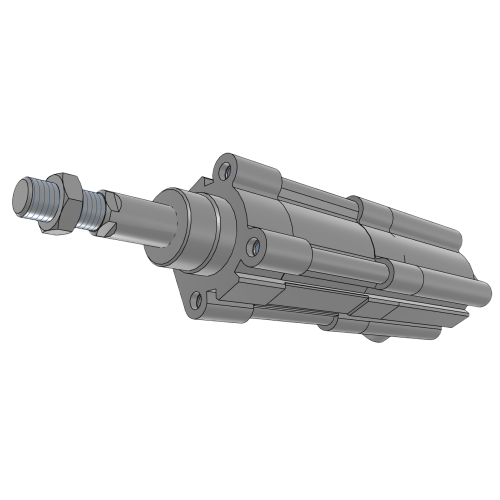
Airtac BSAID Clamp Cylinder BSAID50X800S
The AirTAC Airtac BSAID Clamp Cylinder BSAID50X800S is a genuine double-acting ISO 15552 cylinder with a Ø50mm bore, 800mm stroke and a spring-applied, air-released clamp-lock that holds the rod at ANY position along its travel — with a static holding force of 1400 N.
- BoreØ50 mm
- Stroke800 mm
- Cylinder portG1/4
- TypeDouble rod (BSAID)
- Enclasp portG1/8
- Rod threadM16×1.5
About the Airtac BSAID Clamp Cylinder BSAID50X800S
The AirTAC BSAID50X800-S is a double-acting ISO 15552 profile cylinder featuring a double-rod layout and an integrated spring-applied, air-released clamp-lock. It delivers a bidirectional holding force of 1400 N at any position along its 800 mm stroke. Because it is a double-rod unit, the thrust is equal in both directions at 825 N (0.5 MPa), and the second rod allows you to mount a workpiece on one end while attaching a guide, counterweight, or position flag on the opposite end for dual-side anti-rotation.
It is crucial to distinguish holding force from cylinder thrust: the 1400 N clamp rating is the static load the brake can resist, entirely separate from the 825 N pneumatic thrust that moves the load. The clamp operates via a dedicated G1/8 enclasp port and locks only after the rod has stopped; it cannot brake a moving load. Furthermore, the variable air cushion at the ends only decelerates the piston near stroke limits and does not hold the load. To release the clamp safely, air pressures on both sides of the piston must be balanced, otherwise the rod may jump abruptly.
Airtac BSAID Clamp Cylinder BSAID50X800S Technical Specifications
| Model | Airtac BSAID Clamp Cylinder BSAID50X800S |
|---|---|
| Series | BSAI ISO 15552 clamp-lock cylinder |
| Bore size | Ø50 mm |
| Stroke | 800 mm |
| Type | Double rod (BSAID), double acting |
| Cylinder port | G1/4 |
| Rod thread | M16×1.5 |
| Lock type | Spring-applied, air-released clamp (any position) |
|---|---|
| Static holding force | 1400 N |
| Enclasp / unlock port | G1/8 |
| Operating pressure | 0.15 – 0.7 MPa |
| Temperature | -20 to +70 °C |
| Speed range | 30 – 800 mm/s |
| Max stroke | Up to 1000 mm |
Specifications follow the official AirTAC BSAI datasheet (ISO 15552). Operating pressure is 0.15–0.7 MPa (lower than a plain SAI). Port options: PT / G.
How the Clamp-Lock Holds
static holding force (Ø50 mm)
A spring-applied gripper clamps the rod and holds the load at any position in the stroke — not just at the stroke end (that is a SAIL) — and it is bidirectional: it holds whether the rod was extending or retracting.
Theoretical Output Force (Ø50mm)
| Pressure | Push force | Pull force |
|---|---|---|
| 0.5 MPa | 982 N | 825 N |
| 0.7 MPa (max) | 1374 N | — |
Equal force both directions (double rod). Rated to the 0.7 MPa operating maximum for this series. The clamp holding force (1400 N) is separate from cylinder thrust. Size with a margin.
Where the Airtac BSAID Clamp Cylinder BSAID50X800S Is Used
Vertical Axis Power-Off Hold
Maintains a 1400 N static hold on a vertical lift anywhere in the 800 mm travel during a compressed air failure, preventing uncontrolled drops.
Machining Position Lock
Clamps the double-rod carriage securely at any intermediate point along the stroke for precise milling or inspection operations.
Dual-Side Tooling Carrier
Uses the second rod to mount a counterweight or alignment flag while the primary end holds the workpiece securely in place.
Is the Airtac BSAID Clamp Cylinder BSAID50X800S the Right Clamp-Lock?
Choose this 50 mm bore if your application requires 825 N of thrust in both directions alongside a 1400 N static hold anywhere in the 800 mm travel. If you need less force, the 40 mm bore offers 528 N thrust and a 900 N hold; if your load is heavier, stepping up to the 63 mm bore provides 1402 N thrust and a 2200 N hold. This BSAID model is preferred over a plain SAID when power-off holding is mandatory, and it beats a SAIL end-lock because it clamps at any position, not just the stroke ends. For a replacement, match the double-rod layout, 50 mm bore, 800 mm stroke, PT ports, and the -S magnet for CMSE reed and DMSE electronic sensors. The mounting set for double-rod units omits FB, CA, CB, and CR, utilizing Basic, FA, LB, TC, TCM1, and TCM2. Because the stroke is 800 mm, an external guide is required to prevent side-load damage to the rod seals, despite the 20 mm rod diameter. Always ensure the cylinder has fully stopped before engaging the lock, and add an independent safety measure for human-safety-critical holds.
Quick checklist
- ✓ Hold needed at any position?
- ✓ Or stroke-end only → use SAIL
- ✓ Holding force ≥ your load
- ✓ Balanced-pressure unlock circuit
- ✓ Extra safety measure for people
Airtac BSAID Clamp Cylinder BSAID50X800S FAQ
The integrated spring-applied clamp-lock provides a static holding force of 1400 N. It engages at any position along the 800 mm stroke to hold the load without live air pressure, but only after the rod has completely stopped moving.
The lock is released by supplying air to the G1/8 enclasp port, but only after the pneumatic pressures on both sides of the piston are balanced. If pressures are unbalanced during release, the rod can jump abruptly, presenting a real hazard.
Related AirTAC Lock & Standard Cylinders
Request a Quote for Airtac BSAID Clamp Cylinder BSAID50X800S
Send us the quantity and destination. We confirm price, stock and lead time — usually within 7-8 hours.